Questions tagged [arduino-due]

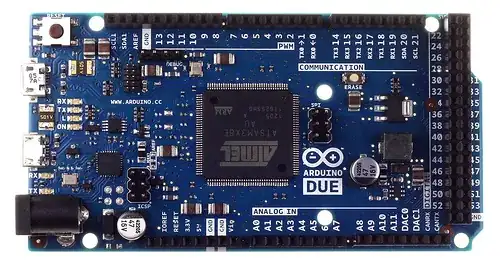
Arduino DUE is an microcontroller card based on the Atmel SAM3X8E ARM Cortex-M3 CPU. This is a 32bit ARM core MCU.

The arduino DUE is different than most Arduino boards on the market since it runs at 3.3V.

The Arduino Due is a microcontroller board based on the Atmel SAM3X8E ARM Cortex-M3 CPU. It is the first Arduino board based on a 32-bit ARM core microcontroller. It has 54 digital input/output pins (of which 12 can be used as PWM outputs), 12 analog inputs, 4 UARTs (hardware serial ports), a 84 MHz clock, an USB OTG capable connection, 2 DAC (digital to analog), 2 TWI, a power jack, an SPI header, a JTAG header, a reset button and an erase button.

Warning: Unlike other Arduino boards, the Arduino Due board runs at 3.3V. The maximum voltage that the I/O pins can tolerate is 3.3V. Providing higher voltages, like 5V to an I/O pin could damage the board.

The board contains everything needed to support the microcontroller; simply connect it to a computer with a micro-USB cable or power it with a AC-to-DC adapter or battery to get started. The Due is compatible with all Arduino shields that work at 3.3V and are compliant with the 1.0 Arduino pinout. The Due follows the 1.0 pinout: TWI: SDA and SCL pins that are near to the AREF pin. The IOREF pin which allows an attached shield with the proper configuration to adapt to the voltage provided by the board. This enables shield compatibility with a 3.3V board like the Due and AVR-based boards which operate at 5V. An unconnected pin, reserved for future use.
Full specs and information.


Other features:

  • 32 bit microcontroller: 4 byte wide instructions during one CPU cycle.
  • 84 MHz MCU clock (Uno is 16 MHz on a less efficient architecture.)
  • 96KB SRAM
  • 512KB Flash

This gives it much more power than a standard ATmega chip.

462 questions
11
votes
1 answer

Why does the Arduino Due have a native and USB programming port?

According to the schematics, the Arduino Due has two USB inputs: Native Programming Why is this? And when would I use the different ports?
poseid
  • 325
  • 1
  • 3
  • 11
5
votes
2 answers

Why was the Due retired?

Looking at the Sparkfun comparison, it seems that the Due is by far the fastest of the Arduinos and has I/O capabilities similar to the Mega. So why was it retired with no obvious successor?
dpdt
  • 151
  • 1
  • 2
4
votes
4 answers

How to package a 16 bit integer to send it with serial.write?

I am trying to display the values i get from reading a potentiometer (0-1023) in the program called 'processing'. when I just use Serial.write(integer) and display the value on a line graph in 'processing' the line will max out at 256 and loop back…
Tom
  • 59
  • 1
  • 1
  • 3
4
votes
3 answers

Arduino Due - creating an 8Mhz clock signal

I am attempting to interface a OV7670 camera to an arduino Due. (I am fairly new to this although have been programming for many years). I need to generate a clock signal for the camera at a minimum of 8Mhz - I realise using the pre-scalers I can…
Triumph Rider
  • 41
  • 1
  • 3
4
votes
1 answer

Arduino Due randomly slows down, serial communications stops

I've got an Arduino Due connected to a Raspberry Pi via Serial3. The Due will randomly stop sending data to the Pi after a few days, or sometimes after several hours. Using an oscilloscope, I can see that the Pi keeps transmitting to the Due, but…
chippies
  • 143
  • 2
3
votes
1 answer

Has anyone modified a 16x2 LCD shield to work with Arduino DUE?

Since the DUE works on 3.3 volts has anyone successfully modified a 5V 16x2 LCD shield to work with Arduino DUE? I'm thinking 3.3V will be seen as a logic "1" by the 5V LCD shield and there are no 5V outputs that feed back to the 3.3V due if the…
w5cdt
  • 31
  • 1
3
votes
4 answers

Newbie Using Brown Out detector on Arduino Due for saving variables to eeprom?

Hi I'm a newbie and working on a project with Arduino Due(Atmel3X8E).I want to try and save the important variables to the eeprom during a power outage,using the brown out detector.Is it possible to do this? Thank you.
Tejus Vivek
  • 51
  • 1
  • 3
3
votes
2 answers

Arduino Due - using built in ADC as a DSO causes issues at high frequencies (kHz)

I am trying to use the inbuilt ADC of the Arduino Due to measure voltage signals. The frequency range I'm interested in measuring is up to about 30 kHz.But I'm observing a strong capacitor behaviour as I increase the frequency ( from 10kHz onwards…
acrox
  • 41
  • 5
3
votes
2 answers

How to program arduino due without arduino ide

Is it possible to program the Arduino Due without the Arduino IDE? Is there a standalone program that can be downloaded, and be used to upload a .bin file (which has already been generated from the arduino IDE) to the Due? Any guidance appreciated.…
aVC
  • 131
  • 1
  • 3
3
votes
0 answers

Reading Reveive Hold Register from USART in SPI Mode on Arduino Due

Sending with this function here works fine: uint16_t usart0spiTransfer16(uint16_t spiMessage16) { uint16_t sdo = 0; byte firstByte = spiMessage16; byte secondByte = (spiMessage16 >> 8); while (((USART0->US_CSR >> 1) & 1) == 0); …
tobilocker
  • 131
  • 2
3
votes
0 answers

Arduino Due native programming port

Arduino does not recommend to program the Due board via Native port as it is not reliable: If the MCU crashed for some reason it is likely that the soft erase procedure won't work as this procedure happens entirely in software on the…
Tigran
  • 111
  • 3
3
votes
2 answers

How to slow ADC clock speed to 1MHz on Arduino Due?

I know that the ADC on the Arduino Due has a clock speed from 1 MHz to 20 MHz. I have two questions: 1. What is the default clock speed when I run a sketch, and 2. How can I change it? (I am using Arduino 1.6.4.) The reason why I want to slow down…
3
votes
0 answers

Interfacing WM8731 code to Arduino Due

WM8731 codec was successfully interfaced with Atmega328 like variants in Arduino. It was first done successfully by Open music labs who are the makers of the breakout board for WM8731. Taking this library as reference another library was developed…
3
votes
1 answer

Is it harmful to write to unused bits in PORT registers?

Background: I'm looking at writing a library to drive an LED matrix panel (one of these:http://www.adafruit.com/product/607) from my newly acquired Arduino Due. My background is C++ programming, not electronics. I'm planning to experiment with…
Mick Waites
  • 630
  • 5
  • 11
2
votes
1 answer

Extracting .hex from Arduino Due

I have an Arduino Due that was programmed by the Arduino IDE, to cut things short I lost access to the original sketch (.ino) file, there is no way of recovering it no matter what. I know that in the 8-bit MCUs I can read the .hex file from the…
1
2 3 4 5