34

According to molecular orbital theory, the bond order of $\ce{CO}$ is 3. When $\ce{CO+}$ is formed, the bond order decreases to 2.5, and thus the bond length should increase.

However, the bond length of $\ce{CO+}$ is found to be less than $\ce{CO}$. How is that so?

orthocresol
  • 71,033
  • 11
  • 239
  • 410
Papul
  • 1,332
  • 3
  • 13
  • 21

3 Answers3

21

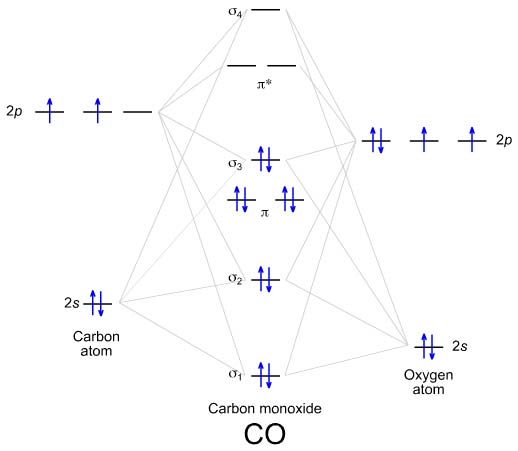
Unfortunately, the arguments presented by buckminst and Uncle Al aren't completely right. The MO schemes are correct but the HOMO-$\sigma$ orbital ($s_{\sigma}^{*}(5\sigma)$ in buckminst's diagramm, $\sigma_{3}$ in Uncle Al's diagram) is not antibonding but slightly bonding in character because there is some mixing with the $\ce{p}$ atomic orbitals of the right symmetry (in this respect the MO scheme of Uncle Al is better than the one of buckminst because it indicates this mixing).

So, the original problem still persists. One possible explanation for the bond shortening after ionization is that the ionization leads to a shift of the $\ce{CO}$-electron-polarization (on ionization an electron is lost from the mostly $\ce{C}$-centered HOMO-$\sigma$ orbital and this leads to a formation of a positive partial charge on the $\ce{C}$ atom). This strengthens the covalence of the $\ce{CO}$-bond and thus reduces the bond length (since the HOMO-$\sigma$ orbital is only slightly bonding there is not much bonding lost by taking away one of its electrons - the lost bonding is outweighed by the gain in covalency). You can think of this strenghtening of the bond covalence in the following way: Two atomic orbitals can interact better (form stronger bonds) if their energies are close. Without the positive partial charge on $\ce{C}$ the AOs of $\ce{O}$ lie energetically a lot below the AOs of $\ce{C}$ (this is most pronounced for the $\ce{s}$ AOs which form the HOMO-$\sigma*$ orbital). But with the positive partial charge on $\ce{C}$ the AOs of $\ce{C}$ are shifted down in energy and thus their energies are closer to the related AOs of $\ce{O}$ which leads to a stronger interaction when bonds are formed.

Philipp
  • 17,748
  • 4
  • 79
  • 118
  • 5
    (+1) More insight on this topic from a theoretical point of view: here. The positive charge at the Carbon also causes the strong $\pi$-bonds to be more polarized towards the Carbon, making the bond stronger. – Martin - マーチン Mar 27 '14 at 08:17
  • @Martin Thanks for providing the reference. I guess it's not by chance that you give a reference written by a professor from Marburg :) – Philipp Mar 27 '14 at 14:10
  • I just went through your post again (unfortunately I already upvoted on it) and I noticed, that there might be an important argument missing: Upon ionisation, the nuclear charge in relation to the electronic charge is higher. Hence the orbitals have to become more contracted as the fewer electrons are more attracted. So another reason would be plain and simple electrostatics. (Upon ionisation, the former HOMO of CO also drops below the $\pi$ orbitals in CO(+1) - missing spin pairing, lower electron repulsion, and $\sigma$ is more contracted than $\pi$.) – Martin - マーチン Jul 14 '14 at 09:53
  • So the other two answers are incorrect? – Dissenter Jul 14 '14 at 13:35
  • @Martin I'm not sure whether I understand your comment correctly. Are you saying that my answer is incorrect or that it might only be missing the electrostatic argument you're making? Also, you state "Upon ionisation, the former HOMO of CO also drops below the $\pi$ orbitals in CO(+1)". That is interesting: Have you calculated this yourself or how do you know that? But I fear I'm not able to draw the connection between the higher effective nuclear charge leading to more contracted orbitals and ionized CO having a shorter bond length than normal CO. Could you eleborate on this some more, pls? – Philipp Jul 14 '14 at 19:51
  • @Dissenter In my opinion the other answers are indeed incorrect for the reasons stated in my own answer. Have a look at the article linked by Martin in his topmost comment. It explains things quite neatly and in more depth than I was able to provide. – Philipp Jul 14 '14 at 19:58
  • My comment is complementary to your already correct answer (which I would have upvoted again, if I had not done it already. In retrospect my comment was articulated badly). I have to think a little more about the contraction part and try to feed it with some data. I might post an answer later on. About the HOMO part, I will check that with a different method again, I do not want to jump to conclusions. Since CO is an awesome simple molecule, too complicated for a lot of computations, I want to make that double dead sure, but yes that statement was based on a result of a calculation I did. – Martin - マーチン Jul 15 '14 at 13:03
  • @Martin Thanks for the effort. I will certainly look forward to an answer of yours. And if there is another effect at work here that needs to be considered I will gladly add this to my portfolio of things to watch out for when analysing a bonding situation - I'm always very interested in things like that :) – Philipp Jul 15 '14 at 16:07
4

http://www.meta-synthesis.com/webbook/39_diatomics/co.jpg
Measured $\ce{CO}$ bond length is 1.128 Å, $\ce{CO^{+}}$ is 1.115 Å. Given the following carbon monoxide MO diagram, from where is the electron removed to afford the cation with a shorter bond length? $\ce{CO}$ has a dipole moment of 0.122 debyes, net negative charge on the carbon. One then suspects the electron is removed from the sigma anti-bonding orbital on carbon.

carbon monoxide MO diagram

Uncle Al
  • 8,542
  • 17
  • 31
  • This is getting exciting! IR stretch: CO, 2143 cm^(-1), CO+, 2184 cm^(-1) - definitely a tighter bond. The cation is more strongly bound, http://131.104.156.23/Lectures/331/331_chapter_6.htm In LCAO terms, perhaps the sp-hybrid leaves two non-bonding lobes. The carbon lobe has more than half the electron density. and preferentially ionizes. – Uncle Al Mar 26 '14 at 21:06
  • There was definitely more to this question than I initially thought. The matter has some aspects that are not very intuitive - the MO diagram of CO makes the answer seem obvious but actually leads to the wrong reasoning (see my answer). – Philipp Mar 26 '14 at 21:37
3

Molecular Orbital theory does NOT predict a longer bond. It correctly predicts a shorter bond. The HOMO for $\ce{CO}$ is a sigma antibonding orbital. When it is ionized, the bond order is increased to 3.5, and the bond length decreases.

enter image description here

buckminst
  • 2,157
  • 13
  • 24