$\color{brown}{\textbf{Identity for cosines.}}$
$\color{blue}{\textbf{Preliminary analysis.}}$
Applying the proposed trick to to production of a pair of cosines, one can get
$$\cos x\cos y=\dfrac{e^{ix}+e^{-ix}}2\,\dfrac{e^{iy}+e^{-iy}}2
=\dfrac{e^{i(x+y)}+e^{-i(x+y)}+e^{i(x-y)}+e^{-i(x-y)}}4,$$
$$\cos x\cos y = \dfrac{\cos(x+y)+\cos(x-y)}2.\tag1$$
Let us define the sign factors
$$p_{kj}=(-1)^{b_{kj}}=1-2b_{kj},\quad\text{where}\;b_{kj}=\genfrac{\lfloor}{\rfloor}{}{0}k{2^j}-2\genfrac{\lfloor}{\rfloor}{}{0}k{2^{j+1}}\tag2$$
is the $j$-th bit of the unsigned integer number $\,k\,$ from the least signed bit ($j=0$).
At the common case, any algebraic sum of the cosine production arguments (with the positive factor near the starting term) can be presented in the form of
$$s_n\left(k,\bar v\right) = \bar p_n(k)\cdot\bar v,\qquad \left(k=0,1\dots2^{n-1}-1\right) \tag3$$
where
$$\bar v=\{v_0, v_1,\dots,v_{n-1}\}\tag4$$
is the vector of a cosine production arguments and
$$\bar p_n(k) =\{p_{k0}, p_{k1},\dots,p_{k,n-1}\}\tag5$$
is the sign combination vector.
$\color{blue}{\textbf{Simple examples.}}$
Are known the binary system representations
$$0=0000_2,\;1=0001_2,\;2=0010_2,\;3=0011_2.$$
Taking in account $(2)-(5),$ easily to see that
$$s^\,_2(0,\bar v) \dbinom11\cdot\dbinom{v_0}{v_1} = v_0+v_1,\quad
s^\,_2(1,\bar v) = \dbinom1{-1}\cdot\dbinom{v_0}{v_1} = v_0-v_1,$$
$$\cos v_0 \cos v_1 = \dfrac12\left(
\cos s^\,_2(0,\bar v)+\cos s^\,_2(1,\bar v)\right),$$
$$s^\,_3(0,\bar v) = v_0+v_1+v_2,$$
$$s^\,_3(1,\bar v) = v_0+v_1-v_2,$$
$$s^\,_3(2,\bar v) = v_0-v_1+v_2,$$
$$s^\,_3(3,\bar v) = v_0-v_1-v_2,$$
$$\cos v_0 \cos v_1 \cos v_2 = \dfrac14\left(\cos s^\,_3(0,\bar v)
+\cos s^\,_3(1,\bar v) + \cos s^\,_3(2,\bar v)
+ \cos s^\,_3(3,\bar v)\right).$$
$\color{blue}{\textbf{Identity proof.}}$
The analysis suggests the inequality in the form of
$$\prod\limits_{j=0}^{n-1}\cos v_j=\dfrac1{2^{n-1}}\, \sum\limits_{k=0}^{2^{n-1}-1}\,\cos s^\,_n(k,\bar v).\tag6$$
Let us prove it by the method of mathematical induction.
- For $\,n=2,\, n=3\,$ formulas $(6)$ holds.
- Suppose that formulas $(6)$ holds for $\,n=m,\,$ i.e
$$\prod\limits_{j=0}^{m-1}\cos v_j=\dfrac1{2^{m-1}} \,\sum\limits_{k=0}^{2^{m-1}-1}\,\cos s^\,_m(k,\bar v).\tag7$$
Then, taking in account formulas $(1)-(4),$ one can get
$$\prod\limits_{j=0}^{m}\cos v_j=\dfrac1{2^{m-1}}\,\sum\limits_{k=0}^{2^{m-1}-1}\,\cos s^\,_m(k,\bar v)\cos v_m$$
$$=\dfrac1{2^{m-1}}\,\sum\limits_{k=0}^{2^{m-1}-1}\,
\left(\dfrac{\cos(s^\,_m(k,\bar v)+v_m)+\cos(s^\,_m(k,\bar v)-v_m)}2
\right)$$
$$=\dfrac1{2^{m-1}}\,\sum\limits_{k=0}^{2^{m-1}-1}\,
\left(\dfrac{\cos s^\,_{m+1}(2k,\bar v)+\cos s^\,_{m+1}(2k+1,\bar v)}2 \right)$$
$$=\dfrac1{2^m}\,\sum\limits_{k=0}^{2^m-1}\,\cos s^\,_m(k,\bar v).$$
Therefore, from the correctness of $(6)$ for $\,n=m\,$ follows its correctness for $\,n=m+1,\,$ and this completes the proof of $(6).$
$\color{brown}{\textbf{Identity for sines.}}$
From OP should that the identity for sines:
- can contain the different signs between terms in the final sum;
- can be expressed via sines or via cosines.
There is a motivation of the previous part of the work.
On the other hand,
$$\sin z = \Im e^{iz} = \Re\left(-ie^{iz}\right) = \Re \exp\left(-i\,\dfrac\pi2+iz\right) = \cos\left(\dfrac\pi2-z\right),$$
and then
$$\prod\limits_{j=0}^{n-1}\sin v_j=\prod\limits_{j=0}^{n-1}\,
\cos\left(\dfrac\pi2-v_i\right)
=\dfrac1{2^{n-1}}\,\sum\limits_{k=0}^{2^{n-1}-1}\,\cos\,\sum\limits_{j=0}^{n-1}\,p_{kj}\left(\dfrac\pi2 - v_j\right)$$
$$=\dfrac1{2^{n-1}}\,\sum\limits_{k=0}^{2^{n-1}-1}\,\cos \sum\limits_{j=0}^{n-1}\left(s^\,_n(k,v)-(1-2b_{kj})\,\dfrac\pi2\right),$$
$$\prod\limits_{j=0}^{n-1}\sin v_j= \dfrac1{2^{n-1}}\,\sum\limits_{k=0}^{2^{n-1}-1}\,\cos\left(s^\,_n(k,v)-\dfrac{\pi n}2 +\pi\sum b_{kj}\right),\tag8$$
$$\prod\limits_{j=0}^{n-1}\sin v_j\Bigg|_{n=2h+1} = \dfrac1{2^{n-1}}\,\sum\limits_{k=0}^{2^{n-1}-1}\,(-1)^{h+\beta_k} \sin s^\,_n(k,v),\tag{8$\text O$}$$
$$\prod\limits_{j=0}^{n-1}\sin v_j\Bigg|_{n=2h} = \dfrac1{2^{n-1}}\,\sum\limits_{k=0}^{2^{n-1}-1}\,(-1)^{h+\beta_k} \cos s^\,_n(k,v),\tag{8$\text E$}$$
wherein
$$\beta_k = \sum b_{kj}\tag9$$
is the sum of bits in the binary number notation.
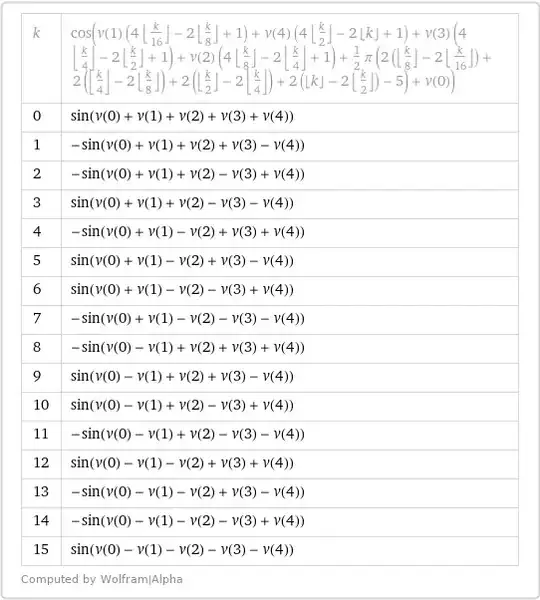
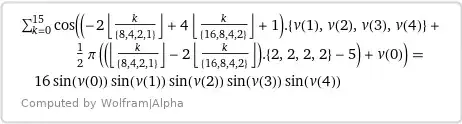
For example, in the case $\,\underline{n=5}$ the terms and the result are