List of things named after Leonhard Euler
In mathematics and physics, many topics are named in honor of Swiss mathematician Leonhard Euler (1707–1783), who made many important discoveries and innovations. Many of these items named after Euler include their own unique function, equation, formula, identity, number (single or sequence), or other mathematical entity. Many of these entities have been given simple and ambiguous names such as Euler's function, Euler's equation, and Euler's formula.
.jpg.webp)
Euler's work touched upon so many fields that he is often the earliest written reference on a given matter. In an effort to avoid naming everything after Euler, some discoveries and theorems are attributed to the first person to have proved them after Euler.[1][2]
Conjectures
Equations
Usually, Euler's equation refers to one of (or a set of) differential equations (DEs). It is customary to classify them into ODEs and PDEs.
Otherwise, Euler's equation may refer to a non-differential equation, as in these three cases:
- Euler–Lotka equation, a characteristic equation employed in mathematical demography
- Euler's pump and turbine equation
- Euler transform used to accelerate the convergence of an alternating series and is also frequently applied to the hypergeometric series
Ordinary differential equations
- Euler rotation equations, a set of first-order ODEs concerning the rotations of a rigid body.
- Euler–Cauchy equation, a linear equidimensional second-order ODE with variable coefficients. Its second-order version can emerge from Laplace's equation in polar coordinates.
- Euler–Bernoulli beam equation, a fourth-order ODE concerning the elasticity of structural beams.
- Euler's differential equation, a first order nonlinear ordinary differential equation
Partial differential equations
- Euler conservation equations, a set of quasilinear first-order hyperbolic equations used in fluid dynamics for inviscid flows. In the (Froude) limit of no external field, they are conservation equations.
- Euler–Tricomi equation – a second-order PDE emerging from Euler conservation equations.
- Euler–Poisson–Darboux equation, a second-order PDE playing important role in solving the wave equation.
- Euler–Lagrange equation, a second-order PDE emerging from minimization problems in calculus of variations.
Formulas
- Euler's formula, e ix = cos x + i sin x
- Euler's polyhedral formula for planar graphs or polyhedra: v − e + f = 2, a special case of the Euler characteristic in topology
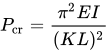
- Euler's formula for the critical load of a column:
- Euler's continued fraction formula connecting a finite sum of products with a finite continued fraction
- Euler product formula for the Riemann zeta function.
- Euler–Maclaurin formula (Euler's summation formula) relating integrals to sums
- Euler–Rodrigues formula describing the rotation of a vector in three dimensions
- Euler's reflection formula, reflection formula for the gamma function
- Local Euler characteristic formula
Functions
- The Euler function, a modular form that is a prototypical q-series.
- Euler's totient function (or Euler phi (φ) function) in number theory, counting the number of coprime integers less than an integer.
- Euler hypergeometric integral
- Euler–Riemann zeta function
Identities
- Euler's identity e iπ + 1 = 0.
- Euler's four-square identity, which shows that the product of two sums of four squares can itself be expressed as the sum of four squares.
- Euler's identity may also refer to the pentagonal number theorem.
Numbers
- Euler's number, e = 2.71828..., the base of the natural logarithm
- Euler's idoneal numbers, a set of 65 or possibly 66 or 67 integers with special properties
- Euler numbers – Integers occurring in the coefficients of the Taylor series of 1/cosh t
- Eulerian numbers count certain types of permutations.
- Euler number (physics), the cavitation number in fluid dynamics.
- Euler number (algebraic topology) – now, Euler characteristic, classically the number of vertices minus edges plus faces of a polyhedron.
- Euler number (3-manifold topology) – see Seifert fiber space
- Lucky numbers of Euler
- Euler's constant gamma (γ), also known as the Euler–Mascheroni constant
- Eulerian integers, more commonly called Eisenstein integers, the algebraic integers of form a + bω where ω is a complex cube root of 1.
- Euler–Gompertz constant
Theorems
- Euler's homogeneous function theorem – A homogeneous function is a linear combination of its partial derivatives
- Euler's infinite tetration theorem – About the limit of iterated exponentiation
- Euler's rotation theorem – Movement with a fixed point is rotation
- Euler's theorem (differential geometry) – Orthogonality of the directions of the principal curvatures of a surface
- Euler's theorem in geometry – On distance between centers of a triangle
- Euler's quadrilateral theorem – Relation between the sides of a convex quadrilateral and its diagonals
- Euclid–Euler theorem – Characterization of even perfect numbers
- Euler's theorem – Theorem on modular exponentiation
- Euler's partition theorem – Relates the product and series representations of the Euler function Π(1-x^n)
- Goldbach–Euler theorem – theorem stating that sum of 1/(k−1), where k ranges over positive integers of the form mⁿ for m≥2 and n≥2, equals 1
- Gram–Euler theorem
Laws
- Euler's first law, the linear momentum of a body is equal to the product of the mass of the body and the velocity of its center of mass.
- Euler's second law, the sum of the external moments about a point is equal to the rate of change of angular momentum about that point.
Other things
- 2002 Euler (a minor planet)
- Euler (crater)
- AMS Euler typeface
- Euler (software)
- Euler Book Prize
- Euler Lecture, an annual lecture at the University of Potsdam
- Euler Medal, a prize for research in combinatorics
- Leonhard Euler Gold Medal, a prize for outstanding results in mathematics and physics
- Euler programming language
- Euler Society, an American group dedicated to the life and work of Leonhard Euler
- Euler Committee of the Swiss Academy of Sciences
- Euler–Fokker genus
- Project Euler
- Leonhard Euler Telescope
- Rue Euler (a street in Paris, France)[3]
- EulerOS, a CentOS Linux based operating system
- French submarine Euler
- Euler square
- Euler top
Topics by field of study
Selected topics from above, grouped by subject, and additional topics from the fields of music and physical systems
Analysis: derivatives, integrals, and logarithms
- Euler approximation – (see Euler's method)
- The Euler integrals of the first and second kind, namely the beta function and gamma function.
- The Euler method, a method for finding numerical solutions of differential equations
- Euler's number e ≈ 2.71828, the base of the natural logarithm, also known as Napier's constant.
- The Euler substitutions for integrals involving a square root.
- Euler's summation formula, a theorem about integrals.
- Cauchy–Euler equation (or Euler equation), a second-order linear differential equation
- Cauchy–Euler operator
- Euler–Maclaurin formula – relation between integrals and sums
- Euler–Mascheroni constant or Euler's constant γ ≈ 0.577216
- Integration using Euler's formula
- Euler summation
- Euler–Boole summation
Geometry and spatial arrangement
- Euler angles defining a rotation in space
- Euler brick
- Euler's line – relation between triangle centers
- Euler operator – set of functions to create polygon meshes
- Euler filter
- Euler's rotation theorem
- Euler spiral – a curve whose curvature varies linearly with its arc length
- Euler squares, usually called Graeco-Latin squares
- Euler's theorem in geometry, relating the circumcircle and incircle of a triangle
- Euler's quadrilateral theorem, an extension of the parallelogram law to convex quadrilaterals
- Euler–Rodrigues formula concerning Euler–Rodrigues parameters and 3D rotation matrices
- Cramer–Euler paradox
- Euler calculus
- Euler sequence
- Gram–Euler theorem
- Euler measure
Graph theory
- Euler characteristic (formerly called Euler number) in algebraic topology and topological graph theory, and the corresponding Euler's formula
- Eulerian circuit, Euler cycle or Eulerian path – a path through a graph that takes each edge once
- Eulerian graph has all its vertices spanned by an Eulerian path
- Euler class
- Euler diagram – popularly called "Venn diagrams", although some use this term only for a subclass of Euler diagrams.
- Euler tour technique

Music
- Euler–Fokker genus
- Euler's tritone
Number theory
- Euler's criterion – quadratic residues modulo by primes
- Euler product – infinite product expansion, indexed by prime numbers of a Dirichlet series
- Euler pseudoprime
- Euler–Jacobi pseudoprime
- Euler's totient function (or Euler phi (φ) function) in number theory, counting the number of coprime integers less than an integer.
- Euler system
- Euler's factorization method
Physical systems
- Euler's Disk – a toy consisting of a circular disk that spins, without slipping, on a surface
- Euler rotation equations, in rigid body dynamics.
- Euler conservation equations in fluid dynamics.
- Euler number (physics), the cavitation number in fluid dynamics.
- Euler's three-body problem
- Euler–Bernoulli beam equation, concerning the elasticity of structural beams.
- Euler formula in calculating the buckling load of columns.
- Euler–Lagrange equation
- Euler–Tricomi equation – concerns transonic flow
- Euler relations – Gives relationship between extensive variables in thermodynamics.
- Eulerian observer – An observer "at rest" in spacetime, i.e. with 4-velocity perpendicular to spatial hypersurfaces.[4]
- Relativistic Euler equations
- Euler top
- Newton–Euler equations
- d'Alembert–Euler condition
- Euler acceleration or force
Polynomials
- Euler's homogeneous function theorem, a theorem about homogeneous polynomials.
- Euler polynomials
- Euler spline – splines composed of arcs using Euler polynomials[5]
Notes
- Richeson, David S. (2008). Euler's Gem: The polyhedron formula and the birth of topology (illustrated ed.). Princeton University Press. p. 86. ISBN 978-0-691-12677-7.
- Edwards, Charles Henry; Penney, David E.; Calvis, David (2008). Differential equations and boundary value problems. Pearson Prentice Hall. pp. 443 (微分方程及边值问题, 2004 edition). ISBN 978-0-13-156107-6.
- de Rochegude, Félix (1910). Promenades dans toutes les rues de Paris [Walks along all of the streets in Paris] (VIIIe arrondissement ed.). Hachette. p. 98.
- Evans, Charles R.; Smarr, Larry L.; Wilson, James R. (1986). "Numerical Relativistic Gravitational Collapse with Spatial Time Slices". Astrophysical Radiation Hydrodynamics. Vol. 188. pp. 491–529. doi:10.1007/978-94-009-4754-2_15. ISBN 978-94-010-8612-7. Retrieved March 27, 2021.
- Schoenberg (1973). "bibliography" (PDF). University of Wisconsin. Archived from the original (PDF) on 2011-05-22. Retrieved 2007-10-28.