Hermitian wavelet
Hermitian wavelets are a family of discrete and continuous wavelets, used in the continuous and discrete Hermite wavelet transform. The Hermitian wavelet is defined as the derivative of a Gaussian distribution for each positive :[1]



where in this case we consider the (probabilist) Hermite polynomial . The normalization coefficient is given by,



The function is said to be an admissible Hermite wavelet if it satisfies the admissibility relation:[2]

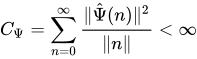
where is the Hermite transform of .


The perfector in the resolution of the identity of the continuous wavelet transform for this wavelet is given by the formula,

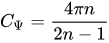
In computer vision and image processing, Gaussian derivative operators of different orders are frequently used as a basis for expressing various types of visual operations; see scale space and N-jet.[3]
Examples
The first three derivatives of the Gaussian function with :
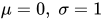

are:
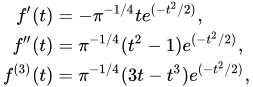
and their norms . Normalizing the derivatives yields three Hermitian wavelets:



See also
- Wavelet
- The Ricker wavelet is the Hermitian wavelet

References
- Brackx, F.; De Schepper, H.; De Schepper, N.; Sommen, F. (2008-02-01). "Hermitian Clifford-Hermite wavelets: an alternative approach". Bulletin of the Belgian Mathematical Society, Simon Stevin. 15 (1). doi:10.36045/bbms/1203692449. ISSN 1370-1444.
- "Continuous and Discrete Wavelet Transforms Associated with Hermite Transform". International Journal of Analysis and Applications. 2020. doi:10.28924/2291-8639-18-2020-531.
- Wah, Benjamin W., ed. (2007-03-15). Wiley Encyclopedia of Computer Science and Engineering (1 ed.). Wiley. doi:10.1002/9780470050118.ecse609. ISBN 978-0-471-38393-2.