Radiodrome
In geometry, a radiodrome is the pursuit curve followed by a point that is pursuing another linearly-moving point. The term is derived from the Latin word radius (Eng. ray; spoke) and the Greek word dromos (Eng. running; racetrack), for there is a radial component in its kinematic analysis. The classic (and best-known) form of a radiodrome is known as the "dog curve"; this is the path a dog follows when it swims across a stream with a current after something it has spotted on the other side. Because the dog drifts with the current, it will have to change its heading; it will also have to swim further than if it had taken the optimal heading. This case was described by Pierre Bouguer in 1732.
A radiodrome may alternatively be described as the path a dog follows when chasing a hare, assuming that the hare runs in a straight line at a constant velocity.

Mathematical analysis
Introduce a coordinate system with origin at the position of the dog at time zero and with y-axis in the direction the hare is running with the constant speed Vt. The position of the hare at time zero is (Ax, Ay) with Ax > 0 and at time t it is
| (1) |

The dog runs with the constant speed Vd towards the instantaneous position of the hare.
The differential equation corresponding to the movement of the dog, (x(t), y(t)), is consequently
| (2) |
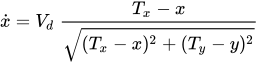
| (3) |
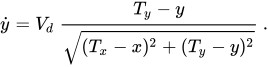
It is possible to obtain a closed-form analytic expression y=f(x) for the motion of the dog.
From (2) and (3), it follows that
| . | (4) |
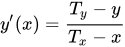
Multiplying both sides with and taking the derivative with respect to x, using that

| (5) |

one gets
| (6) |
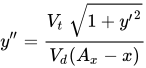
or
| (7) |
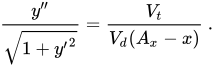
From this relation, it follows that
| (8) |

where B is the constant of integration determined by the initial value of y' at time zero, y' (0)= sinh(B − (Vt /Vd) lnAx), i.e.,
| (9) |

From (8) and (9), it follows after some computation that
| . | (10) |
![{\displaystyle y'={\frac {1}{2}}\left[\left(y'(0)+{\sqrt {{y'(0)}^{2}+1}}\right)\left(1-{\frac {x}{A_{x}}}\right)^{-{\frac {V_{t}}{V_{d}}}}+\left(y'(0)-{\sqrt {{y'(0)}^{2}+1}}\right)\left(1-{\frac {x}{A_{x}}}\right)^{\frac {V_{t}}{V_{d}}}\right]}](../I/e40b8c7b635c6af40d29570b129eb5e25bf92078.svg)
Furthermore, since y(0)=0, it follows from (1) and (4) that
| . | (11) |

If, now, Vt ≠ Vd, relation (10) integrates to
| (12) |
![{\displaystyle y=C-{\frac {A_{x}}{2}}\left[{\frac {\left(y'(0)+{\sqrt {{y'(0)}^{2}+1}}\right)\left(1-{\frac {x}{A_{x}}}\right)^{1-{\frac {V_{t}}{V_{d}}}}}{1-{\frac {V_{t}}{V_{d}}}}}+{\frac {\left(y'(0)-{\sqrt {{y'(0)}^{2}+1}}\right)\left(1-{\frac {x}{A_{x}}}\right)^{1+{\frac {V_{t}}{V_{d}}}}}{1+{\frac {V_{t}}{V_{d}}}}}\right],}](../I/a1225dec2f623dee0d52b98c5d3955c9dfc9cb58.svg)
where C is the constant of integration. Since again y(0)=0, it's
| . | (13) |
![{\displaystyle C={\frac {A_{x}}{2}}\left[{\frac {y'(0)+{\sqrt {{y'(0)}^{2}+1}}}{1-{\frac {V_{t}}{V_{d}}}}}+{\frac {y'(0)-{\sqrt {{y'(0)}^{2}+1}}}{1+{\frac {V_{t}}{V_{d}}}}}\right]}](../I/6fcd4025b9a701c3a7f9d52debd9548d098fb758.svg)
The equations (11), (12) and (13), then, together imply
| . | (14) |
![{\displaystyle y={\frac {1}{2}}\left\{{\frac {A_{y}+{\sqrt {A_{x}^{2}+A_{y}^{2}}}}{1-{\frac {V_{t}}{V_{d}}}}}\left[1-\left(1-{\frac {x}{A_{x}}}\right)^{1-{\frac {V_{t}}{V_{d}}}}\right]+{\frac {A_{y}-{\sqrt {A_{x}^{2}+A_{y}^{2}}}}{1+{\frac {V_{t}}{V_{d}}}}}\left[1-\left(1-{\frac {x}{A_{x}}}\right)^{1+{\frac {V_{t}}{V_{d}}}}\right]\right\}}](../I/b20568b6a6ea5f0f49caaaf6e9dd9250ce6fd75b.svg)
If Vt = Vd, relation (10) gives, instead,
| . | (15) |
![{\displaystyle y=C-{\frac {A_{x}}{2}}\left[\left(y'(0)+{\sqrt {{y'(0)}^{2}+1}}\right)\ln \left(1-{\frac {x}{A_{x}}}\right)+{\frac {1}{2}}\left(y'(0)-{\sqrt {{y'(0)}^{2}+1}}\right)\left(1-{\frac {x}{A_{x}}}\right)^{2}\right]}](../I/96499dbdab962504b0ce47cc2ecfd0c24426fc8d.svg)
Using y(0)=0 once again, it follows that
| (16) |

The equations (11), (15) and (16), then, together imply that
| . | (17) |
![{\displaystyle y={\frac {1}{4}}\left(A_{y}-{\sqrt {A_{x}^{2}+A_{y}^{2}}}\right)\left[1-\left(1-{\frac {x}{A_{x}}}\right)^{2}\right]-{\frac {1}{2}}\left(A_{y}+{\sqrt {A_{x}^{2}+A_{y}^{2}}}\right)\ln \left(1-{\frac {x}{A_{x}}}\right)}](../I/0a7d1f4cf8d1682af8ebc5dc6098f23c76d1a10c.svg)
If Vt < Vd, it follows from (14) that
| (18) |

If Vt ≥ Vd, one has from (14) and (17) that , which means that the hare will never be caught, whenever the chase starts.

See also
References
- Nahin, Paul J. (2012), Chases and Escapes: The Mathematics of Pursuit and Evasion, Princeton: Princeton University Press, ISBN 978-0-691-12514-5.
- Gomes Teixera, Francisco (1909), Imprensa da universidade (ed.), Traité des Courbes Spéciales Remarquables, vol. 2, Coimbra, p. 255
{{citation}}: CS1 maint: location missing publisher (link)