Ccdc60
Coiled-coil domain containing 60 is a protein that in humans is encoded by the CCDC60 gene that is most highly expressed in the trachea, salivary glands, bladder, cervix, and epididymis.[5]
| CCDC60 | |||||||||||||||||||||||||||||||||||||||||||||||||||
|---|---|---|---|---|---|---|---|---|---|---|---|---|---|---|---|---|---|---|---|---|---|---|---|---|---|---|---|---|---|---|---|---|---|---|---|---|---|---|---|---|---|---|---|---|---|---|---|---|---|---|---|
| Identifiers | |||||||||||||||||||||||||||||||||||||||||||||||||||
| Aliases | CCDC60, coiled-coil domain containing 60 | ||||||||||||||||||||||||||||||||||||||||||||||||||
| External IDs | MGI: 2141043; HomoloGene: 18624; GeneCards: CCDC60; OMA:CCDC60 - orthologs | ||||||||||||||||||||||||||||||||||||||||||||||||||
| |||||||||||||||||||||||||||||||||||||||||||||||||||
| |||||||||||||||||||||||||||||||||||||||||||||||||||
| |||||||||||||||||||||||||||||||||||||||||||||||||||
| |||||||||||||||||||||||||||||||||||||||||||||||||||
| Wikidata | |||||||||||||||||||||||||||||||||||||||||||||||||||
| |||||||||||||||||||||||||||||||||||||||||||||||||||


Gene
The gene that encodes CCDC60 is located on the plus strand of chromosome 12 (12q24.23) and contains 14 exons.[6] The gene spans positions 119334712-119541047.[7] The first record of the gene that encodes CCDC60 in the NCBI nucleotide database originated from a data set containing 15,000 human and mouse full-length cDNA sequences.[6]
Protein
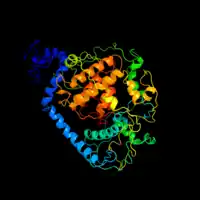
CCDC60 is made up of 550 amino acids.[9] The computational isoelectric point of CCDC60 is 9.17 and the computational molecular weight is approximately 63kDa.[10] Western blots of RT-4 and U-251 cell lines support the predicted molecular weight.[11] The predicted subcellular location of CCDC60 is the mitochondria.[12] The secondary structure of CCDC60 contains a namesake coiled-coil domain in addition to predicted alpha helices and coils.[13]
Regulation
Gene expression
The expression of CCDC60 is tissue-specific. CCDC60 is most highly expressed in the trachea, salivary glands, bladder, cervix, and epididymis.[5] CCDC60 is also expressed in epithelial cells of the upper respiratory system.[14] RNA seq data shows relatively high levels of expression in the prostate, moderate expression in the lungs and ovaries, and low expression in the colon, adrenal gland, and brain.[15]
Transcription factors
There are many candidate transcription factors that bind to the promoter region of the gene that encodes CCDC60.[16]
| Family | Description |
|---|---|
| CAAT | CCAAT binding factor |
| XBBF | X-box binding factor |
| MZF1 | Myeloid zinc finger 1 factor |
| EGRF | Wilms tumor suppressor |
| KLFS | Krueppel-like factor 2 (lung) (LKLF) |
| ZFO2 | C2H2 zinc finger transcription factor 2 |
| CALM | Calmodulin-binding transcription activator (CAMTA1, CAMTA2) |
| SORY | SRY (sex determining region Y) |
| SAL1 | Spalt-like transcription factor 1 |
| VTBP | Vertebrate TATA binding protein factor |
| RUSH | SWI/SNF related, actin dependent regulator of chromatin, subfamily a, member 3 |
| ETSF | Human and murine ETS1 factors |
| HAND | Twist subfamily of class B bHLH transcription factor |
| HESF | Basic helix-loop-helix protein known as Dec2, Sharp1 or BHLHE41 |
| ZFHX | Two-handed zinc finger homeodomain transcription factor |
| CART | Cart-1 (cartilage homeoprotein 1) |
| HEAT | Heat shock factor 2 |
Post-translational modification
CCDC60 is a candidate for phosphorylation by Protein kinase C.[17] The initial methionine residue is predicted to be cleaved from the polypeptide after translation.[18]
Evolutionary history
Orthologs
The most distantly related organism in which a likely ortholog to Human CCDC60 can be found in is Amphimedon queenslandica, a sea sponge. Orthologs to Human CCDC60 are not found in any prokaryotes. Interestingly, there are no known orthologs in arthropods, although there are many other invertebrates that possess likely orthologs.
| Organism | Taxonomic Group | Divergence (MYA)[19] | Accession Number | Sequence Length | Shared Sequence Identity[20] |
| Human | Hominidae | 0 | NP_848594.2 | 550 | 100% |
| Philippine tarsier | Tarsiidae | 67 | XP_008067500.1 | 559 | 77.29% |
| Gray mouse lemur | Lemuriformes | 73 | XP_012612137.1 | 548 | 77.60% |
| Yellow-bellied marmot | Rodentia | 90 | XP_027779037.1 | 559 | 76.32% |
| Sea otter | Carnivora | 96 | XP_022373045.1 | 548 | 84.90% |
| Florida Manatee | Placentalia | 105 | XP_004379174.1 | 551 | 83.64% |
| Common wombat | Marsupialia | 159 | XP_027721296.1 | 564 | 62.86% |
| Southern Ostrich | Aves | 312 | XP_009685824.1 | 489 | 37.03% |
| Bald eagle | Aves | 320 | XP_010573943.1 | 661 | 32.02% |
| High Himilaya Frog | Amphibia | 352 | XP_018413991.1 | 540 | 37.31% |
| Western clawed frog | Amphibia | 352 | XP_012824143.1 | 657 | 32.70% |
| Yellowhead Catfish | Osteichthyes | 435 | XP_027018543.1 | 577 | 26.93% |
| Whale Shark | Chondrichthyes | 473 | XP_020385120.1 | 672 | 34.87% |
| Sea Vase | Ascidiacea | 676 | XP_009860110.2 | 818 | 28.31% |
| Acorn Worm | Hemichordata | 684 | XP_006811258.1 | 733 | 27.87% |
| Pacific Purple Sea Urchin | Echinoidea | 684 | XP_011683370.1 | 791 | 23.76% |
| California two-spot octopus | Mollusca | 797 | XP_014780749.1 | 689 | 27.05% |
| Mountainous Star Coral | Cnidaria | 824 | XP_020617162.1 | 864 | 31.28% |
| Trichoplax | Placozoa | 948 | XP_002117053.1 | 1247 | 34.84% |
| Sponge | Porifera | 952 | XP_011405574.2 | 569 | 22.87% |
Paralogs
There are no known paralogs of CCDC60.
Protein interactions
There are several binary protein interactions involving CCDC60 that have been experimentally verified.[21]
| Protein | Function[22] | Interaction |
| UPF3B | Involved in nonsense-mediated decay (NMD) of mRNAs containing premature stop codons by associating with the nuclear exon junction complex (EJC) and serving as link between the EJC core and NMD machinery. | Physical Association[23] |
| ZNF593 | Negatively modulates the DNA binding activity of Oct-2 and therefore its transcriptional regulatory activity. | Physical Association[23] |
| FAM32A | Isoform 1, but not isoform 2 or isoform 3, may induce G2 arrest and apoptosis. | Physical Association[23] |
| RBM42 | Binds (via the RRM domain) to the 3'-untranslated region (UTR) of CDKN1A mRNA. | Physical Association[23] |
| DCP1B | May play a role in the degradation of mRNAs, both in normal mRNA turnover and in nonsense-mediated mRNA decay. | Physical Association[23] |
| EGFR | Receptor tyrosine kinase binding ligands of the EGF family and activating several signaling cascades to convert extracellular cues into appropriate cellular responses. | Physical Association[24] |
| FAM204A | Unknown function. | Physical Association[23] |
| APP | Functions as a cell surface receptor and performs physiological functions on the surface of neurons relevant to neurite growth, neuronal adhesion and axonogenesis. | Direct Interaction[25] |
| MTUS2 | Binds microtubules. Together with MAPRE1 may target the microtubule depolymerase KIF2C to the plus-end of microtubules. | Direct Interaction[26] |
| B9D1 | Component of the tectonic-like complex, a complex localized at the transition zone of primary cilia and acting as a barrier that prevents diffusion of transmembrane proteins between the cilia and plasma membranes. | Direct Interaction[27] |
Clinical significance
Mutations in CCDC60 have been associated with decreased walking speed.[28] Additionally, CCDC60 is one of many candidate genes that has been associated with diagnosis of schizophrenia in genome-wide study.[29]
References
- GRCh38: Ensembl release 89: ENSG00000183273 – Ensembl, May 2017
- GRCm38: Ensembl release 89: ENSMUSG00000043913 – Ensembl, May 2017
- "Human PubMed Reference:". National Center for Biotechnology Information, U.S. National Library of Medicine.
- "Mouse PubMed Reference:". National Center for Biotechnology Information, U.S. National Library of Medicine.
- She X, Rohl CA, Castle JC, Kulkarni AV, Johnson JM, Chen R (June 2009). "Definition, conservation and epigenetics of housekeeping and tissue-enriched genes". BMC Genomics. 10 (1): 269. doi:10.1186/1471-2164-10-269. PMC 2706266. PMID 19534766.
- "Homo sapiens coiled-coil domain containing 60 (CCDC60), mRNA". 2018-12-29.
{{cite journal}}: Cite journal requires|journal=(help) - Kent WJ, Sugnet CW, Furey TS, Roskin KM, Pringle TH, Zahler AM, Haussler D (June 2002). "The human genome browser at UCSC". Genome Research. 12 (6): 996–1006. doi:10.1101/gr.229102. PMC 186604. PMID 12045153.
- Kelley LA, Mezulis S, Yates CM, Wass MN, Sternberg MJ (June 2015). "The Phyre2 web portal for protein modeling, prediction and analysis". Nature Protocols. 10 (6): 845–58. doi:10.1038/nprot.2015.053. PMC 5298202. PMID 25950237.
- "coiled-coil domain-containing protein 60 [Homo sapiens] - Protein - NCBI". www.ncbi.nlm.nih.gov. Retrieved 2019-03-04.
- Bjellqvist B, Hughes GJ, Pasquali C, Paquet N, Ravier F, Sanchez JC, Frutiger S, Hochstrasser D (October 1993). "The focusing positions of polypeptides in immobilized pH gradients can be predicted from their amino acid sequences". Electrophoresis. 14 (10): 1023–31. doi:10.1002/elps.11501401163. PMID 8125050. S2CID 38041111.
- "Anti-CCDC60 antibody produced in rabbit HPA039048". Immunohistochemistry, Western. Retrieved 2019-05-12.
- Emanuelsson O, Nielsen H, Brunak S, von Heijne G (July 2000). "Predicting subcellular localization of proteins based on their N-terminal amino acid sequence". Journal of Molecular Biology. 300 (4): 1005–16. doi:10.1006/jmbi.2000.3903. PMID 10891285.
- Klausen MS, Jespersen MC, Nielsen H, Jensen KK, Jurtz VI, Sønderby CK, Sommer MO, Winther O, Nielsen M, Petersen B, Marcatili P (June 2019). "NetSurfP-2.0: Improved prediction of protein structural features by integrated deep learning". Proteins. 87 (6): 520–527. bioRxiv 10.1101/311209. doi:10.1002/prot.25674. PMID 30785653. S2CID 216629401.
- "CCDC60 Top Ten Tissues". Genevisible.
- "Experiment < Expression Atlas < EMBL-EBI". www.ebi.ac.uk. Retrieved 2019-05-12.
- Cartharius K, Frech K, Grote K, Klocke B, Haltmeier M, Klingenhoff A, Frisch M, Bayerlein M, Werner T (July 2005). "MatInspector and beyond: promoter analysis based on transcription factor binding sites". Bioinformatics. 21 (13): 2933–42. doi:10.1093/bioinformatics/bti473. PMID 15860560.
- Blom N, Sicheritz-Pontén T, Gupta R, Gammeltoft S, Brunak S (June 2004). "Prediction of post-translational glycosylation and phosphorylation of proteins from the amino acid sequence". Proteomics. 4 (6): 1633–49. doi:10.1002/pmic.200300771. PMID 15174133. S2CID 18810164.
- Charpilloz C, Veuthey AL, Chopard B, Falcone JL (July 2014). "Motifs tree: a new method for predicting post-translational modifications" (PDF). Bioinformatics. 30 (14): 1974–82. doi:10.1093/bioinformatics/btu165. PMID 24681905.
- "TimeTree - The Timescale of Life". TimeTree. Archived from the original on 13 May 2019. Retrieved 12 May 2019.
- "Protein BLAST: search protein databases using a protein query". blast.ncbi.nlm.nih.gov. Retrieved 2019-05-12.
- "PSICQUIC View". www.ebi.ac.uk. Retrieved 2019-05-12.
- "UniProt". www.uniprot.org. Retrieved 2019-05-12.
- Huttlin EL, Bruckner RJ, Paulo JA, Cannon JR, Ting L, Baltier K, et al. (May 2017). "Architecture of the human interactome defines protein communities and disease networks". Nature. 545 (7655): 505–509. Bibcode:2017Natur.545..505H. doi:10.1038/nature22366. PMC 5531611. PMID 28514442.
- Yao Z, Darowski K, St-Denis N, Wong V, Offensperger F, Villedieu A, et al. (January 2017). "A Global Analysis of the Receptor Tyrosine Kinase-Protein Phosphatase Interactome". Molecular Cell. 65 (2): 347–360. doi:10.1016/j.molcel.2016.12.004. PMC 5663465. PMID 28065597.
- Oláh J, Vincze O, Virók D, Simon D, Bozsó Z, Tõkési N, Horváth I, Hlavanda E, Kovács J, Magyar A, Szũcs M, Orosz F, Penke B, Ovádi J (September 2011). "Interactions of pathological hallmark proteins: tubulin polymerization promoting protein/p25, beta-amyloid, and alpha-synuclein". The Journal of Biological Chemistry. 286 (39): 34088–100. doi:10.1074/jbc.M111.243907. PMC 3190826. PMID 21832049.
- Rolland T, Taşan M, Charloteaux B, Pevzner SJ, Zhong Q, Sahni N, et al. (November 2014). "A proteome-scale map of the human interactome network". Cell. 159 (5): 1212–1226. doi:10.1016/j.cell.2014.10.050. PMC 4266588. PMID 25416956.
- Dowdle WE, Robinson JF, Kneist A, Sirerol-Piquer MS, Frints SG, Corbit KC, Zaghloul NA, Zaghloul NA, van Lijnschoten G, Mulders L, Verver DE, Zerres K, Reed RR, Attié-Bitach T, Johnson CA, García-Verdugo JM, Katsanis N, Bergmann C, Reiter JF (July 2011). "Disruption of a ciliary B9 protein complex causes Meckel syndrome". American Journal of Human Genetics. 89 (1): 94–110. doi:10.1016/j.ajhg.2011.06.003. PMC 3135817. PMID 21763481.
- Lunetta KL, D'Agostino RB, Karasik D, Benjamin EJ, Guo CY, Govindaraju R, Kiel DP, Kelly-Hayes M, Massaro JM, Pencina MJ, Seshadri S, Murabito JM (September 2007). "Genetic correlates of longevity and selected age-related phenotypes: a genome-wide association study in the Framingham Study". BMC Medical Genetics. 8 (Suppl 1): S13. doi:10.1186/1471-2350-8-s1-s13. PMC 1995604. PMID 17903295.
- Kirov G, Zaharieva I, Georgieva L, Moskvina V, Nikolov I, Cichon S, Hillmer A, Toncheva D, Owen MJ, O'Donovan MC (August 2009). "A genome-wide association study in 574 schizophrenia trios using DNA pooling". Molecular Psychiatry. 14 (8): 796–803. doi:10.1038/mp.2008.33. PMID 18332876. S2CID 7969539.