Isobutyraldehyde
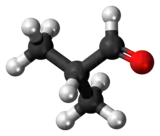
Isobutyraldehyde is the chemical compound with the formula (CH3)2CHCHO. It is an aldehyde, isomeric with n-butyraldehyde (butanal).[1] Isobutyraldehyde is made, often as a side-product, by the hydroformylation of propene. Its odour is described as that of wet cereal or straw. It undergoes the Cannizaro reaction even though it has alpha hydrogen atom. It is a colorless volatile liquid.
 | |
 | |
| Names | |
|---|---|
| Preferred IUPAC name
2-Methylpropanal | |
| Other names
2-Methylpropionaldehyde | |
| Identifiers | |
CAS Number |
|
3D model (JSmol) |
|
Beilstein Reference |
605330 |
| ChEBI | |
| ChemSpider | |
| ECHA InfoCard | 100.001.045 |
| EC Number |
|
Gmelin Reference |
1658 |
PubChem CID |
|
| RTECS number |
|
| UNII | |
| UN number | 2045 |
CompTox Dashboard (EPA) |
|
InChI
| |
SMILES
| |
| Properties | |
Chemical formula |
C4H8O |
| Molar mass | 72.11 g/mol |
| Appearance | colourless liquid |
| Odor | Pungent; straw-like |
| Density | 0.79 g/cm3 |
| Melting point | −65 °C (−85 °F; 208 K) |
| Boiling point | 63 °C (145 °F; 336 K) |
| moderate | |
| Solubility in other solvents | miscible in organic solvents |
Magnetic susceptibility (χ) |
-46.38·10−6 cm3/mol |
Refractive index (nD) |
1.374 |
| Hazards | |
| Occupational safety and health (OHS/OSH): | |
Main hazards |
flammable |
| GHS labelling: | |
Pictograms |
  |
Signal word |
Danger |
Hazard statements |
H225, H319 |
Precautionary statements |
P210, P233, P240, P241, P242, P243, P264, P280, P303+P361+P353, P305+P351+P338, P337+P313, P370+P378, P403+P235, P501 |
| Flash point | −19 °C; −2 °F; 254 K |
| Related compounds | |
Related alkyl aldehydes |
Lilial Hexyl cinnamaldehyde |
Related compounds |
Butyraldehyde Propionaldehyde |
Except where otherwise noted, data are given for materials in their standard state (at 25 °C [77 °F], 100 kPa).
Infobox references | |


Synthesis
Isobutyraldehyde is produced industrially by the hydroformylation of propene. Several million tons are produced annually.[2]
Biological routes
In the context of butanol fuel, isobutyraldehyde is of interest as a precursor to isobutanol. E. coli as well as several other organisms has been genetically modified to produce isobutanol. α-Ketoisovalerate, derived from oxidative deamination of valine, is prone to decarboxylation to give isobutyraldehyde, which is susceptible to reduction to the alcohol:[3]
- (CH3)2CHC(O)CO2H → (CH3)2CHCHO + CO2
- (CH3)2CHCHO + NADH + H+ → (CH3)2CHCH2OH + NAD+
It can also be produced using engineered bacteria.[4]
Other routes
Strong mineral acids catalyse the rearrangement of methallyl alcohol to isobutyraldehyde.
Reactions
Hydrogenation of the aldehyde gives isobutanol. Oxidation gives methacrolein or methacrylic acid. Condensation with formaldehyde gives hydroxypivaldehyde.[2] The latter is a precursor to vitamin B5.[5]

References
- Isobutyraldehyde is a retained trivial name under the IUPAC rules.Panico, R.; Powell, W. H.; Richer, J. C., eds. (1993). "Recommendation R-9.1". A Guide to IUPAC Nomenclature of Organic Compounds. IUPAC/Blackwell Science. ISBN 0-632-03488-2.
- Boy Cornils, Richard W. Fischer, Christian Kohlpaintner "Butanals" in Ullmann's Encyclopedia of Industrial Chemistry, 2000, Wiley-VCH, Weinheim. doi:10.1002/14356007.a04_447
- Atsumi, Shota; Hanai, Taizo; Liao, James C. (January 2008). "Non-fermentative pathways for synthesis of branched-chain higher alcohols as biofuels". Nature. 451 (7174): 86–89. Bibcode:2008Natur.451...86A. doi:10.1038/nature06450. PMID 18172501. S2CID 4413113.
- Atsumi, Shota; Wendy Higashide; James C. Liao (November 2009). "Direct photosynthetic recycling of carbon dioxide to isobutyraldehyde". Nature Biotechnology. 27 (12): 1177–1180. doi:10.1038/nbt.1586. PMID 19915552. S2CID 1492698.
- Eggersdorfer, Manfred; Laudert, Dietmar; Létinois, Ulla; McClymont, Tom; Medlock, Jonathan; Netscher, Thomas; Bonrath, Werner (2012). "One Hundred Years of Vitamins-A Success Story of the Natural Sciences". Angewandte Chemie International Edition. 51 (52): 12975. doi:10.1002/anie.201205886. PMID 23208776.