20

New stars keep forming in the universe thanks to all the nebulae. Now, we need Hydrogen to form stars and there would a time when all the hydrogen will get exhausted, and no more star formation will take place, theoretically.

Will there practically be such a point of time? I guess there is no place where hydrogen is replenished after star formation. Or is there a feedback cycle?

Ranveer
  • 539
  • 2
  • 15
  • 1
    There is no feedback cycle, there will be a point where no stars form anymore, entropy dictates it. – Eduardo Serra Jan 13 '14 at 16:38
  • 2
    @EduardoSerra To be more precise, there is a feedback cycle, but it is a negative feedback rather than a positive. Entropy is the law of decreasing returns essentially. – called2voyage Jan 13 '14 at 16:53
  • Who deleted my comment? There is a positive feedback cycle, which is very weak though. Protons and antiprotons can be produced in black hole evaporation as a side product. – Alexey Bobrick Jan 14 '14 at 13:11

2 Answers2

15

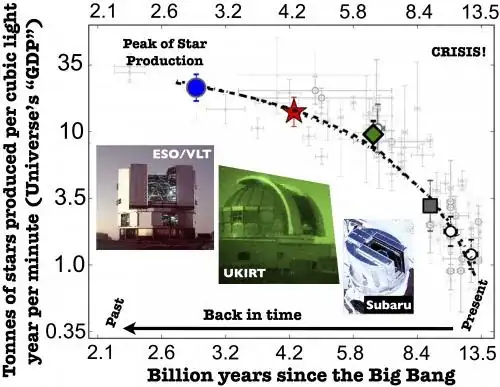
Cosmic GDP has already crashed, as Peak Star was ~11 billion years ago. Cosmic GDP

According to Sobral et al's prediction, the future star production by mass will give only 5% of the stars in the universe today, "even if we wait forever." More theoretical predictions, such as this one, suggest that nebulae will run out of hydrogen on the order of $10^{13}$ years, while star formation will occasionally happen due to collision of brown dwarfs until somewhere on the order of $10^{14}$ years.

Of course, hydrogen itself may have a finite lifetime. The half-life of a proton is experimentally known to be longer than $10^{34}$ years, but it may still be quite finite.

Stan Liou
  • 7,894
  • 1
  • 23
  • 36
  • I thought I remembered reading something about this, but I couldn't remember where so I left it to someone else to answer. +1 – called2voyage Jan 13 '14 at 20:30
  • Very well explained. Exactly the answer I was looking for. Thank you! – Ranveer Jan 13 '14 at 22:02
  • @called2voyage Brian Cox did a nice show on this in his "Wonders of the Universe" series, but if I recall, he got a bit poetic in specifying the time frames involved. Basically a really really really long time. – Robert Cartaino Jan 13 '14 at 23:39
  • 1
    Could it be that at after a certain time, the "dark matter" observed, will become hydrogen? Perhaps after such a long time, that we could never observe it close enough? – frodeborli Jan 14 '14 at 11:13
  • @frodeborli: If it were the case, that would shift the "no more new stars" date upwards. But there's no reason to believe it. – Stan Liou Jan 14 '14 at 11:18
  • @StanLiou I agree that there's no reason to believe it. It's just an idea. I think ideas are important, and sometimes worth to explore. – frodeborli Jan 14 '14 at 11:41
  • @frodeborli, a very interesting idea, by the way. Indeed, how do we know if DM particles are stable. – Alexey Bobrick Jan 14 '14 at 13:08
  • @AlexeyBobrick Thank you; it would seem to make the universe a continuous flow instead of something with a beginning and an end, which is a somewhat pleasing thought. How can I find out if somebody else have explored the idea before? – frodeborli Jan 14 '14 at 13:26
  • @frodeborli: As dark matter particle hasn't been identified, I don't think anybody considered its lifetimes, except for that they are obviously longer than Hubble time. But you can surely ask a question here on on Physics SE. By the way, http://arxiv.org/abs/1307.6434 . – Alexey Bobrick Jan 14 '14 at 13:36
  • @AlexeyBobrick I did at http://astronomy.stackexchange.com/questions/1435/could-dark-matter-be-unstable. – frodeborli Jan 14 '14 at 13:42
2

Given what we know of entropy and of the expansion of the Universe, the answer to your question is of course "Yes".

It will take a really really long time, however.

Edited to add:

"...a really really long time..." is an intentionally vague description. Whether it is 1010 or 101010 Hubble times is open to question.

Cyberherbalist
  • 901
  • 6
  • 16