9

Since I learned about Newton's gravity law, I wonder if I can measure the moon's gravity using (almost) no special equipment. The best I could come up with is a pendulum, which is in a resting position. The moon (at the horizon) will pull on the weight at the bottom of the pendulum and cause it to shift. 6 hours later, with the moon above or below the pendulum, the weight should be back. Maybe we could detect the shift, just like we see the tides.

moon puling on a pendulum

Running the math for a 5 meter long pendulum and 1 kg mass, I get an amplitude of 0,017 mm. I fear that external forces (wind, unstable surface, ...) will be bigger than this effect.

So my question is: is it possible (again, without specific equipment) to measure or detect the moon's gravitational force? What would be the best way to measure/detect it?

agtoever
  • 279
  • 2
  • 11
  • 1
    I haven't run the numbers, but I have a suggestion: instead of making the second measurement when the moon is overhead, measure when it's at the opposite side. You'll get the same displacement, but in the opposite direction, so the total displacement is twice what your proposed experiment would see. – Pete Becker Aug 23 '15 at 12:00
  • @PeteBecker - There will be zero horizontal displacement of the pendulum when the Moon is overhead or directly underfoot. – David Hammen Aug 24 '15 at 14:16
  • @DavidHammen - yes, that't the original experiment. My suggestion was to go to the other side (e.g., moon on the right in the diagram) for the second measurement, which gives twice the displacement. – Pete Becker Aug 24 '15 at 14:19
  • @agtoever - There will also be zero horizontal displacement of the pendulum when the Moon is on the horizon. You have forgotten that Earth as a whole is gravitationally attracted to the Moon. – David Hammen Aug 24 '15 at 14:23
  • @PeteBecker - That won't work for the reason cited above. The maximum horizontal component of the tidal forcing function occurs when the Moon is about halfway up the sky, resulting in a horizontal force of about $8.2\cdot10^{-7}$ m/s$^2$ newtons for a unit mass. – David Hammen Aug 24 '15 at 14:26
  • @DavidHammen - regardless, going to the opposite side will double whatever is being measured. Your argument is with the original numbers, not with my "improvement". – Pete Becker Aug 24 '15 at 14:29
  • Have you thought of using an accelerometer? Inertial Measurement Units are readily available with multiple accelerometers nower days. Usually the accelerometers produce an offset due to the earths gravity. Maybe you could detect the moon as well after having calibrated out the earths gravitational force... – Chandran Goodchild Sep 17 '18 at 19:34

2 Answers2

8

Running the math for a 5 meter long pendulum and 1 kg mass, I get an amplitude of 0,017 mm.

You are off by quite a bit. There is essentially no horizontal deflection when the Moon is at the horizon. The maximum horizontal deflection occurs when the Moon is about 45 degrees above or below the horizon.

The tidal acceleration at some point on the surface of the Earth due to some external body (e.g., the Moon) is the difference between the gravitational acceleration toward that external body at the point in question and the gravitational acceleration of the Earth as a whole toward that body:

$$\vec a_{rel} = GM_\text{body} \left(\frac {\vec R - \vec r} {||\vec R - \vec r||^3} - \frac {\vec R} {||\vec R||^3} \right)$$ where

  • $M_{body}$ is the mass of the external body,
  • $\vec R$ is the displacement vector from the center of the Earth to the center of the external body, and
  • $\vec r$ is the displacement vector from the center of the Earth to the point in question on the surface of the Earth.

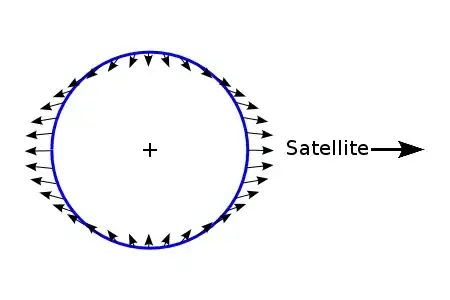
The resultant force looks like this:

Note that the tidal force is away from the center of the Earth when the Moon is directly overhead or directly underfoot, toward the center of the Earth when the Moon is on the horizon, and horizontal when the Moon is halfway between directly overhead/underfoot and on the horizon.

The tidal force is maximum when the Moon is directly overhead, and even then it's only about 10-7 g. You need a sensitive instrument to read that. A simple pendulum or a simple spring will not do the trick.

David Hammen
  • 33,900
  • 3
  • 74
  • 125
  • Thanks for your insight and clear answer! I see now that I made an error about the direction of the forces. It's a bit of a pity that my whole idea about measuring the gravitational force of the moon goes down the rabbit hole, but hey, I guess that's life... ;-o – agtoever Aug 25 '15 at 06:44
  • 1
    @agtoever You can detect the Moon's gravity via the period of the pendulum, but it needs to be a very well-made pendulum, and you need a precise time reference, preferably an atomic clock. See http://leapsecond.com/hsn2006/ – PM 2Ring Jan 18 '19 at 05:34
  • @PM2Ring - It can also be detected with gravimeters (e.g., an extremely sensitive and extremely stable accelerometer), – David Hammen Jan 19 '19 at 13:49
  • @David Certainly! I just wanted to stick with the simple pendulum of the OP. – PM 2Ring Jan 19 '19 at 14:16
  • If you bring your pendulum with you to the Moon, it will do the job. – badjohn Jan 20 '19 at 13:10
1

The Shortt Free Pendulum clock was able to detect the variation in gravity due to the moon and also detected the nutations of the earth's precession. Shortt's clock was tested at the US Naval observatory against an atomic clock and was estimated to have an accuracy better than 1 second per year (0.7).

The long term stability of a Shortt clock is better than the best double oven crystal oscillator commercially available today.

It is quite feasible for a hobbyist to build a free pendulum clock. My friend and I have designed and built two versions of the Shortt clock. We are still in the R&D phase, but I am confident we will be able to measure the effect of the moon. We are still tuning our clocks in air. We haven't pulled a vacuum yet.

Glorfindel
  • 4,790
  • 3
  • 25
  • 40
rgarnett
  • 11
  • 3