1

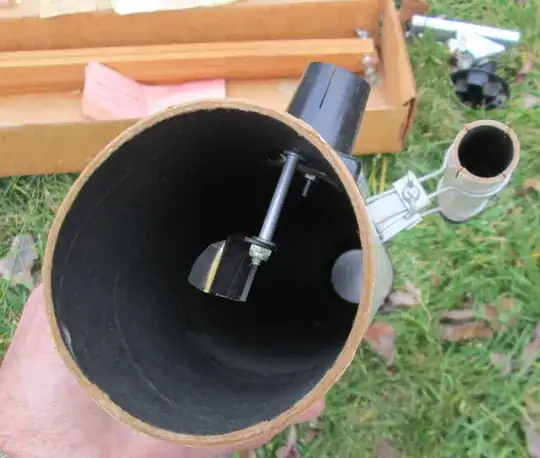
I mentioned my old telescope's secondary mirror in this answer (stiffness) but I'm not certain I am remembering correctly. My first telescope was a Edmund Scientific 4¼ inch Newtonian reflector. This was in the 1970's. I seem to remember that the secondary mirror was a right angle prism rather than an elliptical front-surface mirror.

Am I dreaming or mis-remembering, or did Edmund use prisms on at least some 4¼ inch Newtonians?

Either way, any discussion on the tradeoffs between front-surface elliptical mirrors and 90° prism secondaries would be appreciated.
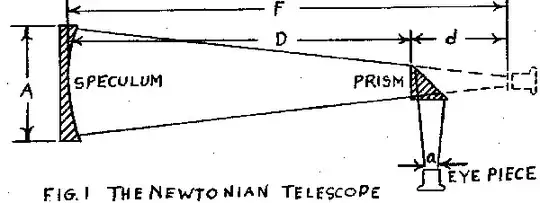

example of Newtonian with prism secondary

Source: John M. Pierce's HobbyGraph Articles HobbyGraph #15; Diagonals and Diagonal Supports.

uhoh
  • 31,151
  • 9
  • 89
  • 293

2 Answers2

3

My Edmund F/10 4 1/4" was bought in 1975, and had a rectangular front-surface mirror as the diagonal, with a single arm support attached to the tube near the eyepiece holder.

I believe the Astroscan 2001 (or at least some models of it) used a prism for the diagonal, supported by the flat glass plate at the front of the tube; haven't found a reference though.

The advantage of a prism is that it is more maintenance-free then a mirror which will eventually need to be re-aluminized. The disadvantages are that there are two optical surfaces instead of one in the light path that could reflect or scatter light, you can get color dispersion, and a rectangular prism will block more light than an elliptical mirror (especially important in a fast scope like the AstroScan). The star diagonal Wikipedia page has a pretty good discussion of the trade-offs.

antlersoft
  • 3,455
  • 11
  • 12
0

Supplemental to @antlersoft's answer:

I was poking around a bit further after I posted and ran across this "1960's Edmund Scientific 'Space Conqueror', 3" reflector" with a prism diagonal at http://www.retrotechnology.com/glass/edmund.html

Not exactly 1970's but at least they were using them.

"Edmund Prism"

uhoh
  • 31,151
  • 9
  • 89
  • 293