4

I am currently designing a vertical take-off and landing vehicle that uses a Tesla powertrain connected to an electric ducted fan. Please comment on if my thought process is sound on my feasibility analysis.

My initial mission goal is extremely modest to grease the wheels of my feasibility analysis and have a realistic utility in society (and for people in my sport, recreational/experimental skydiving).

The vehicle simply needs to lift itself and a 100kg payload (coincidentally the approximate mass of a skydiver with his parachute) to the altitude of 1 mile.

I think I need to calculate my total delta_v, but because I don't need a high speed (like an orbital escape velocity or something like that) I am not positive how to go about getting it without first understanding the maximum thrust from my system.

My current plan for determining thrust from the tesla-system: 1) identify maximum output of tesla battery and motor (lets say Model S P100D) 2) calculate maximum propeller size for #1 based on algorithms available in electric drone aircraft websites/forums 3) calculate potential thrust produced by #2 4) use #3 to determine if liftoff is possible carrying at least #1

My initial calculations are not intended to include all outside forces; I will incorporate these if it is in fact, theoretically feasible at all.

Based on information above as well as the weights of the battery, motor, and an estimate of a basic rocket-shaped frame, I can figure out if a basic propeller will work for this, or if I will need to incorporate an electric turbojet, which would blow up my budget for this.

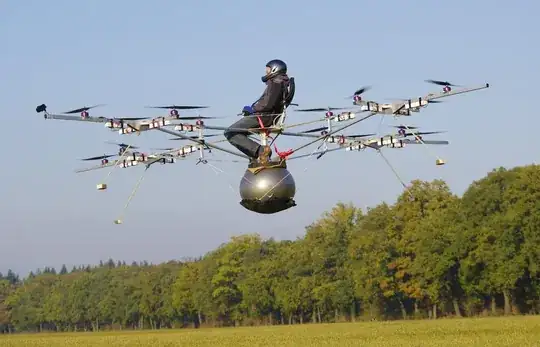
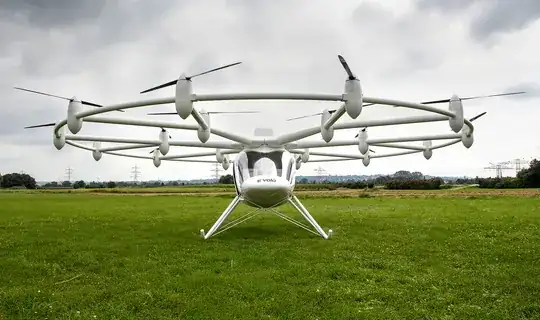
It is also feasible I could have a combination of several motors / batteries attached to multiple propellers with something like a rocket sitting in the middle of an oversized quadcopter. Again, budget goes up considerably.

Dr-Brando
  • 53
  • 2
  • so why not a helicopter or airplane? – user3528438 Nov 07 '17 at 06:12
  • Technically it will be something in between both, likely classified as a helicopter. I guess I don't totally understand your question. The flight mission is to deliver a skydiver to altitude so he can jump out, then the vehicle regenerates energy on decent to prepare for another flight. Rocket-geometry is very aerodynamic, and the physics of a rocket-shaped vehicle taking off and landing reliably have now been shown even in extremely large models (eg. SpaceX Falcon 9). – Dr-Brando Nov 07 '17 at 06:26
  • yeah an electric helicopter or airplane does all you said better and cheaper so why not? also since your velocity would be slower than a bicycle when who cares about aerodynamic? – user3528438 Nov 07 '17 at 15:13
  • @user3528438. I am not sure I know what helicopter or airplane you are talking about that is cheaper. What i'm proposing is simply a small aluminum cylinder with a salvage Tesla powertrain attached to a rotor. Helicopters are typically quite more expensive, and there aren't a plethora of electric helicopters i know of, especially of the inexpensive type. I reiterate that the above craft would likely be classified as a helicopter. The airplane has many more requirements, airfield not the least of them, cost of wings and body are not cheap. Please link me to the cheap electric helicopter. – Dr-Brando Nov 10 '17 at 06:12
  • @user3528438 also, I think you fail to understand the question. the question is not "what is better, my new experimental theoretical rocket-shaped helicopter, or existing aircraft?" which would be an easy answer as you've suggested. The question is about the theoretical thought process on determining if it is even physically possible. I'm not trying to buy the cheapest thing on the market. This is a thought exercise in aeronautical design. Thanks. – Dr-Brando Nov 10 '17 at 06:15
  • 1
  • Delta-v is not a useful metric in atmospheric flight. 2) The amount of energy you can regenerate from descent is negligible compared to the amount of energy your aircraft used to get to that altitude.
  • – Sanchises Dec 07 '17 at 07:45
  • Thank you very much @Sanchises. I agree Delta-v not typically useful for atmospheric flight. Can you please opine on what metrics would be best for determining some design metrics when the desired goal is to launch the aircraft (and it's payload, a skydiver) straight up 1 mile. As for the regenerative breaking, I don't anticipate reclaiming much energy, but perhaps enough to help facilitate and stabilize a powered vertical landing. Any constructive input is appreciated! – Dr-Brando Dec 10 '17 at 01:44