57

Dyson has been making bladeless fans for a few years now that accelerate a consistent stream of air without exposed blades. enter image description here

If this concept were applied to aircraft engines, it could potentially reduce the number of bird strikes, engine complexity/part count, danger for ground crews, etc. That said, it has not been done (or has it?). What are the major roadblocks prohibiting engineers from scaling this technology to large aircraft applications?

Pondlife
  • 71,714
  • 21
  • 214
  • 410
Geoff
  • 1,433
  • 1
  • 10
  • 25
  • 2
    The theory is to use high pressure flow to generate a high velocity jet, and the jet would induce a lower velocity flow at a higher volume (the x15 number above). Since the purpose for an engine is to generate thrust rather than moving air, the the core of this question becomes "does this high velocity to high volume conversion generate lift" or "is a ring nozzle better than a conventional circular nozzle". I guess answers to both are "No". – user3528438 Jul 24 '18 at 15:49
  • 30
    The Dyson is just an ejector pump using a electrically driven centrifugal compressor to create the jet, and arranged in an artful way. It would seem to be a very inefficient way to make thrust, with all the friction losses and such, but it would be interesting to see if the Dyson uses more or less wattage per cfm of air moved than a regular bladed fan (because it's the air being moved that is the thrust). Dyson's marketing tries to portray his inventions, like the particle separator vacuum design, as groundbreaking, but those things have been used in industrial processes for decades. – John K Jul 24 '18 at 16:00
  • 16
    Humorously, turbulent airflow is generally perceived as more cooling to the human skin, than smooth or laminar flows too. – RomaH Jul 24 '18 at 18:48
  • 2
    @JohnK, Dyson's cyclone separator is impressive in its way. Industrial cyclone separators are usually pretty touchy about operating conditions, while Dyson made one robust enough to work in a household vacuum cleaner. – Mark Jul 24 '18 at 19:14
  • 16
    In theory, yes, but it'd cost you £300M and only hipsters could fly on it – Richard Jul 24 '18 at 21:06
  • 13
    @RomaH is not an impression. Turbulence increases mixing, and thus heat transport away from the surface. – Federico Jul 25 '18 at 06:34
  • If you do not know, the Dyson fan is essentially the design of a jet engine's airflow, with the fan repositioned with ducting rather than having the fan jet turbine inline. It could be argued that development of what you have suggested would result in the typical design seen already. – Willtech Jul 25 '18 at 09:45
  • 2
    Have you ever used a Dyson fan, and compared it to a decent conventional fan (in same price bracket)? Dyson is a gimmick that puts unusual looks over function. There still is fan intake, it's just placed where you're not looking for it. Safety is even worse, because instead of large, low speed fan, there is small, high speed one that sucks more violently. Roadblocks are irrelevant where given tech offers no benefits nor solves any problems. – Agent_L Jul 25 '18 at 10:46
  • 4
    @Agent_L Your safety claim is incomplete. The Dyson fan has a small enclosed high-speed fan: higher speed makes things more dangerous but more enclosure makes them safer (in general). You're only considering one of the competing factors. – David Richerby Jul 25 '18 at 12:24
  • 1
    @DavidRicherby: Other than ceiling fans, I haven't seen a fan that wasn't enclosed anyway. You're right that it's enclosed, but to are the "traditional" fan blades. The only real difference is the speed at which the blades rotate. Higher speed = higher stress = higher break chance (but I do agree that safety isn't the operative word here, but rather durability). – Flater Jul 25 '18 at 13:56
  • @JohnK I don't know about Dyson's aerodynamics, but the design of their small reluctance motors and brushless motors are pretty revolutionary for consumer products. – rclocher3 Jul 25 '18 at 19:06
  • 1
    @DavidRicherby All desk fans are enclosed in a wire mesh. Conventional fan sucks at low pressure through large area of mesh, through many openings, Dyson sucks at high pressure through small area of mesh, through few openings. I believe that my claim is complete. I compare Dyson fans to desk fans, not to turbofan aircraft engines. – Agent_L Jul 26 '18 at 09:57
  • @Agent_L The intake is smaller and in an obscured position, which makes it harder to stick things into it than through the widely spaced mesh of a conventional desk fan. – David Richerby Jul 26 '18 at 12:22
  • @DavidRicherby Yes, smaller and in an obscured position, that exactly are the main problems. An intake is safe up in the air, when there aren't any objects, and unsafe when close to the desk surface where small things are stored and dust accumulates. Secondly, the smaller the intake for a given airflow, the harder it sucks air in and is more likely to pick up and ingest foreign objects. If you wonder about people deliberately sticking things into the fan, then indeed Dyson has psychological advantage because the large main loop diverts attention from the actual intake. Not technical one. – Agent_L Jul 26 '18 at 12:51
  • 3
    Having just had the misfortune to spend 10 days (24 hours/day) in a building where the only aircon was Dyson's so-called "fans", except for a solitary no-brand Chinese-made beast with metal rotating blades (10x less expensive, 10x more effiective), bluntly they are no use for anything whatever, unless you consider them as modern sculptures. My personal impression that Dyson's target market sector is "people with more money than sense who want to support British engineering but know nothing about engineering* was strongly reinforced - they are utterly useless for actually moving air. – alephzero Jul 26 '18 at 13:32
  • Apparently, someone started a company to test this hypothesis. https://jetoptera.com/research-and-development/ – Falcon Jun 08 '21 at 20:18

3 Answers3

87

No. Not a useful propulsion engine.

The first problem is power. The air stream from Dyson's fans is weaker than what you can get from a conventional fan the same size, and jet engines need a very powerful stream. You'll notice they're quite heavy as well; Dyson AM-06 has a thrust-to-weight ratio of just 0.06, 100 times less than a jet engine.

The second reason is they're very inefficient at high speeds. Dyson's fans use the Venturi effect, which is also used in aircraft evacuation slides, to turn a narrow stream of fast air into a wide stream of slow air. This happens through friction simply pulling slow air alongside the fast stream.

Current airliner engines do the same thing, but better. There, high-energy air spins a turbine, which then spins a fan. The conversion efficiency of this process is 3x-5x better and produces uniform velocity - important when you're close to the speed of sound. The fan approach also results in a smaller, lighter engine.

Jet engines imitating Dyson's fans would need cores and core intakes as least the same size as current ones. The reason Dyson chooses to protect their intake with a grate and Rolls-Royce or GE don't is Dyson fans produce on the order of 50 W of power, jet engines 50+ MW. No one cares about a few watts, they do about a few megawatts, which translate into a couple ocean tankers full of oil over a plane's lifetime.

If you want, you can protect a jet's intake with a grate too - see F-15SE, Su-57 (PAK-FA) with radar blockers, Mig-29's "dirt runway" top intakes. This has nothing to do with using an ejector or not. Dyson's design does remove the slow fan, but at the cost of a lot of weight and efficiency, and it's core damage that is the worst scenario in bird strikes.

The third reason is that Dyson's fans would not scale. To fly at Mach 0.8, the ejector stream would have to be highly supersonic, which is a problem in itself. To use them for hovering, where they are reasonably efficient, you'd face the problem of Venturi effect fading with distance - requiring an entire grate of ejectors, not one simple ring. Helicopter blades do the same thing better, while being far lighter and easier to fold.

ZeroOne
  • 163
  • 4
Therac
  • 26,835
  • 2
  • 73
  • 110
  • 12
    +1 for a very well done and comprehensive answer! – Mat Jul 24 '18 at 17:31
  • I recall reading about someone using this technique to make a flying saucer. Maneuverability was impressive, but as you note, efficiency was abysmal. – Mark Jul 24 '18 at 19:11
  • 2
    So, in general - a "dyson engine" would weigh much more and be a much more inefficient means of thrust. Both are good reasons NOT to make one. If only "looking totally awesome" were a more meaningful design parameter :D Thanks for the insight @Therac – Geoff Jul 24 '18 at 19:26
  • 3
    I found some data on a Dyson fan vs regular fans for CFM per watt, and the Dyson is considerably more efficient than a regular fan, but this is at gentle breeze fan speeds. The efficiency advantage drops off as you increase the velocity. This suggests that an "annular ejector thruster" device that could move enough air to be of use to propel an airplane would be a lot less efficient than driving the air directly. I would guess that the static thrust of such a device would be not so bad but would drop off a lot as speed increases, pretty much the opposite of a regular jet. – John K Jul 25 '18 at 01:31
  • 1
    This review shows the Dyson fan peaking at 120 CFM per watt. It would be interesting to see the same figures for a jet engine. Can you convert pounds of thrust to CFM or how does that work? – JollyJoker Jul 25 '18 at 08:35
  • @JollyJoker You can, multiply volume by velocity by density. Dyson's setting 10 comes out to 1.83 N of thrust for 19 W, or ~96 N/kW. But this thrust is only usable when below 2.78 m/s (flow velocity). N/kW generally scales inversely with velocity, and scaling it to 278 m/s would give 0.1 N/kW. A TSFC=0.6 at 278 m/s, 46% thermal efficiency jet engine is equivalent to 3.1 N/kW. – Therac Jul 25 '18 at 10:44
  • 1
    @JollyJoker Another comparison point could be helicopters. The de Bothezat had to deliver at least 120 N/kW, more than the Dyson's fan. Everything newer is closer to 80 N/kW - but at much higher thrust speeds, even toys start at 6 m/s. So, at static thrust, Dyson's fan is not better than helicopters; it only turns out efficient when compared to cheap desk fans. – Therac Jul 25 '18 at 11:36
4

Actually, the principle exploited by the Dyson fan is used in some gas turbines, just not quite the way your question expected.

See the section here on “ejector nozzles”.

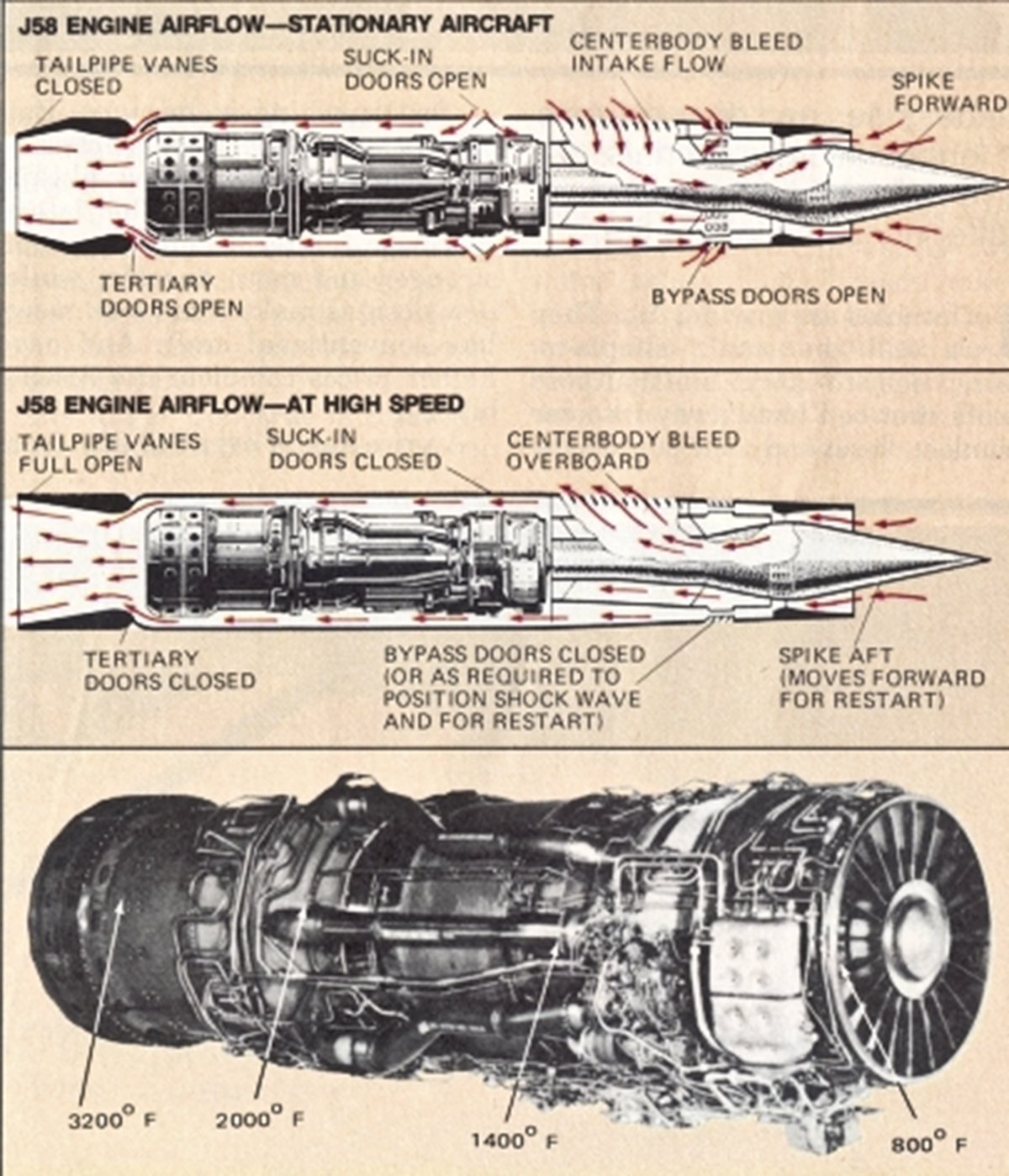
Here is a picture of the J58 engine. When the tertiary doors are open, air is entrained through them, adding mass flow to the engine. In theory, the extra mass flow gives extra thrust. But, the extra air flow was entrained by the core airflow, so in reality the conservation of energy probably means no extra thrust occurs, because you have a higher mass flow, but some of the velocity from the core flow has been transferred to the tertiary flow, so the average velocity will be lower.

(@John K almost got there when he mentioned “annular ejector thruster”.)

Penguin
  • 4,483
  • 18
  • 24
0

The underlying concept in the Dyson fan may be considered similar to that called: 'Trompe' (See Wikipedia), where a jet of water drags a flow of air. You can have a look in ESPACENET at Patents FR935340: 'Flow enhancer for jets and compressors'; US2946540: 'Jet propelled aircraft'; CA611861, for a 'Flying Disc', all by Henri Coanda, and US2918233: 'Aerodyne', by Alexander Lippisch, all in the same line, thus, I'd consider as best option to accept or reject Dyson fan as an alternative to propellers, ducted fan, or turbofans, conducting some experiments, with the design adapted to propulsion, not cooling or moving air, the Dyson fan data provided in a link in answer by JollyJoker is promising. Not?

The concept in Dyson fan was in some aircraft designs, the Avro Canada Flying Disc never went airborne and was uncontrolable, but the P Moeller disc m200x -

- flew with multiple fans, and was transposed into a toy named: 'Magic UFO', a variant drone.
See patents: US3065935, J Dubbury; GB383408, C E Johnson; US3022963, JCM Frost, showing the concept in Dyson fan was considered in Aircraft, calculations and experiments have the last word, but if an arrangement moves more air, meaning more mass, at similar speed, meaning more thrust, and this done with less power, men, you have an idea worth testing at airplane scale. Salut +
Urquiola
  • 1,631
  • 17
  • 21