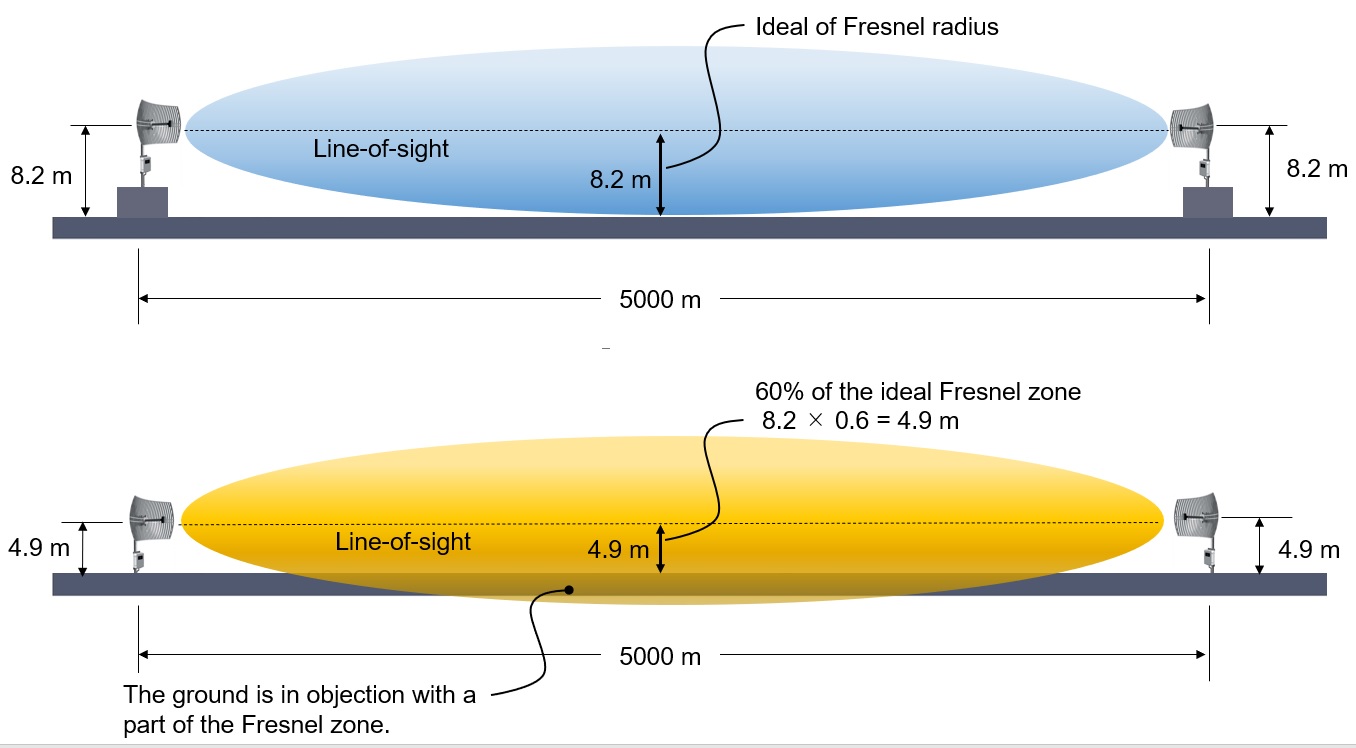
Line of sight calculation is based on earth radius and height above ground of transmitter (and receiver). R = 21000000 (21 million feet) approximately. Based on plane trigonometry, d squared = h * (2 * R + h). This is distance to horizon for an observer at height h above surface of radius R. If R >> h then a good approximation is:
d squared = 2 * R * h;
or
d = square root (2 * R) * square root (h)
and since R is essentially fixed, we can calculate it and are left with
d = 6480 * square root (h) = 6480 h^1/2
which gives d in feet.
Using another approximation 1nm (nautical mile) = 6076 feet
d = 1.07 h^1/2 (h in feet above surface, d in nautical miles)
or
d = 1.23 h^1/2 (h in feet above surface, d in statute miles)
So the well known formula: d = 1.25 h^1/2 is an approximation for the horizons range in statute miles when h is in feet.
The problem stated above is incomplete. You are left with some assumptions when attempting its solution.
1) are we to assume adequate TX power and RX sensitivity to reach?
2) are we limited only be line of sight (i.e direct line between TX and RX that does not penetrate the earths surface?)
3)Should we assume the airfield height to be the height of the surface under the aircraft and at essentially all points between the two?
If all these assumptions can be made (maybe there are more?) then the height of the aircraft above the ground is 1646 m = 5400 ft and d = 81 nm.
Note that if you assume the airfield to be 335 m above ground level you will get a drastically different answer to the line of sight range. With the aircraft at 1981 m (6500 ft) and the field at 335 m (1100 ft) then:
d1 (aircraft) = 89 ft and d2 (field) = 36 nm so d = d1 + d2 = 125nm.