I'm adding another answer to the good one already posted, only to mention some aspects relative to winds in altitude.
Groundspeed vs airspeed
You're talking about groundspeed, speed relative to the ground. But when an aircraft is not taking off or landing, this reference is meaningless.
Air rotates with Earth, meaning when there is no wind air already moves at Mach 1 at 45° of latitude, and is still at the poles, at sea level, a bit more at 10 km height. Adding 300 km/h is adding only 30% only.
Aircraft always fly in this moving air and what counts is the difference between air and the aircraft, what is called airspeed.
For the aircraft this makes no difference air is moving or not, exactly like the fact Earth is moving in space is meaningless for us if we are seated in our kitchen.
So to answer your question: There is no limit at all because there is no impact on the aircraft.
There is an exception for the takeoff and landing phases, where the aircraft depends both on air for being aloft, an the ground to accelerate or brake. If air is moving relatively to the ground, this must be managed, and there are limits, in particular for crosswind, and tailwind. These limits, which are quite small numbers, are defined by the operator, based on the maximum value demonstrated by the manufacturer, e.g. on the A330, Airbus demonstrated a crosswind of 32 kt and a tailwind of 10 kt, but some operator will limit it further.
Wind in altitude
There is a second aspect to your question: Storm wind velocities are given for sea level, but winds at 10 km are very different.
It happens Ciaran strong winds are the left over at sea level of higher currents at the tropopause (10/12 km): Sea this view of the winds at sea level:
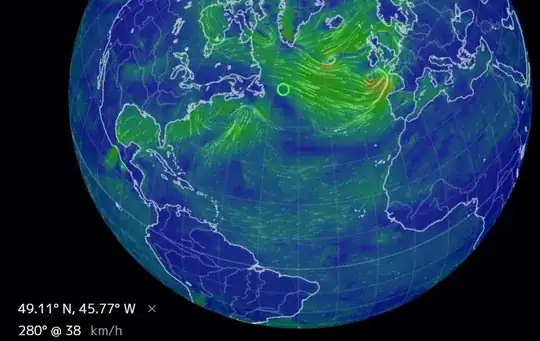
The storm is closing to the English channel, and now the rest of the Northern Atlantic is pretty calm at sea level. The location at the circle has now a wind of 38 km/h, but at an altitude of 10 km (250 hPa), winds are really different:

Now we have a wind of 325 km/h at the same place. These data and images are from earth.nullschool.net. So the question is what are winds in this area when there is no storm?
Jet stream
The answer is West-to-East winds are regularly at 200 km/h at cruise altitude, they form the jet stream around the North pole:
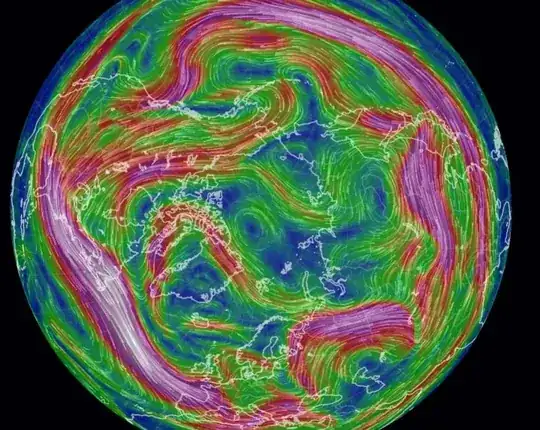
This pink/white oscillation denotes winds between 200 and 300 km/h at this time and this is pretty the same other days.


