This effect is really only substantial for swept wings.
Here is the lift distribution on an un-swept rectangular wing at 10deg AoA at 0 and 10 deg Beta.

Notice the general slight reduction in lift - but also the slight asymmetry introduced.
If you were to plot the wakes, they are pretty uninteresting. The 10deg Beta wake is essentially sheared 10deg to mostly align with the freestream.
However, let's look at the same wing with 20deg of sweep. If you draw some velocity diagrams, you'll find that the left and right wing seem to end up seeing substantially different angle of attack.

It is clear that the two half-wings are seeing very different flow situations. This results in a dramatically changed lift distribution for the two.

Notice the large change in lift distribution on the two wing halves. It is as if the right wing sees a higher angle of attack than the left wing.
The wake is the sheet of vorticity that trails behind a lifting surface. It is stronger at the wingtips than across the rest of the wing, but it exists everywhere there is circulation.
Edits:
It looks like I opened a can of worms with the angle of attack analogy.
I based my comment on foggy memories of a classical argument for a $C_{l,\Beta}$ derivative (dihedral effect, rolling moment wrt. sideslip) and how it depends on wing sweep angle.
For example, from: Etkin B. and Reid, L.D., "Dynamics of Flight; Stability and Control", Third Edition. John Wiley & Sons 1996.

quiet flyer -- My memory was wrong -- they make an argument based on velocity magnitude perpendicular to the wing -- not based on velocity triangles changing the local angle of attack. I think this tracks better with your understanding.
Interestingly, the dihedral effect due to dihedral is calculated with the velocity triangles I remember.
Amusingly, he goes on to make an argument about the oblique wing in this discussion...

Sophit - you're right, I read the OP's question without clicking on the link. So I was answering for actual swept wings.
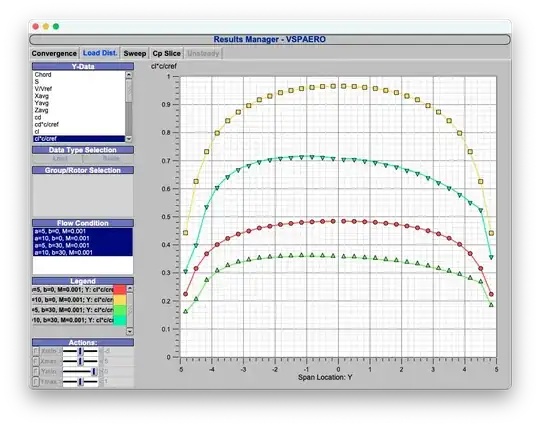
For Robert DiGiovanni, Here is a set of load distributions for the straight wing at 0,30 deg Beta and 5,10 Alpha.
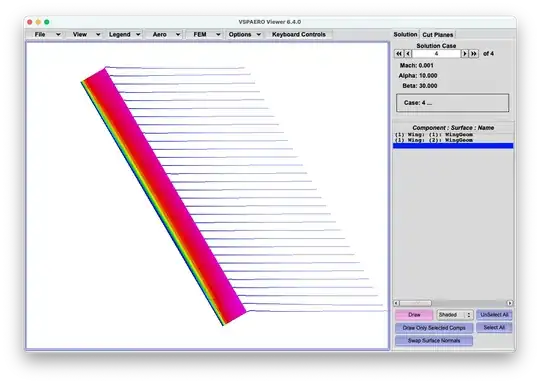
And the 30deg Beta, 10deg Alpha plot of delta Cp and the wake -- rotated about 30 degrees to make it look like an oblique wing.