I understand that many fighters use drogue parachutes and wheel brakes. But aren't there other methods of slowing down after touchdown?
Asked
Active
Viewed 3,306 times
9


-
1Arresting gear on aircraft carriers? – Ambo100 May 09 '15 at 15:34
-
1I meant on runways on land. – Madhav Sudarshan May 09 '15 at 15:38
-
1Arresting gear is sometimes used on short runways for fighter / jet training aircraft. – Ambo100 May 09 '15 at 15:41
-
1What about spoilers? – Madhav Sudarshan May 09 '15 at 15:41
-
3The primary purpose of spoilers is to dump lift so that there is more weight on the wheels and therefore better braking. Speed brakes might be used. – Simon May 09 '15 at 16:11
-
Arresting gear is used only in emergencies for non-carrier qualified aircraft as it places severe stresses on the aircraft and is likely to cause damage. Think of situations where an overpeed landing is required and the aircraft brakes can't stop the aircraft in time. – jwenting May 09 '15 at 20:35
-
2@jwenting The spelling in your comment is amusing and perhaps appropriate for some of the types of situations you describe. :) – reirab May 13 '15 at 03:34
2 Answers
15
The primary (and most effective) method to slow the jet down is aerobraking.

In the T-38 at ~130 knots full aft stick is applied at a rate that prevents the jet from becoming airborne again. The stick will be back towards the seat pan. Fly the nosewheel down to the runway at ~100 knots and apply wheel brakes.
In the F-16 the max aerobraking occurs at 13 AOA with speed brakes extended. You do not want to exceed 15 degrees of pitch angle to prevent scraping the burner can and speed brakes. The speed brakes will not fully extend while the nosewheel is not on the runway (however, it can be overridden but increases the possibility that the speed brakes will scrape).
In either case you do not want to let the nosewheel fall. You also do NOT apply wheel braking until the nosewheel is down.
7
Another way to slow fighter jets down, is by using airbrakes. These are basically two big flaps (usually located at the end of the aircraft) that extend into the flow. I think the airbrakes do most of the braking in the approach phase (as it is a good way to dissipate kinetic energy fast), but i'm pretty sure they're also used to slow down during the roll out.
Here's an image showing an F-16 landing with the airbrakes extended, the two protruding flaps at the end are the airbrakes.

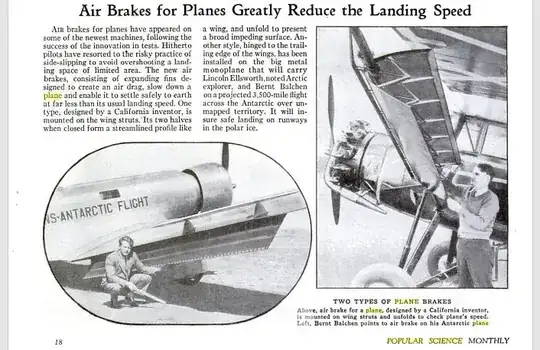
As a bonus, here's a picture of one of the first airbrakes in the book Popular Science (1932):

ROIMaison
- 7,157
- 2
- 37
- 78