22

I've read a lot of NTSB crash reports regarding small, GA aircraft (just trying to figure out what went wrong and what to avoid.) There seem to be a lot of reports that talk about "low altitude high speed stalls" (accelerated stall) happening on approach.

What is an accelerated stall, and how is it created? What is the best way to avoid one? As they seem to cause a lot of GA accidents...

Lnafziger
  • 58,886
  • 39
  • 242
  • 423
Jae Carr
  • 24,145
  • 38
  • 131
  • 228
  • Probably the most devastating example in the recent history is Air France 447. All it took at cruising speed is an unwarranted nose up input for a few seconds. Many factors went into that crash, but at the end of the effort the aircraft stalled out of the sky from 38,000 feet. After the stall, angle of attack was never corrected and maintained at 35 degrees until impact; all-the-while first officer applied TOGA power thinking that alone was gonna get them out of trouble. Very sad. – KORD4me Feb 12 '14 at 00:52
  • 5
    @user1599043 Actually, he held the nose up input for a lot longer than a few seconds and it gradually bled off airspeed. It wasn't really an accelerated stall, but more of a typical stall. Still sad.... – Lnafziger Feb 12 '14 at 01:53

1 Answers1

23

Short Version

An accelerated stall is a stall that occurs at an airspeed higher than normal due to a higher load factor (g loading).

Longer Version

When an aircraft is in a bank or when pulling back on the yoke quickly, the wing has to create additional lift to support the aircraft since the load factor has increased. This increases the angle of attack beyond the critical angle of attack (the point where the wings can no longer produce enough lift to support the airplane) and the airplane will stall even though it is above the normal stall speed for the airplane.
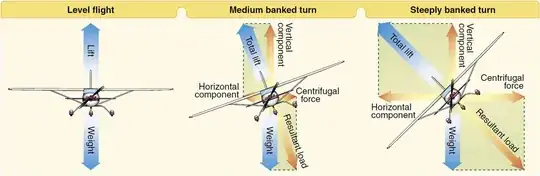
Load Factor Explained

Example

Let's say that we are flying an airplane that has a "normal" stall speed of 60 KIAS. If we start a 60 degree banked turn, this will increase the load factor on the airplane by two (2g) and will increase our stall speed by 41% to 85 KIAS.

Load Factor Chart

A fairly common cause of this type of accident is when a pilot overshoots the runway centerline during the turn from base to final and steepens the bank angle in order to "turn faster" to get back on final. Because the stall speed goes up, they can stall the airplane even though they normally never even come close at their current airspeed.

Instead, they should have just maintained the current bank angle that they had (instead of steepening it) and continued the turn back to re-intercept final using normal maneuvers. If that couldn't be done in the amount of altitude/distance available, then simply go around and come back to try again (while making the proper wind correction in the turns this time).

Lnafziger
  • 58,886
  • 39
  • 242
  • 423
  • Excellent, that makes perfect sense. That does sound like a lot of the cases I read. What was always odd about those cases is that it always seemed to be a pilot with ATP and a lot of hours... I wonder if flying large aircraft creates some different habits? Or perhaps a jet is less susceptible to high speed stalls on final? – Jae Carr Feb 11 '14 at 04:29
  • 3
    Well, maybe it is because there is a second person there in a jet to keep an eye on the flying pilot, or that they are normally flying an instrument procedure in the jet which usually keeps them out of that situation altogether.... – Lnafziger Feb 11 '14 at 04:38
  • Logical, I suppose. Granted, this is just my biased observation... – Jae Carr Feb 11 '14 at 04:41
  • 2
    @JayCarr: Also I believe large planes generally fly with higher margin to stall. The approach speed is 1.3×Vₛ (to be flown until threshold) and the heavy plane will lose a few knots during flare while small plane pilots are usually taught the stall warning should go off during flare, so they may leave themselves less margin. Plus there is nobody shouting "go around" at the private pilot when the speed decreases below the Vₐₚₚ. Pilots with more hours are often more prone to this because they are more confident, trust their estimates more and don't watch their speed as carefully. – Jan Hudec Feb 11 '14 at 20:52
  • @JanHudec- So...the moral of the story is to fly with a higher margin to stall further into the approach? – Jae Carr Feb 11 '14 at 20:55
  • 1
    @JayCarr: The trouble is that on unpaved or short runway you need to balance it with the need to land as slow as possible. So it's more like watch the speed carefully and be ready to go around if you find yourself under the profile. – Jan Hudec Feb 11 '14 at 21:09
  • Additional risk stems from the fact that in a turn you are more likely to be slightly uncoordinated and end up in a spin. – Jan Hudec Feb 11 '14 at 21:09
  • @JanHudec True, most jets have yaw dampers too and they keep you coordinated without pilot input. – Lnafziger Feb 11 '14 at 21:12
  • Another factor may be that jets keep power on almost all of the way to touch down and then bleed airspeed off relatively slowly. This is different than in a light airplane. – Lnafziger Feb 11 '14 at 21:13
  • @Lnafziger: Propeller-driven aircraft also keep power almost all the way to touch down exactly because they bleed airspeed of faster when power is retarded. They also respond almost immediately to increasing power setting (piston engine has weaker relation between rpm and power and turboprops always have constant-speed propellers to keep them at high N1 during approach), so they are easier to handle than jets. – Jan Hudec Feb 11 '14 at 21:50
  • @JanHudec They also respond almost immediately to power reductions (whereas jets don't) so my point was that when they reduce power in the prop airplane they will slow down faster than they are used to. And not all prop pilots keep power in on final (some prefer to always be within gliding distance of the runway). :-) – Lnafziger Feb 11 '14 at 22:13
  • @PeterKämpf Now that he has changed his question, I can do that. For the record, I didn't call it a high speed stall, that was the term that the OP used, and he probably used it as short-hand for a stall at a higher than normal airspeed (an accelerated stall). As far as giving it a different name, as I mentioned in my previous comment, I don't believe that "high speed stall" even has an actual definition, does it? I think that you are doing the same in your answer, but answering the wrong question... – Lnafziger Aug 05 '14 at 11:35
  • B-52 accelerated stall (warning: video shows a deadly airplane crash): https://youtu.be/182AepOJjMs – pr1268 Feb 25 '18 at 14:28