5

I know the pressure distribution on an airfoil but not shear stress. How is shear stress distributed on an airfoil?
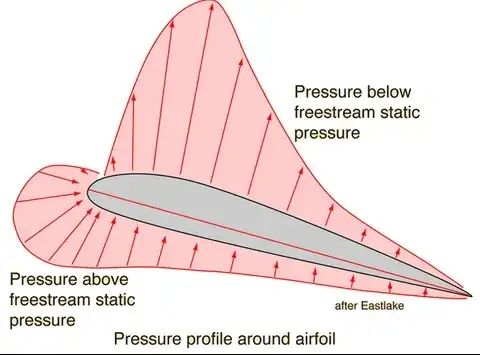
enter image description here

Federico
  • 32,559
  • 17
  • 136
  • 184
David Teahay
  • 2,885
  • 3
  • 27
  • 59

1 Answers1

3

Shear stress is proportional to the speed gradient at the wall. This means:

  1. A thin boundary layer produces more shear than a thick one. The boundary layer is thinnest right next to the stagnation point and grows in thickness downstream.
  2. A turbulent boundary layer will create much more shear stress than a laminar one. Most of the shear on an airfoil happens past the transition point.
  3. Higher speeds cause higher shear stresses. Therefore, the suction area on the upper side of the airfoil produces more shear stress than the pressure area on the lower side. In a separation bubble with speed reversal at the wall you will even get a small amount of "shear thrust".

The shear acts along the local flow direction, so it is mostly front-to-back. Only near the wingtips, where lateral flow becomes non-negligible, will a lateral shear component become noticeable.
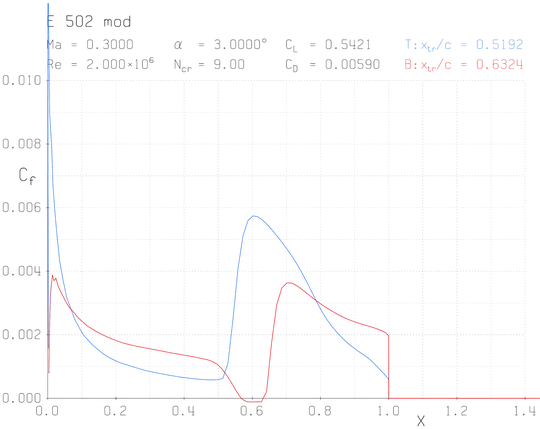
E502mod at 3° AoA, friction plot

Friction drag over chord for an E502mod airfoil at 3° AoA. Blue: Top surface, Red: Bottom surface. Source: XFOIL 6.97. The transition points are clearly visible: It is where shear shoots up again at mid-chord. Note the separation bubble ahead of the transition point on the bottom side: It is marked by negative values of shear.

Peter Kämpf
  • 231,832
  • 17
  • 588
  • 929
  • 1
    For clarification, @DavidTeahay this is the exact answer to the question as worded. But, at first read, I thought the question was more about the shear distribution over a wing. Shear and moments would be used for rib/spar configuration and sizing analyses. FYI. Sorry to bother if you already know the difference. ;) – Gürkan Çetin May 08 '18 at 17:47