When an Airplane starts to take off, the Horizontal velocity would generate it the necessary lift, and then Airplane pitches up to further increase the lift. As the Airplane is climbing up, the net vertical force on it should be the difference of lift and its own weight. When there is a resultant force, should not the climb rate be ever increasing? And when the Airplane reaches the desired height, I'm assuming - either the horizontal velocity is decreased or Airplane goes to normal state from Pitch-up position, basically balancing the lift with own weight. At this moment, Airplane has some vertical speed right, So Isn't the Airplane supposed to be climbing up with a constant velocity, even after reaching desired rate, as Objects continue to move in the same velocity when there exists no force on them? How is this managed in Airliners?

-
1"Isn't the Airplane supposed to be climbing up with a constant velocity, [...] as Objects continue to move in the same velocity when there exists no force on them?" Lift and drag, thrust and weight are acting. Vertical speed (acceleration) can be cancelled varying lift factors: Angle of attack and speed. If speed is fixed, there is a possibility to change the angle of attack to adjust VS, and thrust to keep airspeed constant (or vice-versa, depending on the theory you prefer). See this for a start. – mins Jan 11 '19 at 10:03
-
1The stop to the climb as speed increases comes from changing the pitch of the elevator or stabilator, which controls the angle of the wing. Want to climb less? Raise the tail so the wing angle changes and creates less lift. Doesn't take much. Then use elevator/stabilator trim to hold it there after the desired speed is reached. Similar to reaching highway speed in a car - step on the gas to get to 65, then back off to hold it, step on it a little more to get up a hill and hold the speed, back off a little going down a hill and not accelerate wildly like an 18-wheeler gaining momentum. – CrossRoads Jan 11 '19 at 15:59
4 Answers
Vertical speed is managed, primarily, with controls.
Lift is proportional to square of speed and to angle of attack¹ and angle of attack can be adjusted using the elevators. Pilot, or automation, use those to control the flight path of the aircraft.
As the aircraft accelerates along the runway, at some point the pilot pulls on the control column, which turns the elevators up and the resulting downforce on the tail lifts the nose off the ground². That increases the angle of attack—because the aircraft is still moving horizontally—, lift exceeds weight and the aircraft accelerates upwards.
As it starts to accelerate upwards, the pilot eases the pull on the control column to prevent the aircraft pitching up further. And as the aircraft accelerates upward, the angle between direction it is flying and pitch—that is the angle of attack³—decreases again, until the forces get in balance. Then the aircraft is in steady climb.
When the aircraft reaches the top of climb, the pilot⁴ pushes on the control column. This causes the aircraft to pitch down, which reduces the angle of attack, and thus lift, and the aircraft starts to accelerate downward, that is slow down the climb. At the point the aircraft is moving horizontally, the control column is pushed back to get the forces back in balance.
Now for the details of operating the controls, the longitudinal stability comes into play. Aircraft are normally⁷ designed to be longitudinally stable. That means the aircraft will pitch up as its angle of attack decreases—which increases it again—and pitch down as its angle of attack increases—which decreases it again. Net result is that when the elevators are left alone, the aircraft will maintain specific angle of attack.
As the aircraft climbs, it will tend to slow down unless engine power is increased, because its potential energy increases and it will be taken from kinetic energy if the engines are not providing enough⁸. And as it will slow down, its lift will decrease, so its angle of attack will increase, but that will cause it to pitch down due to stability. The net result is that it will refuse to climb unless enough power is provided.
Similarly when it descends, it will tend to accelerate, because the potential energy will be converted to kinetic⁹ and that will increase lift, which will decrease the angle of attack and the stability will make the plane pitch up. So it will refuse to descent unless power is reduced.
So in the end, vertical speed is actually managed by thrust levers. Which is also much more easily proven from law of conservation of energy.
¹ Up to critical angle of attack, where stall occurs.
² This is called rotation.
³ Angle of attack is properly defined as angle between the relative wind and the chord line of the wing, but aircraft axis is often used in practice. This makes things simpler as you don't have to consider the angle of incidence—angle between the aircraft axis and wing chord—especially since many aircraft have twisted wings where the angle of incidence changes along the span.
⁴ Or more often the autopilot. While take-off is always flown manually, up above FL290⁵ use of autopilot is required as it gets too tiring and unreliable to maintain the altitude by hand with enough precision to ensure separation⁶.
⁵ Flight levels are defined by pressure corresponding to given altitude, in hundreds of feet, on a standard day. So FL290 is 29,000 ft, but more when it is warm and less when it is cold. The reason is that pressure can be measured easily and quite accurately and flying at sufficiently different pressures ensures the altitudes are also different.
⁶ Originally the minimum separation was 2,000 ft above 29,000 ft due to the lower accuracy of altimeters and lower accuracy of flying as the aircraft move faster in the thinner air up there. But because all the aircraft wouldn't fit up there with those separations, 1,000 ft was allowed provided the aircraft is flying on autopilot and has sufficiently accurate altimeter. This is called reduced vertical separation minima
⁷ Some fighters are intentionally designed as unstable, because it allows faster control response. All such aircraft have computerized controls that compensate this, otherwise it would be very tiring to fly.
⁸ Alternatively, consider that the lift vector is tilted aft, and thus has bigger aft component, which is drag. Physics always has multiple ways to analyse a situation.
⁹ The lift vector is tilted forward in descent, so there is some forward component that accelerates the aircraft.

- 56,247
- 12
- 155
- 268
-
The end of the question sounds like he's asking about momentum, i.e. if lift/thrust exert a constant force while climbing, and gravity and drag are roughly constant, why doesn't the plane keep accelerating upward? Also, when you level off, why doesn't momentum keep you climbing even after the four forces are equalized? – StephenS Jan 13 '19 at 20:39
-
@StephenS, the answer is looong, because I wasn't sure what is the actual point of confusion, but I still do believe I did address this point. – Jan Hudec Jan 13 '19 at 20:42
-
My gut tells me the (small) vertical momentum is somehow canceled by drag, but I am not quite seeing how to get there from your (excellent) discussion of pitch and lift. – StephenS Jan 13 '19 at 20:50
-
No, the vertical momentum is cancelled by moving the controls so that the lift is less than weight until all the vertical momentum is removed. That's what the fifth paragraph describes. – Jan Hudec Jan 13 '19 at 21:06
-
-
@StephenS in atmosphere, if an accelerating force is removed drag will slow movement to a stop in that direction. Same as when you make a banked turn. Vectors really help here. Picture rounding out from a climb. Lift now = weight (throttle is pulled back too). Drag will quickly lower the vertical velocity component. And so will gravity! It is rare to exactly level out perfectly straight, but as one rounds with elevator, reduces throttle, and trims for cruise at that altitude, they are operating the air craft as Jan says. – Robert DiGiovanni Jan 14 '19 at 00:42
-
@RobertDiGiovanni, drag is, by definition, the component along the relative wind, and therefore has nothing to do with this. Changes in flight path angle are due to changes in lift, the fact that both forces are part of the same physical phenomenon notwithstanding. Lift equals weight during steady climb (not really, it is a bit less, because there is also a component of thrust acting against weight), but it is strictly less when leveling off. – Jan Hudec Jan 14 '19 at 06:18
-
@Jan Hudec I recognize your experience here, but we went though this in detail before. A climbing aircraft has a vertical drag component. Tell me a rocket is not using thrust to overcome gravity AND drag at a given velocity! I was concerned people would think somehow AOA decreases in a climb. Don't need power on stalls, do we? Must monitor airspeed, and control it with pitch! But I do delight in the discussion, and greatly appreciate what I learn here. – Robert DiGiovanni Jan 14 '19 at 10:22
-
@Jan Hudec We look at the same thing a little differently sometimes. I take gravity as the universal reference force vector. Anything opposite is "lift". Considering "lift" as a perpendicular force relative to the aircraft only makes sense in discussion of the wing, but relative to the discussion of the complete aircraft all vertical components (including thrust and drag) need be considered. – Robert DiGiovanni Jan 14 '19 at 10:42
-
The real concern, even though we do momentarily increase AOA during rotation, is the mindset that increasing AOA will make us "climb" while taking off. Far better is to think "adding speed increases Iift". Much safer. – Robert DiGiovanni Jan 14 '19 at 11:02
-
@RobertDiGiovanni, a climbing aircraft does, indeed, have a vertical drag component. It is, however, parallel with the flight path (by definition; the parallel component is called drag and the perpendicular component is called lift), so it can't change that flight path. – Jan Hudec Jan 14 '19 at 12:16
-
@RobertDiGiovanni, I also don't agree that it ever makes sense to define lift as the vertical component. Besides being contrary to the standard definition, it makes things harder to analyse, not easier. – Jan Hudec Jan 14 '19 at 12:21
-
@Jan Hudec ok, so (one way of seeing it) relative to the gravity vector is the vertical drag component of the climbing aircraft. In translating the physics into SOPs for pilots (that are safe) I only hope to stress the importance of maintaining airspeed. Sort of like "hey, it's ok to increase your AOA to climb, as long as your airspeed is good". In reality, as we rotate to lift off, the plane continues to accelerate to Vy. The angle of climb at safe air speed depends on how much "rocket" we are. Thanks and good day! – Robert DiGiovanni Jan 14 '19 at 13:24
Here is a timeline of an airplane taking off and climbing to cruise:
- The airplane does its takeoff roll. During this phase, the upward force on the aircraft is equal to the weight of the aircraft. The vertical speed is zero. Initially, all of the upward force is produced by the landing gear.
- The airplane pitches up and begins a climb. During this phase (which lasts only a few seconds), the upward force is greater than the weight. The vertical speed is increasing.
- The airplane climbs steadily. During this phase, the upward force is approximately equal to the weight again. The vertical speed is positive, approximately constant.
- The airplane levels off. During this phase, the upward force is less than the weight. The vertical speed is decreasing.
- The airplane cruises at a constant altitude. During this phase, the upward force is equal to the weight. The vertical speed is zero.
To answer your specific questions:
When there is a resultant force, should not the climb rate be ever increasing?
That's right; as long as the upward force is greater than the weight. However, as long as an airplane's vertical speed is increasing, its angle of attack will automatically decrease, even if it maintains a constant pitch. So in practice, any time that the upward force is greater than the weight, it will quickly go back down until it's approximately equal to the weight again.
And when the Airplane reaches the desired height, I'm assuming - either the horizontal velocity is decreased or Airplane goes to normal state from Pitch-up position, ...
This part is correct. Generally, when the pilots decide that they're done climbing, they'll pitch down in order to stop the climb.
... basically balancing the lift with own weight.
This part is not correct. During the climb, upward force and weight are already balanced. The way that the pilots stop the climb is by temporarily making the upward force less than the weight.
I don't think pilots usually think about upward force and weight; the thought process is more like "I want to climb, so I'll pitch up" and "I want to stop climbing, so I'll pitch down". But "behind the scenes", what they're really doing is adjusting the upward force.
(You'll notice that I'm saying "upward force" instead of "lift". For the purposes of this topic, the difference isn't important, but there is a difference.)
At this moment, Airplane has some vertical speed right, So Isn't the Airplane supposed to be climbing up with a constant velocity, even after reaching desired rate, as Objects continue to move in the same velocity when there exists no force on them?
Your reasoning is correct. If the pilots want to keep the vertical speed constant, they will keep upward force equal to weight. When they want to start climbing, they'll make upward force greater than weight, and when they want to stop climbing, they'll make the upward force less than the weight.

- 5,771
- 1
- 31
- 58
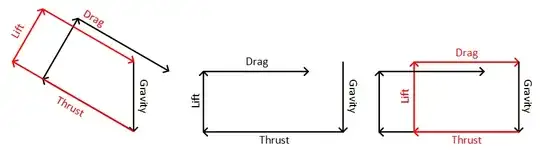
I find it helps to look at the force vectors:

(source: own work)
The left shows the forces conventionally, with the plane at the center. However, if we rearrange them as on the right, we can see that the forces are balanced. This means the plane is in unaccelerated flight.
If we pitch up to climb, this is what happens:
 ]
]
(source: own work)
The thrust, lift and drag vectors rotate with the plane, but gravity still points downward. On the right, we can see that the forces are no longer balanced, so the plane accelerates upward.
If we do nothing else to compensate:

(source: own work)
At left, the plane slows down, which will reduce lift and drag. The forces now balance, and the plane returns to unaccelerated flight.
At center, we complete our climb and pitch back down. However, the forces are again unbalanced, so the plane accelerates downward.
At right, the plane speeds up, which increases lift and drag. The forces now balance, and the plane returns to unaccelerated flight.
If we also adjust thrust, the results are slightly different:
(source: own work)
At left, we increase thrust to maintain speed, which will keep drag the same, but lift still decreases. The forces now balance, and the plane returns to unaccelerated flight.
At center, we complete our climb and pitch back down. However, the forces are again unbalanced, so the plane accelerates downward.
At right, we reduce thrust to maintain speed, which will keep drag the same, and lift increases. The forces now balance, and the plane returns to unaccelerated flight.
Summary: While there is acceleration at the top and bottom of the climb, there isn't during the climb itself, so vertical speed remains constant.

- 27,747
- 3
- 62
- 109
"Accelerate wildly like an 18 wheeler gaining momentum"? Now hold on there, just a second.
The crux of this question is balancing of forces. In atmosphere drag is what prevents any object from continuously accelerating. Drag will increase with velocity until its force is the same as the accelerating force. Now you have balanced forces at constant velocity.
Easiest example is the parachute. Without one your terminal velocity will be around 120 mph falling prone with arms and legs out. Even faster if you point straight down (less drag). The parachute provides much more drag, and requires only 15 mph to balance gravitational acceleration.
In 18 wheelers, we try to control our speed with dynamic braking (from engine) to avoid heating brakes. We also know doubling speed will heat brakes 4x faster as kinetic energy is proportional to the square of velocity. Also of note is the stopping distance is 4x greater as well. Speed control also serves one well in landing as the same kinetic energy will square with velocity. At 70 mph you have 36% more energy than at 60mph.

- 20,216
- 2
- 24
- 73
-
The je ne sais quoi of climb out is to hold Vy with pitch at full power. Watch that airspeed! – Robert DiGiovanni Jan 14 '19 at 11:21