5

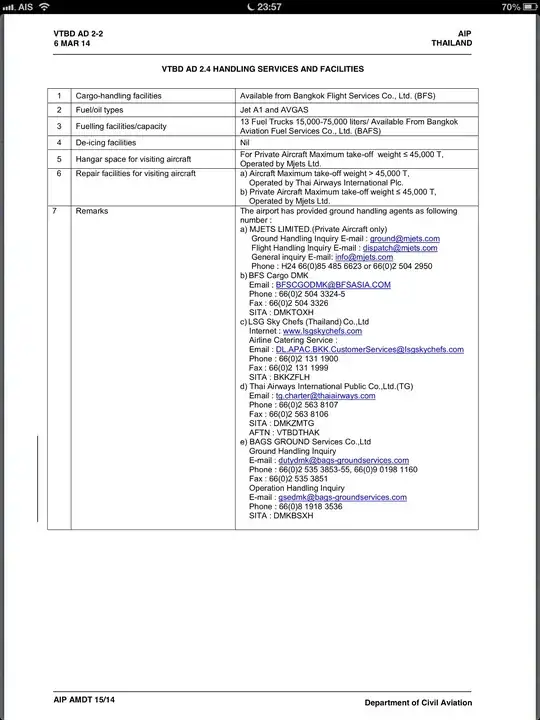
Image of document detailing handling services and facilities. One of the sections of the document refers to aircraft with maximum takeoff weight of >45,000 T

I got the attached document from http://www.aisthai.aviation.go.th/.

This document refers to aircraft with MTOW 45000T.

Is that 45000 tons? That's pretty heavy for me. Or am I interpreting the document incorrectly?

Steve V.
  • 23,246
  • 14
  • 99
  • 162
vasin1987
  • 8,128
  • 7
  • 44
  • 79
  • 8
    the abbreviation of a tonne is a small t it could mean [45k Tablespoons][http://en.wikipedia.org/wiki/Tablespoon) but that would be silly – ratchet freak Aug 01 '14 at 18:29

3 Answers3

7

It stands for metric tons, as indicated in the "GEN 2.1 Measuring system, aircraft markings, holidays" section of the AIP that you linked to as one of the units for mass.

That being said, the number format appears to be wrong and they most likely intended 45.000 metric tons, which works out to about 99,000 lbs. and is a somewhat common point to use for aircraft classification in other countries.

Lnafziger
  • 58,886
  • 39
  • 242
  • 423
  • 3
    My guess is that you're correct. Just for the heck of it I sent them an email asking for verification. I'll report back if they answer. – Terry Feb 21 '15 at 21:37
4

That is not 45000 but 45,000.

Seeing that the comma has been used for thousands in the fuel trucks capacity, it could be a copy-pasted typo.

Federico
  • 32,559
  • 17
  • 136
  • 184
  • 1
    Yeah but why comma and not decimal. Is it standardize? Any other reference? – vasin1987 Aug 01 '14 at 17:43
  • 11
    @vasin1987 in some countries the comma for decimals IS the standard. anyway, answer edited. – Federico Aug 01 '14 at 17:46
  • 1
    I wonder if the number is right, but the units are wrong? 45,000 tons sounds like a lot, but 45,000 kg or lbs is a lot more reasonable. – egid Aug 01 '14 at 20:17
  • I checked to see if this might be referring to tare weight but: a) I have never heard of tare weight being used in an aviation context; b) tare weight is the empty weight of an box or shipping container - possibly relevant to an aircraft, but a maximum empty weight limit? I don't think this concept has legs in this context; and c) the official abbreviation for tare weight is tw. This comment doesn't help find the answer, but it does help define what the answer is not! – Skip Miller Aug 01 '14 at 21:16
  • @egid that would be the typo I mean: a comma instead of a full stop (would be 45 tons) – Federico Aug 01 '14 at 21:58
  • but adding those extra digits is still strange, most of the time when a MTOW is displayed it's with 2 maybe 3 significant digits never 5 – ratchet freak Aug 02 '14 at 00:52
  • According to this entry, http://en.wikipedia.org/wiki/Decimal_mark

    Thailand officially uses the "point" as the decimal delimiter and the "comma" as the thousands separator. So there's either a typo or a reallllly big plane...

    – DJohnM Aug 02 '14 at 02:04
  • In English, 45,000 is 45000. – David Richerby Aug 02 '14 at 18:31
  • In the VFR flights section, they put 10 000 ft. No comma at all. /shrug – CGCampbell Feb 22 '15 at 12:56
  • Also, in the tables and codes section, all mass (weight) is either kilograms or metric ton. – CGCampbell Feb 22 '15 at 13:00
  • @CGCampbell so you agree with me that it could be a typo, or I misunderstood you? – Federico Feb 22 '15 at 13:06
  • @Federico yes, however I'm actually going through all of the addendums now – CGCampbell Feb 22 '15 at 13:12
3

They clearly can't have meant 45 thousand tonnes. Even the likes of the AN225 and the A380 are nowhere near that big.

In parts of continental europe they use the comma as a decimal seperator. All too often I see datasheets (I work in electronics) where the text is in english but the numbers are using european format. However the fact that there seems little reason to use three decimal places for a number like that and the fact they use , as a thousands seperator in the fuel section makes me think this probablly wasn't the source for the original error.

I suspect whoever wrote it somehow mixed up kilograms and tonnes and this may have been compounded on proofreading by the above issue of some countries using decimal commas.

Peter Green
  • 1,681
  • 12
  • 15