I have a question about the 707 Engine Inlet Doors, according to Wikipedia the Pratt & Whitney JT3D inlet doors purpose is to provide additional air. Is the thrust higher on more air intake? And why modern engines don't have it anymore?
I have a question about the 707 Engine Inlet Doors, according to Wikipedia the Pratt & Whitney JT3D inlet doors purpose is to provide additional air. Is the thrust higher on more air intake? And why modern engines don't have it anymore?


The intake speed at the compressor is between Mach 0.4 and Mach 0.5 and changes little with airspeed. That means that at low speed the intake has to suck in air from a wide capture area, (even from behind the inlet lip at low speed) while at high speed only the part that flows into the center of the intake is digested, while surrounding air will spill over the intake lip and flow around the nacelle.
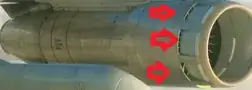
The surface that separates the flow going into the engine and that which does not is called the stagnation stream line or surface. This surface is way aft of the inlet lip at low speed, and the pressure near it is the highest (stagnation pressure). The challenge for the inlet designer is to design the lip with a rounded shape so that the flow going into the engine is uniform. It won't be if the lip is as shaped in the sketch. The high pressure on the outside and the low pressure inside the lip open the doors to admit a small percentage of the air to the engine inlet at low speed. As airplane speed increases, the stagnation point (or line) shifts to the lip itself and the pressure equalizes on the doors, closing them.

The fairly sharp intake lip of the JT3D will capture air rather inefficiently at low speeds (the topmost case in the sketch above), which could even lead to flow separation right after the intake lip, reducing mass flow and compressor efficiency. By adding the suction-activated doors, the intake can capture more air and keep the flow attached.
More recent intake designs have thicker intake lips, so the flow stays attached even at very low airspeed.
