1

As mentioned in this answer: https://drones.stackexchange.com/a/2564/5088

The leading edge of the tail should be lower than its trailing edge, providing some "down force" in flight.

I am confused why a down force is required, because I thought that it would not produce lift. Can somebody explain why the downforce is required?

3 Answers3

4

In conventional aircraft design, the tailplane usually provides a downforce to insure longitudinal stability around the pitch axis, which is also the Center of Gravity.

enter image description here

Photo Source

The center of gravity is forward of the main lifting service and the tail is well back providing a downward force.

In normal normal cruise, the two forces balance each other. If turbulence or some other force causes the nose to rise, the aircraft will start to slow, and the angle of attack will increase on the lifting wing, but decrease on the downward acting tai. This causes the less lift on the wing but also less downward force on the tailplane. This will then cause the nose to lower and return back to the cruise attitude.

If the nose should drop, the speed will increase, and the angle of attack will decrease on the wing, but increase on the downward acting tail. This causes more downward force on the tailplane, which will then cause the nose to raise back to the normal cruise attitude. This is called positive stability.

As you load the aircraft with a more rearward C of G, less downward force is required, and there will be less induced drag from the rear tailplane. This can give you less fuel consumption and better range.

If you move the C of G too far rearward, the tail will need to be trimmed to provide much less downforce, or even a upwards force. In this situation you will have negative stability because changes in speed and angle of attack will now have the opposite of the desired effect. Any decrease in speed and increase in angle of attack will cause the the nose to rise further, and any increase in speed and decrease in angle of attack, will cause the nose to drop further.

A rear C of G outside the normal limits can make the aircraft difficult to control or make recovery from a stall impossible.

Mike Sowsun
  • 37,747
  • 4
  • 122
  • 156
  • Please do not leave the impression that positive tail lift equals negative stability. This nonsense has been repeated much too often. – Peter Kämpf Jan 24 '23 at 12:04
  • 1
    In most conventional aircraft, the C of G is forward of the center of lift and the tail must provide downforce. An aircraft loaded with a C of G outside it’s rear limit will need positive lift, and it will have negative stability. Why is this nonsense? – Mike Sowsun Jan 24 '23 at 13:24
  • For you homebuilders out there, the tail trims the wing, the wing does the lifting. Be aware that wing center of pressure can move as AoA changes. Design tail accordingly. More info here. – Robert DiGiovanni Jan 24 '23 at 15:55
  • A good design will keep tail load small, negative at low AoA and positive at high AoA. This leaves the largest margin for control inputs. And positive tail lift can easily be combined with allowed cg limits - only at a forward cg position will the tail lift stay negative through the whole AoA range. – Peter Kämpf Jan 24 '23 at 18:51
  • Please modify your answer to make it clear that movement of the nose relative to the horizon, and a change in airspeed, are NOT the factors causing the instability. It is the change in *Angle of Attack* (AOA). If overall aircraft AOA momentarily increases (gust of wind or whatever), then the main wing AOA increases, increasing lift, and nose down moment, but the horizontal tail AOA (negative) is reduced ( less negative), reducing down force and reducing nose *UP* moment. Result? The aircraft overall moment is nose down, reducing AOA to where the moments are again in balance. – Charles Bretana Jan 25 '23 at 13:16
  • *That* is the essence of positive longitudinal stability. And it all happens as I described, as *AOA* changes, no matter whether the nose is up, down or sideways, and no matter whether the airspeed is increasing, decreasing, or stable. – Charles Bretana Jan 25 '23 at 13:19
  • @Charles Bretana Thanks for the added info. My knowledge of aerodynamics is mostly self-taught and it makes sense to me now that AOA is a much bigger factor than speed. – Mike Sowsun Jan 25 '23 at 15:12
  • Not only a bigger factor, the only factor. – Charles Bretana Jan 25 '23 at 23:47
2

Airplanes with conventional tails use the tail surface to "trim" the wing, to force it to operate at an angle to the airflow so that it produces lift, as well as provide stability via "weathervane effect".

Think of a weathervane on a barn, which points into wind. It's statically stable. I need to make it point into wind at an offset angle for some reason. So I'll "trim" the vane by bending the trailing edge over. As the wind shifts, the vane will point into it, but with some constant offset angle because of the trimming force applied by the bent trailing edge. If I bend the trailing edge more, it will point with an increasing offset angle. I could call this the vane's "angle of attack".

In an airplane I take this effect and rotate the axis 90 degrees, and because it's now a free body in space, the pivot axis becomes the center of mass of the entire thing. Absent any trimming force, my airplane merely becomes a very stable ballistic object, like a lawn dart.

The plane has static stability, it wants to point into wind, because the "pivot", the C of G, is ahead of the center of all of the aerodynamic forces acting vertically, including the fuselage, engine nacelles, and tail. Like the weathervane on a barn turned sideways, but as a free body in space, more of a lawn dart.

To make the "weathervane" actually fly along, resisting gravity to hold the thing up instead of arcing into the ground as a very stable lawn dart, you have to "trim" it to force it to align itself into the airflow with a positive angle on the wings. If you want the wings to lift up, you have to force it to operate the wings at a positive angle, and to make it operate at a positive angle, you have to apply a trimming force in the opposite direction back at the tail, like bending the trailing edge of the weathervane.

Which means, if you want the wings to lift up, the tail has to be generating a trimming force downward, and so the tail's local angle of attack will be negative in order to force the main wing to be aligned into the airflow at a positive angle. This is what it means by the reference to having the leading edge of the tail lower than the wing. This opposing force balance is needed to make the wing operate at an angle to the flow that holds everything up.

For the center of mass, as the effective pivot axis, it just has to be ahead the aerodynamic center of the whole thing, like a weathervane, to be statically stable. Center of mass position, if too far aft, kills the weathervaning effect (stability is neutral), or if far enough aft, flips the weathervaning effect around the wrong way (stability is negative).

So your model has to have two things to fly properly. If you turn it sideways and attach it to a pivot of some sort, and you locate the pivot at its center of mass, it needs to point into wind, whatever direction the wind is coming from. That confirms positive static stability. Then you need to configure the tail to "trim" it, so that when it aligns into the wind, it aligns with an offset so that the air hits the main wing at a positive angle. It will now achieve its stable state with the wing at a positive angle to the airflow. If you then hold it horizontally and throw it, it should fly, more or less.

John K
  • 130,987
  • 11
  • 286
  • 467
1
  • Short Answer: This is a result of making the aircraft stable in longitudinal axis.

Longitudinal Stability Basics

Nomenclature: $C_m$ is the pitching moment coefficient. Pitch-up moment is denoted by +ve $C_m$. Also, $α$ denotes Angle of Attack.

If the AC of a surface is ahead of CG, then that surface has a destabilizing contribution. This can be understood through this image:
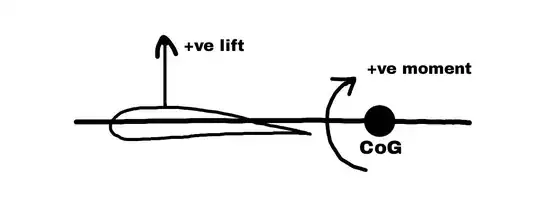
Image 1

A positive $∆α$ will produce a positive $∆C_m$ (pitch-up). This becomes a vicious cycle, since pitching-up will further increase the $α$ - that in turn will increase the $C_m$ further (greater pitch-up moment) and so on. Basically, the aerofoil will have a tendency to diverge away from equilibrium - on its own, it is statically unstable.

Likewise, if AC is behind CG, a positive $∆α$ produces a negative $∆C_m$ (pitch-down). Pitching down will reduce the $α$ - the aerofoil has a tendency to return back to its trim $α$ and is thus statically stable.

Making a stable aircraft

A conventional aircraft primarily has two surfaces that determine its longitudinal stability - the wing and the tail.²

  • Wing: Its contribution can either be stabilizing or destabilizing, depending on the position of CG relative to its AC.

  • Tail: Its contribution is always stabilizing, since CG is always ahead of tail AC.

Consider an aircraft with its wing AC ahead of aircraft CG. In that case, the wing has a destabilizing contribution.

Wing contribution: (destabilizing) $$\frac{dC_{m\ wing}}{dα} > 0$$

Tail contribution: (always stabilizing) $$\frac{dC_{m\ tail}}{dα} < 0$$

It is desirable to have a wing on an aeroplane, but a conventional wing on its own is unstable. To fix this, we add a tail.

Now, how do we ensure that the tail would be enough? It is necessary to ensure that the stabilizing contribution of tail is greater than the destabilizing contribution of wing:

$$ \left( \frac{dC_{m\ wing} + dC_{m\ tail}}{dα} \right) < 0 $$

This ensures that the aircraft as a whole is statically stable. But how is this achieved in practice? - By putting the CG ahead of the neutral point

CG position

Neutral point: This is the point on the longitudinal axis at which positioning the CG results in the aircraft having no tendency:

  • to return to the equilibrium (stability) and,

  • to diverge away from the equilibrium (instability).

If an aircraft with neutral stability is subjected to a disturbance that changes its $α$, then that will produce zero net $C_m$. This means that the aircraft will find itself in a new equilibrium, and will now maintain this new $α$.

At neutral point, wing's destabilizing moment is equal in magnitude to tail's stabilizing moment - that's why their combination is neutral.

If CG is moved ahead of the neutral point, the aircraft becomes stable. This is because:

  • Tail moment arm increases: This increases its stabilizing effect.

  • Wing moment arm reduces: In our example where wing AC is ahead of CG, wing arm reduces. This reduces its destabilizing effect.

Likewise, if CG is moved aft of the neutral point, the aircraft becomes unstable. This is because wing's unstable contribution increases and tail's stable contribution decreases.

Till now, we have considered an example where wing AC is ahead of CG. In practice, the stability required is usually so large that it can only be achieved by moving CG well ahead of wing AC. This is the configuration we see in most conventional aircraft.

Trimming the moments

With the aircraft in equilibrium at the neutral point:

  • the positive $C_{m\ wing}$ will be equal in magnitude to the negative $C_{m\ tail}$.

  • Also, a change in $α$ will produce proportional change in the $C_{m}$ of both the wing and the tail, such that no net change in pitching moment is produced.

Moving CG ahead of the NP reduces +ve wing moment and increases -ve tail moment. The combined result is a net -ve $C_{m}$. To trim that out, tail incidence must be reduced. This produces what is known as "longitudinal dihedral" or "decalage" or whatever you wish to call it.

  • Dihedral: Angle between two planes.

  • Longitudinal dihedral: Angle between wing and tail. More specifically, the difference between wing incidence and tail incidence. A positive LD is where wing incidence is greater than tail incidence.

For a longitudinally stable aircraft, trim will be obtained when the wing incidence is greater than tail incidence (positive dihedral). For an unstable aircraft, it's the opposite - wing incidence will be less than tail incidence at equilibrium (negative dihedral). For a neutral aircraft at equilibrium, wing incidence will equal tail incidence (no dihedral).¹

Finally, answer to the question:

As stated earlier, the amount of stability that most conventional aircraft require can only be produced by moving the CG well ahead of wing AC. However, this causes the wing to produce a negative $C_m$.

To trim this out, the tail has to produce a positive $C_m$, and to do that, it needs to produce a downforce. And it needs a negative incidence to produce that downforce.

Again, this dihedral (difference in incidence) is formed as a result of making the aircraft statically stable in pitch. That answer you linked to is referring to the fact that if the aircraft is stable, it will (generally) have this LD.

Note that simply creating a large longitudinal dihedral (giving the tail a negative incidence) won't produce stability, it's the other way around. Making a stable aircraft by moving the CG forward (and then trimming it) will produce a longitudinal dihedral as a byproduct.


¹ For simplicity, this entire paragraph ignores the fact that wing modifies the flow at tail (by inducing a downwash and reducing the dynamic pressure). In practice, the only thing guranteed for a stable aircraft in equilibrium is that lift-per-unit-area at wing will always be greater than that at the tail, which generally translates to wing incidence being greater than tail incidence.

² For simplicity, this answer only considers the contributions of wing and tail. Surfaces like fuselage and engine-nacelles etc. will have their own contribution (usually destabilizing).

Aditya Sharma
  • 3,336
  • 2
  • 10
  • 33
  • @sophit I stand corrected, I was wrong about longitudinal dihedral. LD is not what makes an aircraft stable, but it is the result of having a stable aircraft in equilibrium (trim). While LD can be used to analyse why $\left( \frac{dC_{m\ wing} + dC_{m\ tail}}{dα} \right) < 0$, it is not what makes that value zero. Conventional aircraft, canards and flying wings continue to have LD, but that's just the inevitable¹ byproduct of them being statically stable. LD is not what makes them stable, having CG ahead of neutral point does. (¹ignoring downwash!) Good day! – Aditya Sharma Jan 25 '23 at 10:30
  • 1
    I'm glad (I'm helped) you finally clarify this matter, better late than never And now it's also clear why that terminology is not to be found in any technical book: it helps (maybe) people understand the concept but it is no more correct than "equal transit time" Have a nice day you too – sophit Jan 25 '23 at 11:28
  • @sophit Kinda. They say flow acceleration causes low pressure, and incorrectly explain what causes acceleration. In reality, low pressure causes flow acceleration. I similarly stated that LD causes stability, whereas in reality, stability is what gives rise to LD. However, unlike equal transit theory, LD is a real phenomenon - the wing incidence is always greater than tail incidence. The concept isn't wrong, it's failure on my part to correctly understand this concept. Anyways, good day! – Aditya Sharma Jan 25 '23 at 11:50
  • 1
    You've got the point, that's the important thing – sophit Jan 25 '23 at 11:51