Following is an image of hyperconjugative effect. We can see a $\ce{\sigma}$-orbital delocalising electron pair with an empty $\ce{\pi^\ast}$-orbital.
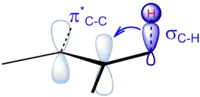
The explanation to your problem can be given by deciding whether the effect is "centralized" or "decentralized". Let me explain it by an example.
A quick scene:
Suppose, you and your friend is sitting across a boat ($\ce{C_{you}=C_{friend}}$) in the middle of a river, and both of you have to reach on either bank soon (a process similar to delocalization, probably). Assume the methyl groups to be oars you need to move across the river.
In $\ce{R2C_{you}=C_{friend}H2}$, both the oars are with you. So, only you can row the boat and hence both of you can reach to the bank soon. Technically, the $\ce{\beta-H}$'s are at one carbon, so the effect can happen only on it, hence "centralized" and super-fast.
But, in $\ce{RHC_{you}=C_{friend}HR}$, both of you have the oars. So, both of you can row the boat and therefore both of you will reach to either bank a bit later. Technically, the $\ce{\beta-H}$'s are distributed equally among the carbons, so the effect can happen on either side, hence "decentralized" and not as fast as in the previous case.
As per your concern on steric factors, you may know that "alkyl" is referred to a straight hydrocarbon chain, and it isn't as bulky as to create "steric hindrance".
I guess that makes some sense :)
EDIT: The above stuffs explains how is first isomer the most stable. I'd previously said that "steric effects" doesn't matter, but in case of cis and trans isomers, it matters and it's the only thing that differentiate them (along with polarity). Due to this, cis isomer is least stable among the three.
Reference table of $\ce{\Delta H^°_f}$: http://ursula.chem.yale.edu/~chem220/chem220js/STUDYAIDS/thermo/heats-formation.html#Alkenes (in #C = 4)


