4

Since the overlap increases with directional properties of orbital,

$$\ce{p - p > s - s > s - p}$$
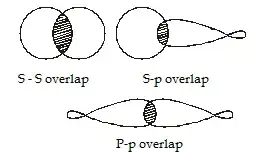
However it is also observed that the bond strength of

$$\ce{H-F > H-H > F-F}$$ $$\ce{\{s - p > s - s > p - p\}}$$

Why does this happen? I've done some research and found this which says that it may depend on the p orbital's alignment with inter-nuclear axis.

The reference doesn't seem to apply here, since all the above orbitals are aligned along the inter-nuclear axis.

What am I missing here?


Bond dissociation enthalpies:

$$\begin{array}\\ \ce{H-F} &&& \pu{568 kJ/mol} \\ \ce{H-H} &&& \pu{436 kJ/mol} \\ \ce{F-F} &&& \pu{157 kJ/mol} \\ \end{array} $$ Source

Martin - マーチン
  • 44,013
  • 13
  • 159
  • 319
newbie105
  • 397
  • 1
  • 13
  • It may have to do with the fact that HF bonds are partly covalent and ionic, increasing the bond strength by introducing more ionic character then the latter two bonds –  Oct 17 '20 at 02:53
  • @dval98 Quite possibly. But this was specifically mentioned as an application of VBT in my textbook. – newbie105 Oct 17 '20 at 03:15
  • I think if you look at HBr and HCl then the order is fine. It is just that the bond in HF has too high ionic nature. You don't need overlap between of anything between two opposite point charges, to bring it to an extreme. In other words these kind of rules are qualitative and should be taken within contexts. Note that even the graphics rendering is totally qualitative, a real overlap should consider non only the lobes but also the probability density within them, which brings Electronegativity into the discussion as well. Finally the argument is also used differently but to discuss the imp.. – Alchimista Oct 17 '20 at 12:12
  • ... the impact of hybridisation, like in a part of the thread you have linked. – Alchimista Oct 17 '20 at 12:13
  • 1
    @Alchimista so what you are saying is $\ce{ p - p > s - s > s - p }$ is not universal and the bond strength depends on other factors as well. So is it safe to say that VBT even fails to achieve what it was devised for? – newbie105 Oct 17 '20 at 12:38
  • 1
    @newbie105 I would say that I do not need valence bond theory to justify why a Cation and an Anion stick to each other. Newtownian mechanics works well when not out of scope. I do not see the reason for both generalisations you made. In other words you certainly need a covalent bond in H2 and F2. For HF that's not straight forward – Alchimista Oct 17 '20 at 17:36
  • You should read about hybridisation, if you're so hung on VBT. What you think about is total basics and somehow you think you can get with comparing letters stuff that needs a computer - yes, actual VBT is for computational chemistry. – Mithoron Oct 17 '20 at 17:59
  • 2
    The images often used for the 'phenomenological interpretation' of VBT are crap, and even if these orbitals existed and had such a shape they would be wrong. Also, with more overlap doesn't only come more 'attraction', but also more 'repulsion'. VBT as often applied in OC may provide a good starting point for descriptions, but it'll never be enough to shed actual light on the bonding patterns and is most likely not yielding the right description. Additionally $\ce{F2}$ is a molecule where there is still quite some debate about the bonding, some going as far as introducing new concepts. – Martin - マーチン Oct 21 '20 at 14:13

0 Answers0