11

Why is hydrated carbon dioxide - the predominant form of acid that one gets upon dissolution of carbon dioxide in solution - so unstable?

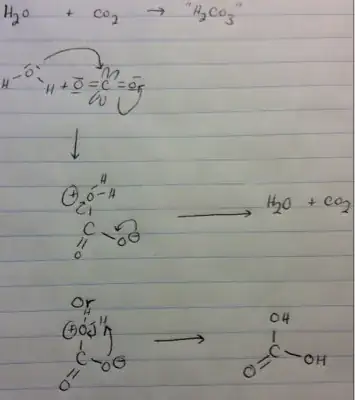
Is the below rationale valid?

  1. Carbon in carbon dioxide has two (empty? no, but still vulnerable to attack) p-orbitals and bears a strong partial positive charge.
  2. Oxygen's lone pair can attack an empty p-orbital and form a formal charge-separated complex with the carbon dioxide.
  3. This is "hydrated" carbon dioxide or "carbonic acid." This form is extremely unstable and subject to disproportionation due to an unfavorable charge and the unfavorable nature of charge separation itself. The change in entropy also favors the products of disproportionation.
  4. However, there exists a pathway to stability - that is - protonation of the oxygen with the negative formal charge by the oxygen bearing the positive formal charge.
  5. This, however, is akin to a forbidden fruit; the ephemeral three-membered ring that would have to be formed exhibits "ring strain" (if you object to this term, can you please elaborate on your objection), and as a result, disproportionation is overwhelmingly favored, especially from an entropic standpoint (reconstitution of carbon dioxide gas is highly entropically favorable).
enter image description here

Dissenter
  • 18,815
  • 49
  • 177
  • 341

2 Answers2

12

The situation is described by the following equilibrium $$\ce{H2O + CO2 <=> HO-CO-OH}$$ In a closed system, using Le Chatelier’s principle you can manipulate the equilibrium in either direction (e.g. pump in carbon dioxide and increase the concentration of carbonic acid, etc.). However in an open system, as carbon dioxide escapes, the amount of carbonic acid will decrease.

When all is said and done, water and carbon dioxide are two extremely stable molecules. Since $$\Delta G = -RT\ln K$$ Their stability is what drives the equilibrium to the left and why carbonic acid appears to be (relatively) so unstable.

ron
  • 84,691
  • 13
  • 231
  • 320
  • I had the same issue in class today; I don't see how we get from water and carbon dioxide to (HO)2CO directly. I think my proposed intermediate explains the instability; it is very hard to actually form (HO)2CO unless under pressure; only 0.4% of the CO2 pumped into water turns into actual carbonic acid or (HO)2CO at STP. The rest is in the charge separated form. – Dissenter Sep 08 '14 at 23:20
  • 3
    "I don't see how we get from water and carbon dioxide to (HO)2CO directly" Your scheme is correct, it's just another SN2 reaction of water and a carbonyl. – ron Sep 08 '14 at 23:24
  • SN2 but no leaving group? – Dissenter Sep 08 '14 at 23:36
  • 1
    After water reacts with one C=O, the oxygen in the remaining C=O (let's view the C=O as a two-membered ring) is the leaving group, more specifically, one of the two C=O bonds is the leaving group. The remaining C-O bond keeps the leaving group connected to the carbon. – ron Sep 08 '14 at 23:46
  • Okay, so I just need to generalize the very specific definition of SN2 presented to me in my textbook. – Dissenter Sep 09 '14 at 00:00
  • 4
    Yes. (but my comment needs to be at least 15 characters) – ron Sep 09 '14 at 00:04
  • Apart from the obvious nucleophilic attack a concerted [2+2] cycloaddition reaction can occur. (As for many cases one should not stretch the definition of SN2 too much, it is just a mathematical border case. True SN2 reactions may only happen in gas phase, never in solvent.) – Martin - マーチン Sep 09 '14 at 06:39
  • @Martin Three questions: 1) Would you also suggest that a Grignard reagent reacts with $\ce{CO_2}$ via a 2+2 cycloaddition? 2) Would you agree that diethyl carbonate reacts with water by an $\ce{S_{N}2}$ mechanism? 3) If so, where in the series (diethyl carbonate, ethylene carbonate, methylene carbonate [C2H2O3], carbon dioxide} might the mechanism switch to 2+2 and why? – ron Sep 09 '14 at 13:36
  • I am not sure, but it is certainly a possibility worth considering. In a Grignard the Mg is only very loosely bound to the C, so a usual nucleophilic attack might be more favourable. 2) I believe the most favourable path will be a nucleophilic attack. But again I cannot be sure. 3) I honestly have no idea. I would consider all pathways and then decide for the energetically most efficient. It will very much depend on the surrounding system. In condensed phase, there will be many factors influencing the actual mechanism. Usually you cannot observe mechanisms, so an educated guess has to do.
  • – Martin - マーチン Sep 09 '14 at 13:56