22

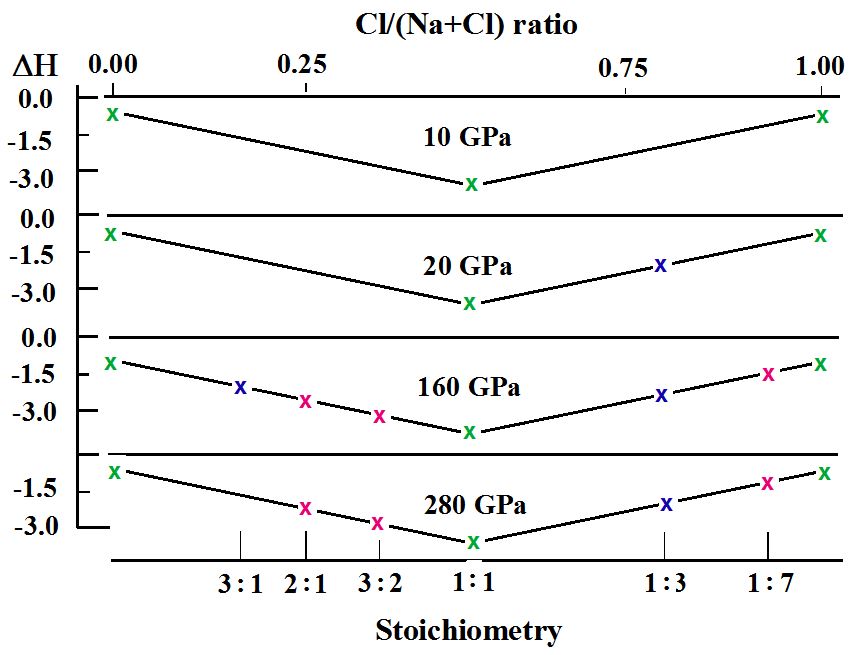
There. And there. Almost a year ago, a group of scientists claimed to have reached compounds of $\ce{Na}$ and $\ce{Cl}$ with weird stochiometries ($\ce{NaCl3, Na3Cl, NaCl7, Na3Cl2}$ and $\ce{Na2Cl}$).

What one of the articles says:

These compounds are thermodynamically stable and, once made, remain indefinitely; nothing will make them fall apart.

For example, $\ce{NaCl7, NaCl3, Na3Cl2}$, and $\ce{Na2Cl}$ are metals (that explains the apparent violation of electroneutrality since charge balance rules are inapplicable to metals), and only one semiconducting phase of $\ce{NaCl3}$ is stable in the pressure range between 250 and 480 thousand atmospheres.

At first, I thought this whole thing was bogus. But then, I faced another, apparently convincing, article and even one from RSC. Then the questions popped up:

  • Why does this happen? (Why is such a compound more thermodynamically stable at high pressure?)
  • How can the bonding in these be explained?

(Source)

M.A.R.
  • 10,576
  • 19
  • 71
  • 93

1 Answers1

17

Yes NaCl3 is possible.

Think of the more common iodine analog.

$\ce{KI + I2 -> KI3}$

For a comprehensive analysis see:

Unexpected stable stoichiometries of sodium chlorides

At 25-48 GPa, NaCl3 is stable in the Pnma structure, which has 4 formula units in the unit cell. Unlike all the other new phases predicted here (which are metallic), this phase is a semiconductor. Its structure (Fig. 2(B)) contains almost linear asymmetric Cl3 groups. Bader analysis (19) shows that the middle atom in the Cl3-group is nearly neutral, with most negative charge on the side atoms (Table 1) and the total charge of this anion group being ~-0.8. This result is reminiscent of well-known triiodides and azides with I3 - and N3 - ions, and of recent calculations on hypothetical H3 - ions (20), which were found to have charge configuration [H-0.81H+0.72H-0.81]-0.9. Pnma-NaCl3 still can be viewed as an octet compound, with covalent bonding within [Cl3]--groups and ionic bonding between Na+ and [Cl3]-. At 48 GPa, with the formation of a new phase of NaCl3, the octet rule breaks down.

This research group compressed chlorine gas between NaCl plates, while heating with lasers and observed formation of $\ce{NaCl3}$.

DavePhD
  • 40,570
  • 2
  • 85
  • 181
  • 1
    Aside: the "new" higher pressure NaCl3 is valence isoelectronic with the known intermetallic compound Cr3Si (NaCl3: 1+(3×7)=22 valence electrons, Cr3Si: 6+(3×4)=22). So the trichloride ions polymerize to make in effect an intermetallic compound! – Oscar Lanzi Jan 30 '23 at 13:38