8

Which allotrope of phosphorus is kinetically the most stable?

I ruled out white and yellow as being quite reactive.

Red and black allotropes are both polymeric and comparitively less reactive.

Black looks the most stable one thermodynamically. But kinetically, I have no idea whether it should be red or black.
The answer provided to me is Red.

(Relevant chat discussion)

Martin - マーチン
  • 44,013
  • 13
  • 159
  • 319
user223679
  • 702
  • 8
  • 16
  • IIRC, Black is the thermodynamically most stable and Red is kinetically most stable. The reasoning, however, eludes me. – Gokul May 19 '15 at 05:39
  • You can bookmark an entire conversation in chat, and link to it. I did it for you and inserted the link. – Martin - マーチン May 19 '15 at 06:37
  • 2
    Thermodynamic stability is easy to define, but kinetic stability is not that easy to define. I would consider what it means to be kinetically stable. – Zhe Mar 31 '17 at 17:29

1 Answers1

8

I think the key to this question lies in the understanding of the difference between thermodynamic and kinetic stability. In this post, I find Thomij's answer the most rigorous and enlightening.

From this you should learn, that the thermodynamically most stable allotrope corresponds to the global minimum on the potential energy surface, while a kinetically stable allotrope, i.e. hindered through an activation barrier, corresponds to local minimum. From this it can easily be seen, that the thermodynamically most stable allotrope is also the kinetically most stable allotrope. This is due to the fact, that the barriers for interconversion of the different allotropes always have to be higher for the most stable one.

In the following two dimensional case you see that the thermodynamically most stable, i.e. the global minimum, is surrounded by two local minima. It must always be true, that $E_\mathrm{a}(1\to2)<E_\mathrm{a}(2\to1)$ if $1$ is a local and $2$ is a global minimum. The same applies to the other case. If this was not true, then $2$ cannot be the global minimum and hence not the thermodynamically most stable modification.
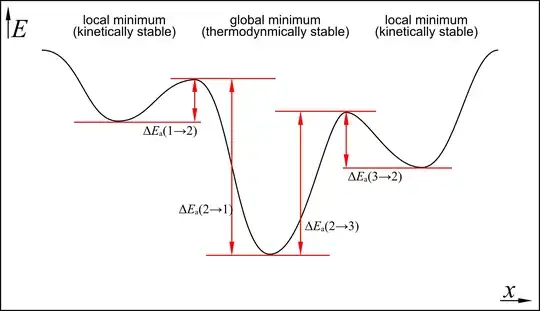
simple 2D potential energy surface

Having established that, it is therefore true, that black phosphorus is the thermodynamically and kinetically most stable form, see Hollemann-Wiberg, p. 680.

However, looking at a different reaction, the case might not be so simple any more. This is even true for different temperatures, as the following graphic will show (quoted from the linked book).

Hollemann Wiberg, p.680

Martin - マーチン
  • 44,013
  • 13
  • 159
  • 319
  • the thermodynamically most stable allotrope is also the kinetically most stable allotrope. Is this P specific? Since diamond/graphite doesn't show this. – user223679 May 20 '15 at 06:46
  • @user223679 What do you mean with diamond/graphite doesn't show this? This has to hold for any element/allotrope. If you are looking at different reactions and conditions, things might change, as kinetics is a function of those. – Martin - マーチン May 20 '15 at 06:52
  • I am unable to conclude from the graphic that black is the answer. The paragraph comments on the thermodynamic stability while the flowchart seems to say that 550-620 degrees is required to convert red, which seems to say red is kinetically stable. – user223679 May 20 '15 at 06:55
  • In response to your first comment, The classic textbook example is the conversion of diamond to graphite, which is thermodynamically favorable because the free energy of graphite is lower, but doesn't occur under ordinary conditions because the kinetics of the reaction (in the form of the immense activation energy required) are extremely unfavorable I meant this. – user223679 May 20 '15 at 06:58
  • Of course red is kinetically stable, but kinetics is the only reason that it is stable, it is still unstable with respect to black and violet phosphor. – Martin - マーチン May 20 '15 at 06:58
  • @user223679 Under normal conditions, diamond is kinetically stable and won't form graphite. It remains still less stable with respect to graphite. – Martin - マーチン May 20 '15 at 07:02
  • In response to your 2nd comment, so red is kinetically the most stable? it is still unstable with respect to black and violet phosphor. --> That seems to be unstability defined on the basis of thermodynamics and not kinetics. – user223679 May 20 '15 at 07:04
  • 3rd comment: Even in the case of P, under normal condition, wouldn't red be kinetically more stable, as your graphic's flowchart suggests that. – user223679 May 20 '15 at 07:08
  • This discussion ended in chat. Look here for the bookmarked conversation. – user223679 May 20 '15 at 19:05
  • @Martin-マーチン With regard to diamond, note that in the interconversion between graphite and diamond, assuming microscopic reversibility, the free energy barrier from graphite to diamond is higher than the reverse. Of course, graphite can under combustion much better, but again, it is not clear what "kinetic stability" even means... – Zhe Mar 31 '17 at 17:30