3

In the trans-hydroxylation of alkenes to give alcohols, there is a formation of epoxide.enter image description here

Does the reaction stop here if we don't add water?

Even though if we add water, why does the product depends on which medium the reaction is carried whether acidic or basic? My text says the ring opens differently for basic and acidic medium, but both finally gives us a trans-vicinal-diol.
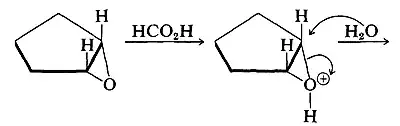
enter image description here

miyagi_do
  • 2,044
  • 5
  • 23
  • 40

1 Answers1

2

This answer has technically been given in the comments, but it bears repeating.

Yes, you can stop the reaction at the epoxide stage through careful choice of conditions. If you prevent both acidic and basic aquaeous environments, then epoxide rings are stable. They are present in a wide range of molecules and even in natural products such as epothilone.

You could also open epoxides with other nucleophiles to create different 1,2-substitution patterns — with predefined stereochemistry, if the epoxide was stereoselective.

And finally, there are even methods out there to turn vicinal diols into epoxides (usually via sulphonylation, e.g. to a tosylate followed by intramolecular $\mathrm{S_N}2$ reaction).

Jan
  • 67,989
  • 12
  • 201
  • 386