0

enter image description here Isn't this molecule achiral? I mean if I flip the mirror image on right by 180 degrees(like we do to determine chirality in tetrahedral carbons) it would be superimposeable? But apparently it is chiral. How am I flipping wrong?


EDIT I finally got the hang of it (I think). Are the images below correct?
enter image description here

Avyansh Katiyar
  • 5,534
  • 6
  • 29
  • 64
Polario
  • 450
  • 5
  • 10
  • 1
    This is a $\pu {3D}$ structure. So use of model would be very helpful to see the difference. – Mathew Mahindaratne Mar 31 '18 at 20:00
  • http://www.chemtube3d.com/TM-Ru(en)3enantiomers.html it shows here but I still cannot understand :( – Polario Mar 31 '18 at 20:11
  • 1
    @yashasvigrover can't you attempt to rotate them in the link and see that they can't align. – Tyberius Mar 31 '18 at 20:16
  • Check edit please – Polario Mar 31 '18 at 21:45
  • I know it is optically inactive I just needed to know where I was wrong?Also it does not address the superimposeable mirror age aspect of the question which essentially the crux of the question? @mithoron – Polario Mar 31 '18 at 22:51
  • "I mean if I flip the mirror image on right by 180 degrees" when checking chirality, you don't flip the mirror image! You just check the superimposition of the mirror image and the original molecule. The mirror image was already obtained by flipping the original molecule, a second flip will always make it identical. – Gaurang Tandon Apr 01 '18 at 01:07
  • No it won't.You can rotate the mirror image as you want because if it is a separate molecule,it won't superimpose.Take your hand for example,it won't superimpose no matter what you do – Polario Apr 01 '18 at 01:17
  • This interactive image of $\ce{[Fe(en)3]^{3+}}$ might help you understand: https://chemapps.stolaf.edu/jmol/jmol.php?model=N1CCN[Fe3+]123(NCCN2)NCCN3 – Pritt says Reinstate Monica Apr 02 '18 at 17:26

1 Answers1

3

See following image:
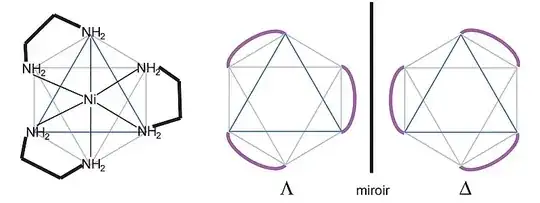
Look at the purple loop (en) on upper left hand side structure. Now, if you rotate the whole molecule ${90^o}$ clockwise around an axis going through top $\ce {NH2}$- $\ce {Ni}$-bottom $\ce {NH2}$, you will get that loop overlapping on similar loop on the mirror image. But, now look what happens to the other two loops? They are not overlapping on other two loops on mirror image. For example, the purple loop on bottom of left hand side structure will move to back side of the same side (it would be ${180^o}$ far from similar loop in the mirror image). Thus this molecule would not superimpose with its mirror image.

Mithoron
  • 4,546
  • 14
  • 40
  • 61
Mathew Mahindaratne
  • 39,943
  • 27
  • 55
  • 107