12

Let us for simplicity discuss RHF formalism. For $2n$-electron system we have $n$ Hartree-Fock equations written for $n$ spatial orbitals $\{ \phi_{k} \}_{k=1}^{n}$ $$ \newcommand{\mat}[1]{\boldsymbol{\mathbf{#1}}} $$ \begin{equation} \hat{F}(1) \phi_{k}(1) = \varepsilon_{k} \phi_{k}(1) \, , \quad k = 1, 2, \dotsc, n \, . \end{equation} Once we introduce finite basis $\{ \chi_{q} \}_{q=1}^{m}$ and express spatial orbitals as a linear combination of basis functions $\chi_{q}$ \begin{equation} \phi_{k}(1) = \sum\limits_{q=1}^{m} c_{qk} \chi_{q}(1) \, , \quad k = 1, 2, \dotsc, n \, . \end{equation} we end up with $n$ Roothaan–Hall equations \begin{equation} \sum\limits_{q=1}^{m} F_{pq} c_{qk} = \varepsilon_{k} \sum\limits_{q=1}^{m} S_{pq} c_{qk} \, , \quad k = 1, 2, \dotsc, n \, , \end{equation} which can be rewritten in the following matrix form \begin{equation} \mat{F} \mat{c}_{k} = \varepsilon_{k} \mat{S} \mat{c}_{k} \quad k = 1, 2, \dotsc, n \, . \end{equation} The Fock matrix $\mat{F}$ and the overlap matrix $\mat{S}$ are both $m \times m$ square matrices, $\mat{c}_{k}$ is a column $m \times 1$ matrix, $\varepsilon_{k}$ is just a scalar value.
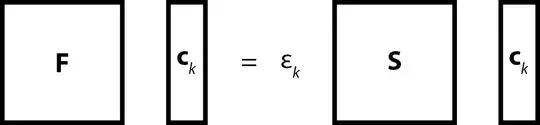
enter image description here

We can then collecl all $n$ $\mat{c}_{k}$ column $m \times 1$ matrices into one $m \times n$ matrix $\mat{C}$ and all $n$ values $\varepsilon_{k}$ into $n \times n$ square matrix $\mat{\varepsilon}$ \begin{equation} \mat{F} \mat{C} = \mat{S} \mat{C} \mat{\varepsilon} \, . \end{equation}

enter image description here

In practice, however, we extend both $\mat{C}$ and $\mat{\varepsilon}$ to $m \times m$ matrices from $m \times n$ and $n \times n$ respectively, which results in having $m-n$ virtual (unoccupied) orbitals.

Taking into account that virtual orbitals are even more unphysical than their occupied counterparts the question is what is the point of such extension of $\mat{C}$ and $\mat{\varepsilon}$? Why do not we just leave them of $m \times n$ and $n \times n$ sizes respectively?

Wildcat
  • 19,049
  • 2
  • 77
  • 107
  • 5
    Virtual orbitals are automatically 'given' by the solved eigenvalue equations. These orbitals are important for some post-HF methods such as CI and perturbation theory. – LordStryker Sep 11 '14 at 13:04
  • Indeed, I'd just give that as the answer. If you think about a simple atomic orbital picture (i.e., a minimal basis) there's a conservation of orbitals when you compute the MOs. Since there are typically two electrons per occupied orbital, there will be unoccupied virtual orbitals. – Geoff Hutchison Sep 11 '14 at 22:35
  • @GeoffHutchison That is absolutely true (even for larger basis sets). See also http://chemistry.stackexchange.com/a/15117/4945 – Martin - マーチン Sep 12 '14 at 13:25
  • @GeoffHutchison, yes, the question is about why do we expand the matrices. I understand that we can do it, but not have to. At least for HF itself. – Wildcat Sep 12 '14 at 13:42
  • @Martin, in answer which you linked you said: "the dimension of the involved matrices have to be the same". But that is wrong, as far as I understand, since they do not have to. You can extend matrices of coofficient and orbital energies to $m \times m$ size where $m$ is the number of basis functions, but you do not have to do so. $m \times n$ matrix of coeeficient and $n \times n$ matrix of orbital energies where $n$ is half of the number of electrons would do the job. – Wildcat Sep 12 '14 at 13:46
  • 5
    The unitary transformation to form the canonical orbitals guarantees that you have a diagonal $\mathbb{F}$ matrix, and all of them are interdependent on their own solution (pseudo eigenwert), this means they are also dependent on the virtual orbitals. Hence for every function you plug into the formalism you get a molecular orbital. – Martin - マーチン Sep 12 '14 at 14:21
  • It's worth pointing out that some solid-state DFT codes do not provide all virtual orbitals by default because there are so many of them and the code therefore uses different methods for the diagonalization. This is more of a technical reason, though. At any rate, one cannot focus solely on the initially occupied orbitals since the inital guess may be bad for the system under consideration. Therefore, one wants to have all orbitals available such that the iterations may switch occupation to the appropriate ones. – TAR86 Jan 11 '19 at 05:56

1 Answers1

8

Virtual orbitals are automatically 'given' by the solved eigenvalue equations and are necessary for solving said equations. These orbitals are important for some post-HF methods such as CI and perturbation theory and coupled-cluster theory.

LordStryker
  • 4,629
  • 1
  • 40
  • 61