28

I understand that molecular dipoles are electric dipoles. And electric dipole moment vectors point from the negative to the positive charge.

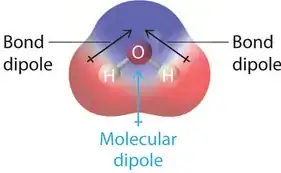
In class we learned to draw these special molecular dipole arrows (with a "plus" at the beginning) that point from the positive to the negative partial charge. I also see these arrows all over the internet, e.g.:

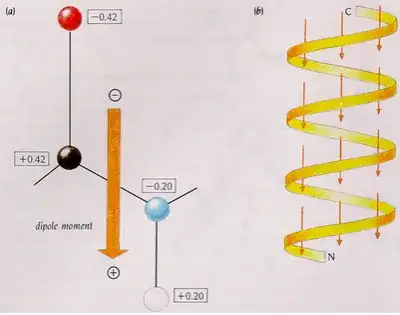
But for alpha-helices, the dipole moment points from the C to the N terminus. And the detail always shows the arrow pointing from the oxygen (negative) to the hydrogen (positive):

Should I just accept that even though an alpha-helix is a molecule like water, the "standard" way to draw its molecular dipole arrow is in the opposite direction than what people normally draw for water and other small molecules?

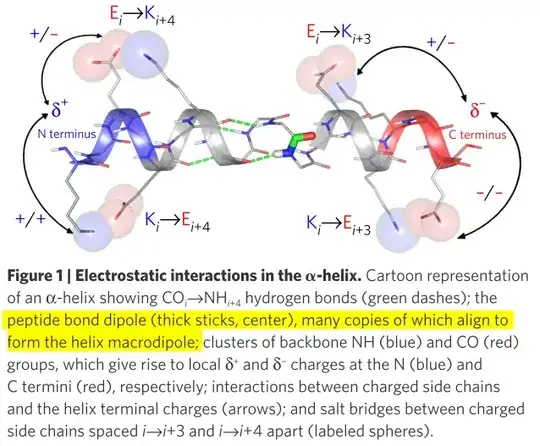
Edit: Another image, from a recent publication, but without macro-dipole arrow...:

enter image description here

Reto Höhener
  • 627
  • 2
  • 9
  • 16
  • Are you talking about alpha helices in membranes or in protein cores? Either way it has been a while since the polarity was described as going from C to N. – James Jun 22 '15 at 20:19
  • Any alpha helix I guess. – Reto Höhener Jun 22 '15 at 20:23
  • 1
    The O to H in the backbone will be massively irrelevant compared to polar or charged amino acids, or non-polar (hydrophobic) residue r groups. In structural biology you don't worry about the backbone charge direction as it will not affect the iso/leucine and polar groups that form the "surface" of the helix. I guess this question is confusing without any context. Could you cite the origin of the images? – James Jun 22 '15 at 20:31
  • The images were just the first that came up when googling for "molecular dipole" and "alpha helix dipole". We have this exercise where something about alpha helix stability is argued with the helix macro dipole. – Reto Höhener Jun 22 '15 at 20:43
  • The more "alpha helix dipole" google images I look at, the more confused I get. Everybody seems to have a different idea. And wikipedia says that there is some controversy about the alpha helix macro dipole, but doesn't give a direction. – Reto Höhener Jun 22 '15 at 20:50
  • 3
    The direction of the arrow is just a convention. Apparently no hard rule exists for denoting the dipole moment of alpha helices. What is important is that you know that the C-terminus is partially negative and the N-terminus is partially positive. I guess it's also important to know which way your teacher wants the arrow drawn. – canadianer Jun 22 '15 at 21:38
  • 1
    Dipole moment is a vector. The molecular dipole moment that you are talking about is the net dipole moment i.e. sum (vector addition) of all bond dipole moments. Like all vectors, dipole moment has direction. When you say there is a dipole moment from C-terminus to N-terminus you are thinking of protein as a linear molecule, ignoring the tertiary structure. The net dipole moment of the protein will depend on the tertiary structure and the side chains. If this comment necessarily answers your question then I'll convert it as answer. – WYSIWYG Jun 23 '15 at 03:43
  • @WYSIWYG thanks. my question is: why do people draw the macro/net/sum dipole of a linear alpha helix from negative to positive, but for a water molecule they draw it from positive to negative. – Reto Höhener Jun 23 '15 at 09:57
  • 3
    @Zalumon Electrical dipole moment is always negative to positive. See here. I am not sure why in chemistry a reversed direction is used for molecules. Perhaps because they want to denote the direction of electron cloud density. This seems to be a case of conflict of semantics. It is better to ask this question in Chemistry-SE. – WYSIWYG Jun 23 '15 at 12:32
  • 4
    http://www.av8n.com/physics/electric-dipole.htm#sec-mutations –  Jun 29 '15 at 15:08
  • 1
    @Loong You can add that as an answer and you can claim the bounty too (a petty 50 points, but I don't have much to spare here) – WYSIWYG Jun 30 '15 at 11:21
  • 1
    http://scienceline.ucsb.edu/getkey.php?key=2477 – user3786990 Jul 02 '15 at 00:59
  • I think your problem is the difference between the chemist and physicist notation of dipoles / polarization: they use opposite definition, and most of them not aware. So there might be big mix-ups in the references, if you are not careful. – Greg Dec 22 '15 at 06:39

2 Answers2

14

I (accidentally) stumbled upon the following statement in Atkins' "Elements of Physical Chemistry" (p378):

We represent dipole moments by an arrow with a length proportional to $\pmb{\mu}$ and pointing from the negative charge to the positive charge (1). (Be careful with this convention: for historical reasons the opposite convention is still widely used.)

Unfortunately he does not go into more detail. And I know this does not really answer your question.

The definition from the IUPAC is the same as the one used by Atkins:

electric dipole moment, $\mathbf{p}$
Vector quantity, the vector product of which with the electric field strength, $\mathbf{E}$, of a homogeneous field is equal to the torque. $\mathbf{T} = \mathbf{p} \times \mathbf{E}$. The direction of the dipole moment is from the negative to the positive charge.

The source quoted there is from 1993, so you can probably understand my surprise, when I did a little more searching and found in C. Párkányi's "Theoretical Organic Chemistry" (1997, p239):

[...] in organic chemistry the positive direction of the dipole moment is normally defined as the direction from the center of the positive charge towards the center of the negative charge. This convention prevails in physical organic chemistry and in inorganic chemistry. However, while the dipole still points from the positive charge to the negative charge, in physical chemistry and in chemical physics the positive direction of the dipole moment is defined in the opposite way, i.e., from the negative charge to the positive charge.

There are also a few sources given, but I currently have not enough time to look them up. I find this statement (definition) highly confusing and it also does not give another reason why this is the direction it uses. Please forgive me for not going into more detail here, I really don't want to add any more to the confusion.

Conclusion
Don't add to the confusion. Use $$\huge\ominus \overset{\mathbf{p}}{\longrightarrow}\oplus$$ as your definition from now on. Popular use does not make it right. Help using it consistently in the correct way and flush out the historic remnants that are still being taught. However, keep Atkins' warning in mind when you read books, paper, etc.. In the literature you will find both versions.


If anyone wants to argue with you about this, give the following derivation. The dipole moment operator $\mathbf{P}$ is a vector operator that is the sum of the position vectors $\mathbf{r}$ of all $N$ charged particles weighted with their charge $q$.[goldbook] $$\mathbf{P} = \sum_i^N q_i \mathbf{r}_i$$
For a molecule (neutral by definition) we find $$\begin{align} 0& =\sum_i^N q_i &\Leftrightarrow&& 0&=\sum_{i_+}^{N_+}q_{i_+} + \sum_{i_-}^{N_-}q_{i_-} &\Leftrightarrow&& \sum_{i_+}^{N_+}q_{i_+} &= - \sum_{i_-}^{N_-}q_{i_-} &. \end{align}$$ This can be transformed into $$\sum_{i_+}^{N_+}|q_{i_+}|\mathrm{e} = - \sum_{i_-}^{N_-}|q_{i_-}|(\mathrm{-e}).$$ Therefore we can write $$\begin{align} \mathbf{P} &= \sum_{i_+}^{N_+} q_{i_+} \mathbf{r}_{i_+} + \sum_{i_-}^{N_-} q_{i_-} \mathbf{r}_{i_-} &\Leftrightarrow&& \mathbf{P} &= \mathrm{e}\left( \sum_{i_+}^{N_+} |q_{i_+}| \mathbf{r}_{i_+} - \sum_{i_-}^{N_-} |q_{i_-}| \mathbf{r}_{i_-} \right)&. \end{align}$$ In the parenthesis the first term is a linear combination of vectors for all positive charges with the resulting vector $\mathbf{r}_+$ and the second term is a linear combination for all negative charges with the resulting vector $\mathbf{r}_-$. The dipole operator is therefore equivalent to $$\begin{align} \mathbf{P} &= \mathrm{e}\left(\mathbf{r}_{i_+} - \mathbf{r}_{i_-}\right), \end{align}$$
which is a linear combination of vectors that points from negative to positive.
Martin - マーチン
  • 44,013
  • 13
  • 159
  • 319
  • 3
    It is true, but not true in practice. Atkins and IUPAC may decide something, but majority of chemists use the chemist notations (including several theoreticians and many textbooks). – Greg Dec 22 '15 at 06:41
8

Let's take a simple case of a positive charge $q_+$ and a negative charge $q_-$ with $q_+ + q_- = 0$ placed along the $x$-axis at $x_+$ and $x_-$, respectively. The dipole at the $x=0$ is $$\mu=q_+x_+ + q_-x_- $$ which can be rewritten as $$\mu=q_+(x_+ -x_-) $$ which is a vector pointing from $x_-$ towards $x_+$. So this is the "natural" direction based on the definition of a dipole.

However, chemists a very concerned with the "flow" of electrons and electronegativity. So in the case of water we like to use the bond dipole to depict the "flow" of electrons from the $\ce{H}$ to the $\ce{O}$ due to the higher electronegativity of $\ce{O}$. So we tend to invert the direction of the dipole vector.

For this reason it is important to always define the direction of the dipole "arrow" in drawings to there is no confusion.

Jan Jensen
  • 4,819
  • 15
  • 28
  • 1
    Is the convention of reversed direction of dipole moment universally true for all cases. Is it defined like that somewhere (IUPAC) ? – WYSIWYG Jun 27 '15 at 12:52
  • Yes http://goldbook.iupac.org/E01929.html – Jan Jensen Jun 27 '15 at 13:06
  • 1
    It says that "The direction of the dipole moment is from the negative to the positive charge." Clearly contradicts the popular chemistry convention of positive to negative. – WYSIWYG Jun 27 '15 at 13:11
  • This does not really answer the question. Can you add some details on why chemists use a reversed direction of dipole? Please add a canonical reference for that if possible. – WYSIWYG Jun 28 '15 at 20:46