5

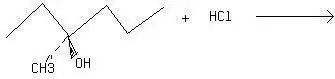
I know that $\ce{OH-}$ is usually a bad leaving group, but why does the following reaction occur via SN1 in presence of anhydrous $\ce{ZnCl2}$?
enter image description here

Mithoron
  • 4,546
  • 14
  • 40
  • 61
nilanjana
  • 863
  • 1
  • 9
  • 12
  • 3
    Is $\ce{HCl}$ really part of your reaction equation? Because if it is you have no problem with $\ce{HO-}$ as leaving group as $\ce{HCl}$ would protonate the hydroxyl group converting it into a good leaving group. – Philipp Aug 24 '13 at 17:32
  • I guess I'll make an answer out of my comment then :) – Philipp Aug 24 '13 at 19:31

1 Answers1

9

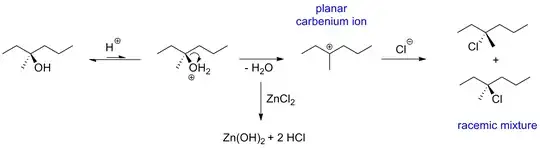
You are right, $\ce{OH-}$ is a bad leaving group. But the $\ce{HCl}$ in the reaction mixture protonates it. Thus, the bad leaving group $\ce{OH-}$ is converted to the good leaving group $\ce{H2O}$. Anhydrous $\ce{ZnCl2}$ might additionally facilitate the reaction by acting as a Lewis acid and it binds the expelled water thus preventing the back reaction.
enter image description here

Philipp
  • 17,748
  • 4
  • 79
  • 118
  • 1
    +1, good answer. I just want to make one minor point: since the mechanism is SN1 and the carbocation intermediate is planar, one should get a racemic mixture of products. The representation of stereochemistry is therefore somewhat inaccurate and misleading, I think. – Greg E. Aug 24 '13 at 20:10
  • 1
    @GregE. Oops, sorry. You are completely right. I answered a question about $\text{S}_{\text{N}}2$ four hours ago and seem to have mixed that in. I've corrected my answer. – Philipp Aug 24 '13 at 20:27
  • @Philipp How does ZnCl2 acts as lewis acid ? Does it uses it's empty 4s orbital? – Lalit Jan 26 '22 at 17:48
  • @Lalit https://chemistry.stackexchange.com/questions/14028/why-is-aluminium-chloride-a-lewis-acid-if-its-an-ionic-compound – Shub Jan 07 '23 at 15:42