Neutral MATTERS
I connected it to the house via an isolator switch, but this just doesn't work well at all. The three outputs measure at 230 each, (how is it 690?) but when I turn anything on, even low power devices, the output from the generator goes haywire, and the generator runs roughly, circuit breakers close, displays output of 280, 190, and 210 for example.
Because neutral is missing/not connecting/not wired. European homes are wired 230V phase to neutral and then with multiple phases. If neutral is not connected to the generator, then neutral will bounce all over the place.
Look. Thomas Edison fired Nikola Tesla because Edison did not understand how all this stuff works in 2-dimensional multiple phasing with AC power. I can barely explain it myself. However, Edison had a very good grasp on the simple 1-dimensional version of the same thing, and used it when wiring the USA for DC electric power, and that became our simpler split-phase system. So here it is.
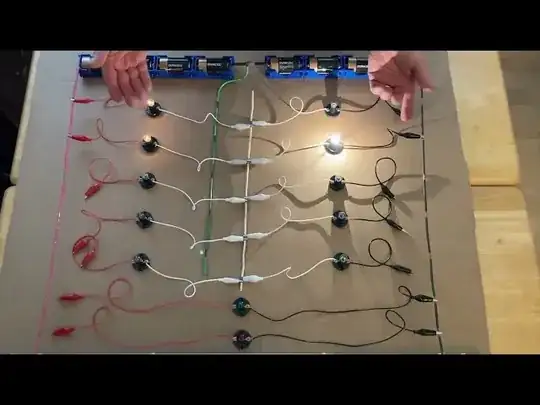
I love this video because the thumbnail says it all.
White = neutral.
Black and Red = 2 of the phases. (well there are only 2 phases in this system).
The red wire is POSITIVE 6 volts, and the neutral is 0 volts, and the black is NEGATIVE 6 volts. All the lights are 6 volts (except the bottom 2).
Think about what is happening here. Because the polarity is opposite, very little power flows on neutral (normally) - only the difference/imbalance current. This works very well, and that is why Thomas Edison used it.
But now, what happens if you LOSE THE NEUTRAL? If you have 2 lights on both sides, it is balanced already - and so the neutral does next to nothing. However, when the load is imbalanced, as in the thumbnail, crazy stuff starts to happen. The neutral voltage gets pulled to one side. And the video is all about that if you want to watch it.

In North America, everyone has split-phase 120/240V like this. All our lights are 120V but motors can be connected 240V. A "Lost Neutral" to a home is a regular occurrence, and it drives us crazy. However we are obsessed with putting earth spikes on everything, so neutral simply re-routes through the dirt, which means voltage difference is only 10-30% typically. People can go months without knowing they have a problem. This is no help with a generator, though.
The same thing is happening to you, in 3-phase.
The only real difference is that with AC power, we are able to manipulate phasing in a way that gives us functionally two dimensions. And that gives us Tesla's invention of 3-phase AC power, which took the world by storm (once someone figured it out). 3-phase comes in 2 flavors: "Wye" (for Y) and "Delta" (for the Greek letter Δ).
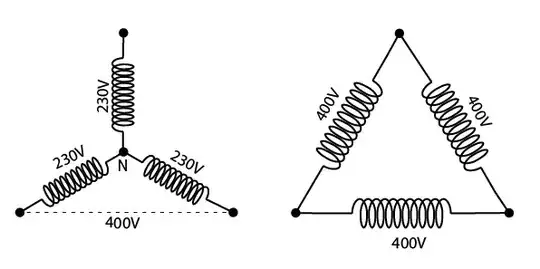
I am showing standard European voltages here. Notice how "wye" has 4 connections, but "delta" has only 3.
A very large motor takes only the corner connections and ignores neutral. However, every load in a residence - including your range/hob - is wired from one phase to neutral. Why? So the range/hob can work in a single-phase home.
Now, how does it work with 3 phases sharing one neutral wire? That is Tesla's genius. Tesla figured out that with AC power phased correctly and this type of "wye" wiring, neutral current will never exceed current of any one live wire. And so the neutral wire can be the same size as the live wires.
When a European single-phase customer loses neutral, their power just fails entirely. But when a 3-phase customer loses neutral, voltages go "bonkers" just as you expect them to. See what happens when you have all single-phase loads and lost neutral?
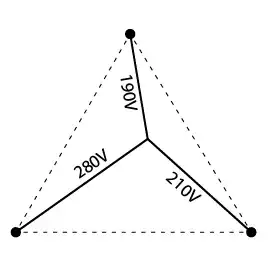
Nothing holds neutral in the middle. It just bangs around like a pinball based on the momentary loads on each phase.
So, you need to sort out your neutral wire on that generator. If it is able to provide neutral, you need to wire it and use it. If it is a "delta" generator incapable of providing neutral, then you will need to either get rid of it, or use balancing transformers to synthesize a neutral.
There's one other way to synthesize neutral
and I'm only suggesting this because you are on a war footing (because it's risky And Definitely Not Code). And also because you need heat. This technique will give it to you!
Remember in the above video where the disconnected neutral did not matter if both phases had equal load... And, the imbalance wasn't that bad if phases had near equal load... (E.G. 4 and 5 lights).
That works because the heavy loads are acting like a "resistor ladder". If you have lots of balanced load on all three phases, it will also act like a resistor ladder and keep neutral reasonably near the middle.
Ukraine has mostly nuclear and hydro so Ukraine uses a lot of electric resistive heating - baseboards, that kind of thing. Most of those are wired 230V live-neutral. So I assume they are very abundant. There are also plug-in space heaters, but those are a bit dangerous.
If you put 3 matched heaters, each of equal wattage, each connected from a phase to neutral -- that will act as a "resistor ladder" and will pull neutral toward the middle. The heaters can be combined, so say two 1500W heaters could be used on one phase, and a 2000+1000W heater used on a second phase, and a 2500+500W heater on the 3rd phase.
The heaters need to be the largest loads.
Further, the thermostats must be disabled. You can't have heaters turning on and off - they need to be on whenever the generator is on.


