5

I have a curved staircase where the treads and risers are embedded into the skirts. There is no center stringer. The underside is drywalled. I’ve tried to surface screw the front of the tread to each riser but there is both creak from the bottom corner AND it seems some boards have flex.

I considered pocket screwing the top tread to the back riser but I want to stain these and keep the carpet gone so that might make too much to fill. Any suggestions without tearing up drywall?

enter image description here

isherwood
  • 137,324
  • 8
  • 170
  • 404
Dan
  • 51
  • 1
  • 2
  • Can you provide a photo from the underneath the stairs. Also try and see where the flex (and therefore) creak is. They are either moving at the stringer or in the centre, rubbing against the riser. – Rohit Gupta Aug 08 '23 at 04:58
  • 3
    @RohitGupta He says explicitly that he doesn't have access underneath the stairs. – Kevin McKenzie Aug 08 '23 at 21:02
  • If they really are pocketed in the stringers, your path of least resistance is… from underneath. There will be shims you can just tap back into place. – Tetsujin Aug 09 '23 at 08:45

5 Answers5

7

Pocket-screwing along the risers to the upper and lower treads may help stop the squeaks, if you use enough pocket screws. If the treads and risers can pry apart enough to insert construction glue between the pieces before screwing, then that may help solidify the stairs even more.

To cover the holes, get 1/4" plywood in the wood species of your choice and cut/cover the front of the risers with the plywood. Careful measuring and cutting is a must, but if done well will give a clean surface for staining, with no filling of the pocket screw holes needed.

FWIW stain would never be able to fully hide filled pocket screw holes.

Frame challenge: Squeaky stairs do reveal that someone is walking on them, which may give that 3-AM burglar or those kids that should be in bed a bit of pause on meandering around your house.

Triplefault
  • 7,485
  • 1
  • 11
  • 34
5

You could try squeak-no-more screws...they snap off under the surface of the wood leaving a small hole. But you still have to screw into structure.

https://www.amazon.com/OBerry-Enterprises-3233-Squeek-More/dp/B0006IK8YE?th=1

enter image description here

Steve Wellens
  • 6,376
  • 1
  • 24
  • 39
  • 2
    There are a couple of brands of these, based on the same concept. The holes can of course be covered with appropriately colored wood putty. My main concern is that they're going to be unpleasant to deal with if you ever have to actually disassemble that connection. – keshlam Aug 08 '23 at 13:21
  • 1
    @keshlam, that's true of any good solution. I'd expect the next disassembly to be for demolition prior to rebuild. – isherwood Aug 08 '23 at 13:22
  • 2
    Probably true, @isherwood. And if a tread does want to be replaced, one can hole-drill around the sucker and get it out that way. It's just an elegance nitpick. – keshlam Aug 08 '23 at 15:20
5

An age-old idea for squeaky floorboards is squirt talcum powder where the offending pieces of wood meet. Never tried it, but it seems like a good, cheap, first move, before resorting to any other physical attempt.

Tim
  • 5,308
  • 11
  • 31
1

I had success with injecting normal PVA wood glue into the join between the riser and tread. After injecting the glue I jumped up and down on each step to help it work in, and topped it up.

This was a case of having not got round to fixing the squeak, and the carpet fitters being available sooner than expected leaving me with limited time.

The fitters were coming Monday, as I found out Saturday afternoon. I glued them just before bed on the Saturday night to allow the glue to dry in a stable position. One step needed a further application on the Sunday. That was a few years ago and they're still good.

As yours are intended to be visible, you'd probably want a dispensing syringe rather than the nozzle on the bottle.

Chris H
  • 6,616
  • 1
  • 16
  • 30
0

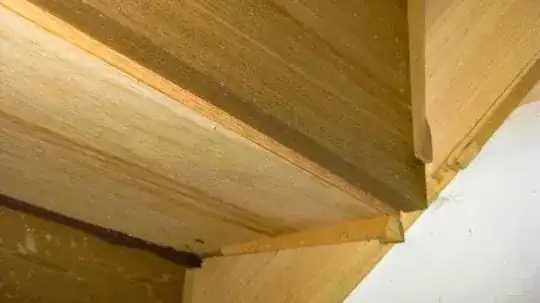
The point everyone seems to be missing is that if the treads are pocketed into the stringers, in the traditional style, then the pockets are not parallel top & bottom, they are slightly 'triangular' & shimmed from underneath.

This means that no amount of glueing & screwing from the top will prevent the rear of each tread from sinking with additional weight. By the time you've rammed enough screws in it to hold it still, you're never going to look good if you try to stain/varnish it.
Think pincushion.

The art of the traditional staircase is you can't see the nail-holes. It's all underneath. You trim it back to spec simply by tapping the shims tight again. Sure, these days it wouldn't go amiss to add some glue to that. You might even try screwing each riser to its lower tread, which would probably not have been done originally… ironically, to prevent squeaks.
Note the risers do not sit on the tread below, they hang behind.

Only photo I could find. Seems no-one wants to build them this way any more.
enter image description here

Tetsujin
  • 11,467
  • 1
  • 20
  • 40