0

I'm trying to fix an uncompleted installation of a two-way switch.

One switch, the light and all the wiring have been installed by someone else, with whom we can't have any contact soon.

I bought the second switch and tried to install it. I blindly tried different combinations and had those results:

  1. With some wire combinations, it didn't work at all.
  2. With some others, it worked 3/4 times, but in some positions, one switch didn't work until I reached the other one.
  3. When bridging all wires of the second switch together, the first switch controlled the lamp (ON/OFF) -- but I now doubt it, maybe some of them wasn't wired correctly?

In no case was it working fully as expected, but I didn't try all combinations.

I have a basic understanding of the way it should work when everything is wired correctly.

I tried to systematically understand the consequences of inverting wires in all combinations, and came to the conclusion that it should either

  1. work as expected
  2. work 3/4 times
  3. everything is shortcut and the light is always on

So, if I understand correctly, the wiring is wrong. The colors seem random and non-standard, so I can't rely on that.

Is this correct? Is this something I can easily fix?

UPDATE: each switch is connected to 3 wires coming out of the wall.

UPDATE 2: I'm living in Belgium, but the colors of the wires in my walls don't seem to be the national, or even less the European ones ;-)

ymajoros
  • 101
  • 2
  • Colors can depend on where you live, http://en.wikipedia.org/wiki/Electrical_wiring#Colour_code – ratchet freak Dec 06 '14 at 15:45
  • Outside of the color problem, this is the same as https://diy.stackexchange.com/questions/52664/why-isnt-this-3-way-wiring-working/52683#52683. The discussion there may help you understand why getting a switch "backward" will have this effect, and the suggested how-to-fix-it sequence at the end of that post doesn't actually require identifying the wires if the colors are semi-rational. – keshlam Dec 06 '14 at 17:40
  • (... Assuming the switches and wiring work. See my comment on @ratchetfreak's answer, where you provided some additional information about what happens when you bypass a switch.) – keshlam Dec 06 '14 at 17:47

1 Answers1

1

Look at the other switch; there should be 1 coming in; a black live, and 2 travelers black and red or black and labeled black coming out. The neutral will just be pigtailed. If there is just a single switched live going out then you will need to run an extra wire to the other switch.

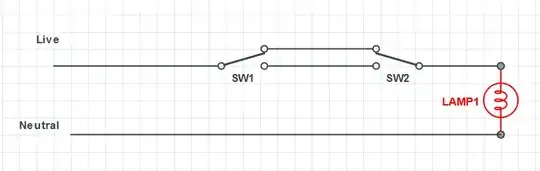
To make a single switch into 2 you need an extra traveler (switched live) between the switches.

enter image description here

ratchet freak
  • 11,967
  • 1
  • 24
  • 33
  • What do you mean by "the other switch"? Each one has 3 wire. The colors aren't consistent with what you say or anything that I could find on the net. I think they are almost random. – ymajoros Dec 06 '14 at 15:40
  • @ymajoros the one already there. – ratchet freak Dec 06 '14 at 15:42
  • I remember 2 blue wires and another one. – ymajoros Dec 06 '14 at 15:43
  • @ymajoros where do you live each country tends to have it's own convention red and blue is common in Europe. – ratchet freak Dec 06 '14 at 15:44
  • I live in Belgium, but those colors seem to be the random invention of the person who installed it. I looked it up and it seems I shouldn't see those colors, so I'm trying to understand my problem without counting on them ;-) – ymajoros Dec 06 '14 at 15:47
  • You have a volt tester? then you can check which ones are the travelers. Test each wire against the neutral, one will be independent of the position of the other switch and the other 2 will switch when the other switch is toggled. – ratchet freak Dec 06 '14 at 15:54
  • Guess I should do that. Having experienced 220V while doing dumb things recently, my question is about whether my observations show that the wiring is completely incorrect and should be redone by a professional anyway. I find it strange that short-cutting all 3 wires of the second switch makes the first one work as expected (ON/OFF). – ymajoros Dec 06 '14 at 15:59
  • @ymajoros: If that last statement is really true (connecting all 3 wires of the second switch makes the first one work as expected), then this sounds like the first switch is malfunctioning -- as you can see from the wiring diagram, what that should do is force the light on. Replace that switch and see if this solves it for you. If not, then I'd say you have a wiring problem; one of those travelers is not working for some reason or you're connected to something other than a traveler. Definitely time to get out the voltmeter. – keshlam Dec 06 '14 at 17:45