3

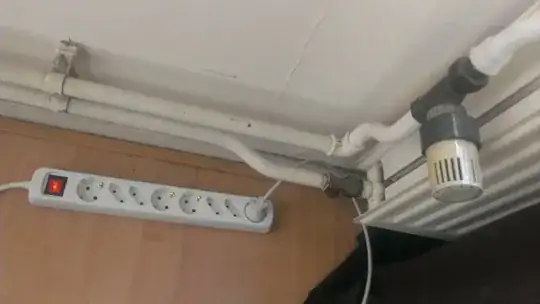
I just moved into a dutch student house without any grounded plugs which is quite usual around here. I get the 'Macbook Tingle' after some time, which solved by nudging the Macbook to the Radiator. and now I'm about to connect more computer appliances to an extension cord.

This makes me wonder: Can I earth the entire extension cord/ power strip with a crocodile clip to the radiator? Of course securing both sides properly. Needless to say I know this is not ideal but I'm also not keen on leaving it without anything.
enter image description here

3 Answers3

4

This seems extremely dangerous. If the plumbing for the radiators is not grounded, and a fault occurs. You could potentially electrify the entire plumbing system.

Worst case scenario. The heating plumbing is electrically connected to the water plumbing, you electrify the plumbing, and everybody in the building dies when they wash their hands.

Tester101
  • 131,561
  • 78
  • 320
  • 610
  • 1
    Stop holding back. Tell us what you really think. – bib Feb 13 '15 at 15:56
  • 2
    For cold water pipe grounds, etc. to properly work, you must know that the pipe has been properly bonded to ground in an area where you can definitely see and test it. And there must be NO dielectric fittings (anticorrosion) between your connection and that ground bonding. Speaking from experience as one who got zapped as a little kid because a bad element in a hot water heater energized the cold water bib outside the utility room. "Hey, it was the '60s, man, uncool!" – Fiasco Labs Feb 13 '15 at 16:01
4

No. There is no guarantee of good conduction between the radiator and ground. It may be too high a resistance to have any practical effect. And that can change without warning if something happens to the pipes. Better than nothing maybe, but mostly gives you a false sense of security.

If you can't get a safety ground and need protection, the recommended solution is to use a gfi/gfci, which will detect leakage and cut the power. I have a "gci in a box" extension cord I use for that purpose when I can't replace the outlet.

By the way, your "MacBook tingle" isn't something I've heard of, but strikes me either a serious problem that needs to be repaired, or just vibration in the fan or disk drive,, or a sign that you're provoking a Repetitive Stress Injury and not an electrical effect at all. No PC should ever be carrying enough voltage on it's external surfaces to tingle, grounded or not.

keshlam
  • 28,994
  • 5
  • 48
  • 98
  • The MacBook tingle is leakage through the Y-capacitor between power and ground. It's not dangerous, but it's real and annoying. (It will happen on any device with a metal chassis connected internally to the ground pin, a Y filter capacitor, and no actual connection to earth.) – Glenn Willen Dec 30 '22 at 07:14
  • (As I understand it, the Y-capacitor is only needed if the internal / case ground is actually connected to the ground pin of the wall plug. So the tingle only happens if your device can be plugged in with a ground connection, but does not currently have one. Of course, this can happen if your outlet is bad; but it's classic on MacBooks in particular, because their power supplies ship with both grounded and non-grounded plugs, and you can use either.) – Glenn Willen Dec 30 '22 at 07:20
  • There's lots of discussion of MacBook current leakage on the net, so apparently it's real. I still don't consider it acceptable; it's bad design. If you can't ground the case, isolate it or insulate it. "They all do that" is the last resort of an incompetent engineer. – keshlam Dec 31 '22 at 04:16
-1

A gfi/gfci will be safer, but won't allow a surge protector to protect your electronic devices without a ground.

  • Seems both off topic for this question and incorrect. (Surge protection can be done just between hot and neutral, though if you have ground it's better to use two more MOVs and protect every combination.) – keshlam Dec 31 '22 at 04:24