0

I was looking to run cat6 between my 2 properties for security cameras. It currently has a cable line between the two buildings that was once used for dish network and probably used for cable TV a long time ago. I use it for the cameras now using a passive adapter but the speed is only 2MBs.

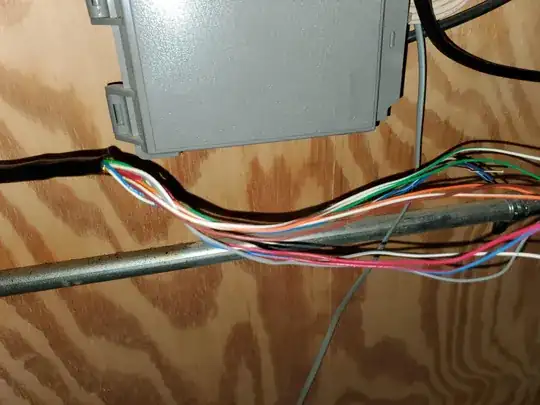
I was about to test how easy it was to pull the cable line through the conduit when I discovered a second cable. This appears to be connected to the phone lines but only the blue and blue/white wires were actually connected. It has 12 wires, 8 of which are the standard colors of a cat5/6 wire, the other 4 looked like grey, grey/white, red, red/blue. The line has not been in use for at least 12 years.

What type of cable is this?

Would I be able to use this as a cat5 cable utilizing the 8 wires?

Is there a better way to utilize this cable since it has 12 wires?

Edit: This line was likely installed in 2001, it's about 150ft long. enter image description here
rtaft
  • 775
  • 4
  • 15
  • Got a picture of the cable? Solid or stranded copper? What kind of jacket? If you pull back the jacket a bit can you tell if there are pairs of wires and are twisted? Often there's a marking on the jacket that'll indicate the CAT type. – Steve Jul 07 '20 at 22:10
  • 1
    It’s probably 6-pair cat-3, primarily used for old key (phone) systems. – mreff555 Jul 07 '20 at 22:26
  • 6-pair telephone (CAT3) cable, almost certainly. Slate (grey/gray) is the "5th color" in the sequence, and then the primary color changes from white to red and it starts over with the red/blue (6th) pair. Why Run Backwards You'll Vomit is the most common mnemonic for the primary colors in order (White, Red, Black, Yellow, Violet) and that (plus the 4 you know and Slate) will get you through a 25-pair cable. – Ecnerwal Jul 07 '20 at 22:33
  • @Steve updated with pick and more info – rtaft Jul 07 '20 at 23:01

2 Answers2

2

It is probably 6-pair phone cable. Based on the picture, this is almost certainly not CAT-3, as the pairs are not twisted together.

The canonical example of such wire was 25-pair, used throughout phone systems of yesteryear. The catch is that old phone systems used 1 pair for each simultaneous voice connection and then a number of pairs (how it worked varied quite a bit) for very low-speed signaling between the phones and the main unit. If it turns out to actually be CAT-3 then you should be able to get 10 Megabits out of it. If it isn't even CAT-3 then there are various adapters, line drivers, etc. and you should be able to get a couple of Megabits (i.e., similar to DSL speed, though different technology), but not necessarily much better (and possibly worse) than the coax you have now.

manassehkatz-Moving 2 Codidact
  • 115,769
  • 11
  • 130
  • 326
  • The wires are too big to fit into an RJ-45 to even test it so likely not CAT-3 as you said. When I bought the passive adapter, I tested it with 2ft of cable. It says it supports 10/100 speeds but I was only getting 10mb/s over the 2ft cable. I set it up anyway and used it only to view the camera system occasionally in low res mode. What I didn't know was that I'm actually getting an 100mb/s according to iperf, and running 3 cameras in full res mode works fine, so my whole upgrade the speed quest may have been unnecessary. – rtaft Jul 07 '20 at 23:43
1

As noted in comments, 99.9% likely to be Cat3 telephone cable, and low odds on it being usable for high speed networking. You also have not mentioned a length.

In any case, the correct item to carry high speed network BETWEEN BUILDINGS is fiber optic cable, which gets rid of a whole lot of electrical problems that wires between different buildings are prone to by not being a wire - it can also go fast as blazes, and over long distances.

Ecnerwal
  • 213,340
  • 10
  • 261
  • 571