2

I just had plumber replace cast iron toilet/lav/etc drain. It all drains fine. the only problem is I have a modern art sculpture in my basement..

Is this to code? Will it pass a house inspection if I want to sell?

My big concern is the drain runs out and then has two 90 degree bends running it back to the pipe feeding the sewer.

It looks like a trombone slide!

I'm having the plumber come back, as I'm concerned about blockages etc.

Original plumbing:
enter image description here

After updates:
enter image description here

isherwood
  • 137,324
  • 8
  • 170
  • 404
net mechdb
  • 21
  • 1
  • 3
  • 1
    Looking at the picture, there's nothing inherently wrong with what was done. It could have been made cleaner/nicer looking with one 90° going down directly to the stack, then the additional drain dropping into a vertical Wye, but I doubt that's going to give you any significant increase in likelihood of clogging. – FreeMan Sep 13 '22 at 16:15
  • 2
    @FreeMan It would be a tight fit to get all that and the clean out in that vertical run... but sure could have shortened the horizontal runs. – JACK Sep 13 '22 at 16:50
  • 1
    May be true, @JACK. I'd also have used a Wye for the clean out. I used a Tee in mine, and it's a royal pain to get the snake to turn that sharp 90, and mine's in the floor, so I'm not even working at eye-level/over head. – FreeMan Sep 13 '22 at 16:57
  • Sounds like drains are "in the eye of the beholder" within local requirements, of course. I was just concerned this was a learn as you earn type thing. – net mechdb Sep 13 '22 at 17:12
  • @FreeMan Maybe the plumber was thinking of using a Wye and did long and then couldn't find one... (nothing else to do, it's storming). – JACK Sep 13 '22 at 18:04
  • If it were me I'd really want to know why a plumber would not do it the original way. It's elegant, efficient, looks good, and consumes far less time and materials. All things I respect. If you were paying T&M, IMO you have good reason to complain. And I don't like the way the washer stack is so far from the wall in the new configuration. It's begging to be knocked out by a careless person. – jay613 Sep 13 '22 at 23:18
  • 1
    "the washer stack is so far from the wall in the new configuration" TBH, @jay613, it looks like the washer stack wasn't touched - looks like it still feeds into the bottom of the cast iron elbow that is part of the original stack. Agree with all your other points. – FreeMan Sep 14 '22 at 12:45
  • @jay613, isn't the obvious answer to add a cleanout? It may be a requirement of modern code to have a cleanout proximal to exiting the structure, and it's just a good idea. I would've kept things a lot more compact, but.... – isherwood Sep 14 '22 at 12:55
  • @isherwood and freeman -- it's hard to be sure from different camera angles but I'm 90% sure the laundry stack before is about 6 inches from the main one, and after is about two feet. It was definitely touched. Before there was a strange high-hat trap for the laundry, after it's gone. Before there WAS a cleanout for the main sewer pipe, and the laundry drained into a wye on the cleanout and it looks VERY compact. Before the laundry trap joins the riser with a tee, after it's a (better) wye .... point is, it was ALL redone, and I'm pretty sure it's sticking way out into the room now. – jay613 Sep 15 '22 at 14:48
  • I see the cleanout now. It was on the near end of the lowest horizontal run. Missed that earlier. Still, this is all opinion. I've said mine. :) The question is very specific and not related to most of what we're discussing. – isherwood Sep 15 '22 at 14:56
  • 90s are fine, especially long-sweep. Pitched a 1/4" per foot the wrong way is not. They needed to cut that cast iron riser shorter. Which is (a pita) what happened. Not exactly happy with the positioning of the clean out, but w/e. If that wasn't free I'd be kinda pissed. If it was free that's why they fixed it for free; improper pitch. – Mazura Sep 16 '22 at 17:14

3 Answers3

1

I'm not a code guru, but I see no problem here. The extension was presumably added to allow space for the cleanout, which is in an accessible location and has as few downstream bends as possible. It's maybe a bit longer than it would have needed to be, but....

Don't bother your plumber unless there's an actual problem.

isherwood
  • 137,324
  • 8
  • 170
  • 404
1

The open end of the pipe that used to be the laundry vent, at the top right of the picture, is probably problematic. I can't tell you exactly how because I don't know where it goes but I'll stick my neck out, take a guess, and say that wherever it does go has not been altered. I would be curious to know why that was cut and why (and how) the laundry vent now rises up through a new opening in the ceiling. And I would make SURE the old pipe doesn't lead to an open sky-facing vent or worse, to a dry or even wet sewer stack.

jay613
  • 37,422
  • 2
  • 51
  • 148
  • Good catch! TBH, though, that appears to be bright and shiny and new. Also, counting joist bays, it doesn't appear to be in the "original" picture - another indicator that it may be new and just not yet in use. It should be right about where the white thing in the top right corner of the "original" picture is, so maybe it's there but just out of shot... – FreeMan Sep 15 '22 at 15:29
  • 1
    It's the same pipe. It's shinier in the second pic because of the lighting. The cast iron stack goes up towards a joist, and the cut pipe is suspended before the very next joist by a strap that you can see in both pics. The "white thing" in the first pic is a light bulb, and in the second pic you can just see the edge of the junction box that holds it up. – jay613 Sep 15 '22 at 15:44
1

Short answer: most likely fine.

Long answer:

The fittings used for change of direction in sanitary drainage systems will depend on the local code.

The International Plumbing Code allows the use of the following fittings for the following changes of direction:

706.3 Installation of fittings. Fittings shall be installed to guide sewage and waste in the direction of flow. Change in direction shall be made by fittings installed in accordance with Table 706.3. Change in direction by combination fittings, side inlets or increasers shall be installed in accordance with Table 706.3 based on the pattern of flow created by the fitting. Double sanitary tee patterns shall not receive the discharge of back-to-back water closets and fixtures or appliances with pumping action discharge.
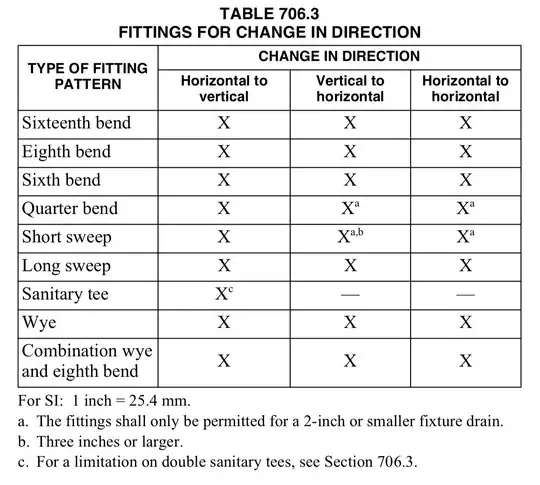
enter image description here

Starting from the main horizontal line at the hanger, the first change in direction is from horizontal to vertical, and it looks like either a quarter bend or short sweep bend was used, which meets the requirements of the table above.

The next change in direction is from vertical to horizontal, and it looks like a long sweep bend was used, which meets the requirements of the table above. (Note that this line is larger than 2", a long sweep bend is the only allowable 90° fitting for this location).

Next is the line cleanout, followed by a horizontal to vertical change of direction using two eight bends.

So if you are in an area that is based on or uses the International Plumbing Code, this installation should pass inspection.

However, this installation would not pass inspection if it was located where I live (British Columbia, Canada), as our code only allows the use of 90° elbows for changes from horizontal to vertical. Any vertical to horizontal must be made with two 45° elbows.

pdd
  • 5,749
  • 13
  • 26