7

I have a 3 story townhouse that was built in 2004. We recently redid the flooring in the top floor, and while we had the subfloor exposed we tried to eliminate the squeaking that we've been hearing by screwing the subfloor further into the joists. We screwed around 200 screws in a 10' x 10' bedroom, and the floor (or something) still squeaks.

Could the joists themselves be deflecting when we walk on them? There's a section in my home warranty (expires in 10 months!) covering joist deflection, but it has to be more than a certain number of inches of deflection over a certain length. How do I know if the joists are deflecting, and how do I measure the amount of deflection?

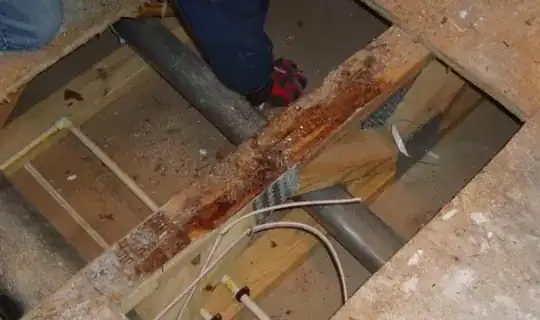
This is what my joists look like (we had the subfloor open in another area b/c mold from an improper shower installation). enter image description here
I don't know if I can put an image in a comment, but this is how I'm interpreting the instructions from the answers, and there's a wall in the way. Do I just measure at the wall and hope that it's not more deflection where I can't measure?

enter image description here

Zaralynda
  • 387
  • 1
  • 3
  • 12
  • Just use the laser to measure on both sides of the wall and take the larger. Also note that the maximum deflection may not be at the location of the wall, especially if the wall is not right in the middle of the span. However, I doubt you're going to find any serious deflection, especially if you haven't noticed any cracking in the walls or ceiling below. – Hank Oct 30 '13 at 00:02

2 Answers2

2

Get a laser pointer or level. Sight along the joist from one end to another to establish the level.

Get a ruler and measure the deflection at the center (or lowest point)

Typically, building codes specify a L/360 deflection limit.

This means that the maximum sag in the center of a joist is 1/360th of the length of the joist.

Chris Cudmore
  • 14,129
  • 7
  • 59
  • 89
  • There's a wall in the middle of the problematic area on the top floor. How do I measure with the wall where the lowest point would be? – Zaralynda Oct 29 '13 at 16:13
  • You're going to have to assume that the joist was originally level. Then use the laser level to establish a baseline. – Chris Cudmore Oct 29 '13 at 16:15
  • I added a drawing to the original question to show where there's a wall. How will that affect things? Thanks! – Zaralynda Oct 29 '13 at 16:38
  • @Zaralynda you assume that the level of the floor doesn't change significantly from one side of the wall to the other. You're looking at the difference in height where the laser level may show an exterior wall up 1/2" and the interior dividing wall down 1/2", that's a difference of 1" in level across the floor. Measure the same in other rooms, assume you are close to level from one side of the wall to the other, and plot the results to see if you're out of level and/or sagging. – BMitch Oct 29 '13 at 16:42
1

Joists movement will cause squeaking too. Usually helped with cross bracing. Also (and I know you just screwed 200 screws in) it is better to glue then screw.

If you are just worried about home warranty (and not how to fix it) then I would get a good digital level and measure various parts of the room to get the differences. A little math will tell you in inches how much they are off. (digital level so you have a photo proof and can work the math) And if you buy the one in the link I will surely pay half after it has been used.

mike
  • 3,040
  • 18
  • 30
DMoore
  • 48,293
  • 15
  • 84
  • 193
  • The joists do have crosses in them already. I'll post a picture this evening. – Zaralynda Oct 29 '13 at 16:14
  • @NiallC. thanks for the feedback but this is what needs to be done so I think it answers the question. There is not going to be anything realistically done if there are some slightly warped joists. It is just noise he is complaining about. On floors like this we bring in weights to sit on the plywood as we glue and screw. – DMoore Oct 29 '13 at 16:18
  • @DMoore I added a picture so I'm not sure if my joists are cross braced or not? – Zaralynda Oct 29 '13 at 16:21
  • @Zaralynda They are not. – Chris Cudmore Oct 29 '13 at 16:21
  • @Dmoore was referring to bracing between adjacent joists to keep them vertical. – Chris Cudmore Oct 29 '13 at 16:21
  • @NiallC my primary question right now is "is there something wrong w/my joists that I need to call the home warranty for before it expires?" This answer doesn't answer that question, but if my joists aren't that bad, it does address the secondary problem (the squeaking) – Zaralynda Oct 29 '13 at 16:23
  • @Zaralynda do you feel that your floors aren't level when you walk? Sometimes just walking on a floor tells the most info. – DMoore Oct 29 '13 at 16:25
  • @Zaralynda - new pic shows no cross-bracing. – DMoore Oct 29 '13 at 16:30
  • @DMoore there are spots where you can feel deflection as you walk around, but I'm not sure how much deflection is okay and how much is too much. I grew up in SC on concrete slab foundations! – Zaralynda Oct 29 '13 at 16:40
  • @Zaralynda - do you mean you feel a bounce when you step or a soft spot? – DMoore Oct 29 '13 at 17:14
  • @DMoore there's a soft spot near the door, but it's more of a bounce at the joists. – Zaralynda Oct 29 '13 at 18:30
  • @Zaralynda - that is due to the type of joists you have. I will update a better answer later. – DMoore Oct 29 '13 at 22:45