First of all, it helps to get the terminology sorted out:
A function in time-domain is known as a signal.
A function in frequency-domain is known as a spectrum.
As Hilmar said, there are four different flavors of "Fourier", which convert a signal to a spectrum. The Fourier series is the best to start with to truly understand the frequency domain. The basic premise is this: any periodic signal can be represented as an infinite sum of sines and cosines. In this equation, s(x) is a signal:
$$
a_n=\frac{1}\pi\int^Ts(x){\cos{nx}}\mkern3mudx
$$
$$
b_n=\frac{1}\pi\int^Ts(x){\sin{nx}}\mkern3mudx
$$
$$
s_f(x)=\frac{a_n}2+\sum_{n=1}^\infty{a_n\cos(nx)+b_nsin(nx)}
$$
$$
s_f(x)=s(x)
$$
In this equation, an and bn are the real and imaginary parts of the discrete spectrum, respectively. Therefore as you can see, the Fourier transform of a cosine will be a real number, and for a sine, it will be an imaginary number. The T on the integral means that we are integrating over a full period of the signal. This is primarily used in what's called harmonic analysis, which I've mostly used when analyzing analog circuits with non-sinusoidal signals (square waves, triangular waves, etc.) But what if the signal isn't periodic? This doesn't work, and we have to turn to the Fourier transform.
The Fourier transform converts a continuous signal to a continuous spectrum. Unlike the Fourier series, the Fourier transform allows for non-period function to be converted to a spectrum. A non-periodic function always results in a continuous spectrum.
The discrete-time Fourier transform achieves the same result as the Fourier transform, but works on a discrete (digital) signal rather than an continuous (analog) one. The DTFT can generate a continuous spectrum because because as before, a non-periodic signal will always produce a continuous spectrum--even if the signal itself is not continuous. An infinite number of frequencies will still be present in the signal, even though it is discrete.
So, to answer your question, the DTFT is arguably the most useful one, as it operates on digital signals, and therefore allows us to design digital filters. Digital filters are far more efficient than analog ones. They're much cheaper, much more reliable, and much easier to design. The DTFT is used in several applications. Off the top of my head: synthesizers, sound cards, recording equipment, voice and speech recognition programs, biomedical devices, and several others. The DTFT in its pure form is mostly used for analysis, but the DFT which takes a discrete signal and yields a discrete spectrum is programmed into most of the above applications, and is an integral part of signal processing in computer science. The most common implementation of the DFT is the Fast Fourier Transform. It's a simple recursive algorithm which can be found here. I hope this helps! Feel free to comment if you have any questions.


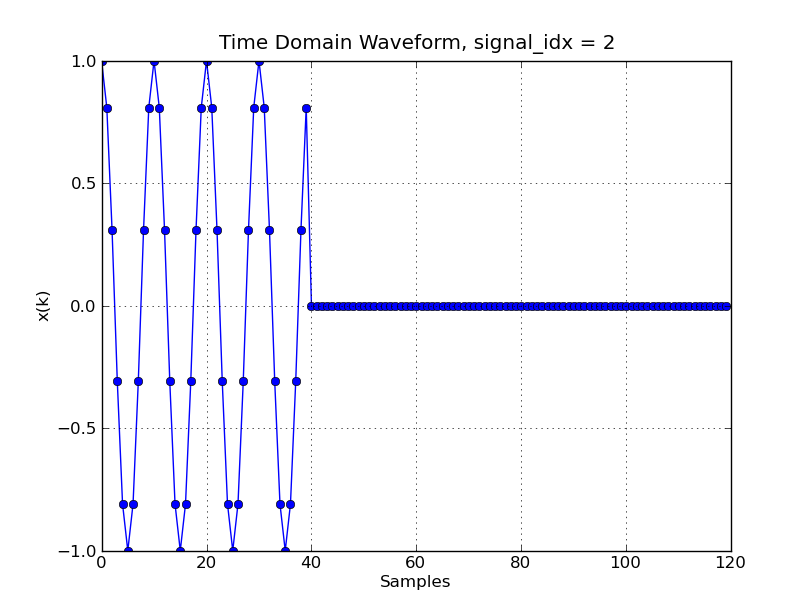
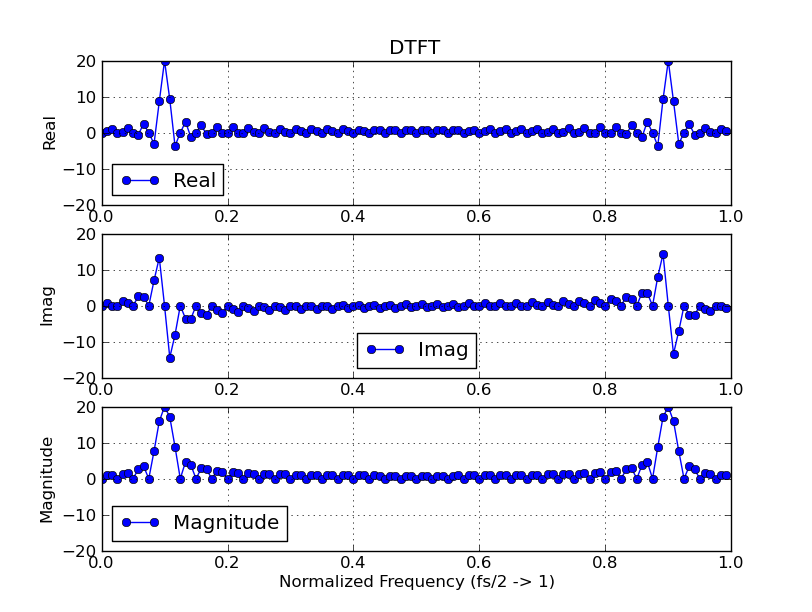
http://i974.photobucket.com/albums/ae227/ElectroNerdy/DTFTSinRepresentation.png
http://i974.photobucket.com/albums/ae227/ElectroNerdy/DTFTCosSignal.png
– ElectroNerd Feb 04 '12 at 01:50