This question, having a physical and network rather than mathematical nature, is close to being off-topic, but for your convenience let me put an answer for it.
Making a phone call is traditionally a communications network operation. But recently IP telephony over computer networks (internet) also emerged and furthermore GSM (mobile cellular) systems are so much intermingled with internet that the traditional medium seems to have blurred boundaries.
Making a traditional phone call using your GSM cellular phone, involves accessing an operator base station (BS) closest to your location. Base Stations, work at 900/1800 MHz, ranges and can be reached at as low as about -110 dB signal levels. Therefore, your phone can reach a BS about a 5/10 kilometers away in free space and less than a km in city areas. Once it's reached, remaning connection to other cities etc., is powered and handled by the BS network itself. Your phone is only required to reach the closest BS.
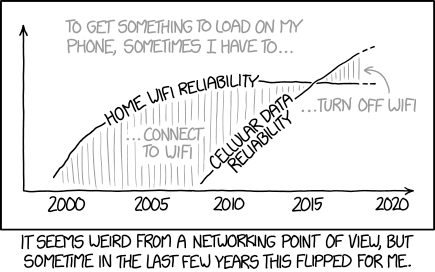
Wi-Fi is term used to denote wireless internet access point, that enables internet capable devices to wirelessly connect to internet. It may be at your home, office or airport, operating at 2.4 (or recently 5) GHz. It's signal output power level is low, therefore it can be reached within a hundred or less meters for fast / reliable connections. Once you access a wifi, the remaining communication is powered by Wi-Fi adapter / router device and your device is not involved.
As another option, you can also make an IP phone call using WhatsApp, Skype etc with your smart phone-computer combo. Then it's either accesing the closest (and allowed) Wi-Fi access-point at home/office or it may also be doing it through the GSM BS internet using its mobile data feature...