Remember Ohm's law, that says the voltage \$V\$ across something (also called a "potential difference") is equal to the current \$I\$ through that thing multiplied by the electrical resistance \$R\$ of that thing:
$$ V = I \times R $$
or
$$ I =\frac{V}{R} $$
The electrical resistance of a person is probably a thousand Ohms, or thereabout, from wet hand to wet hand, and if you have a voltage source of say 2V potential difference, holding one side of that source in each hand will result in the following current:
$$ I = \frac{2V}{1000\Omega} = 0.002A $$
You might feel a tingle with 2mA of current flowing through you, but that's all.
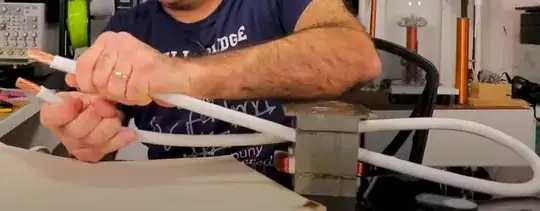
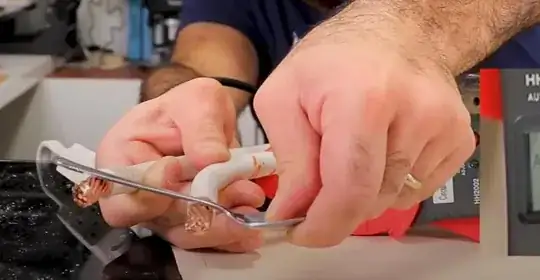
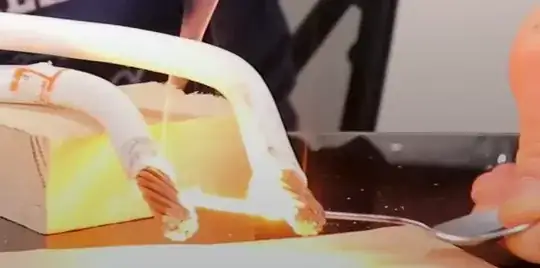
By contrast, if you connect a section of spoon between that source's terminals, then you can expect much, much more current. Let's say the total resistance \$R\$ of that wire and spoon combination is 0.01Ω (10mΩ), then the current would be:
$$ I = \frac{2V}{0.01\Omega} = 200A $$
This assumes that the voltage source is able to maintain 2V even while delivering that much current. The important thing is that there isn't a high enough voltage (potential) anywhere in the system to cause more than a couple of milliamps to flow through a person that comes into contact with any part of it, regardless of how much current is flowing in the wire and spoon. It's current that flows through the human body that is considered dangerous, not the current in the wire.
The only real danger posed by touching this low 2V system is getting burned by the rapidly heating elements in the circuit. The spoon here is dissipating (receiving) a lot of energy each second (power), which is being converted to heat.
With 2V across the spoon (actually slightly less, since the thick wire also has some resistance, and will "steal" some small fraction of the total voltage) and 200A flowing through it, to calculate power \$P\$ we find the product of those two quantities:
$$ P = I \times V = 200A \times 2V = 400W $$
That means 400J of energy is being dumped into the metal of the spoon each second, causing it to heat up. Within a couple of seconds that spoon will reach hundreds of °C, becoming a burn hazard, but not an electrical hazard.
There is another consideration, to do with the voltage of the electrical (mains) supply in the home. That supply provides a potential difference oscillating between +170V (US, Canada) (or +320V in Europe) and -170V (-320V). In other words, the potential difference between the live and neutral terminals of the wall sockets swap polarity 60 (US, canada) or 50 (Europe) times per second, the peak difference being 170V (320V).
The neutral side is tied to your home's earth node, (or the power-company's own earth, again depending on where you live). That means you and the floor you stand on have a very similar potential to the neutral node, and (as long as your electrician wired up the house correctly) you won't receive an electric shock from touching neutral. The potential difference between neutral and your home's structure is insufficient to cause significant current to flow should you come between them.
That's not the case for live. Touch that at your peril, because between your feet where you are in contact with the floor, and your hand where you touch live, is hundreds of volts. That will shock and possibly kill you.
So why, if Electroboom's system is being powered by mains electricity, don't you get a shock? If you look carefully, there is no direct connection between the wire/spoon and the mains supply. All 400W of that electrical power is being transferred magnetically, inside the transformer. Being isolated like this, the electrical resistance between mains live and the wire/spoon is near infinite, and again by Ohm's law, if you touched the spoon or wire, you can expect no current to flow between live and earth via your body.