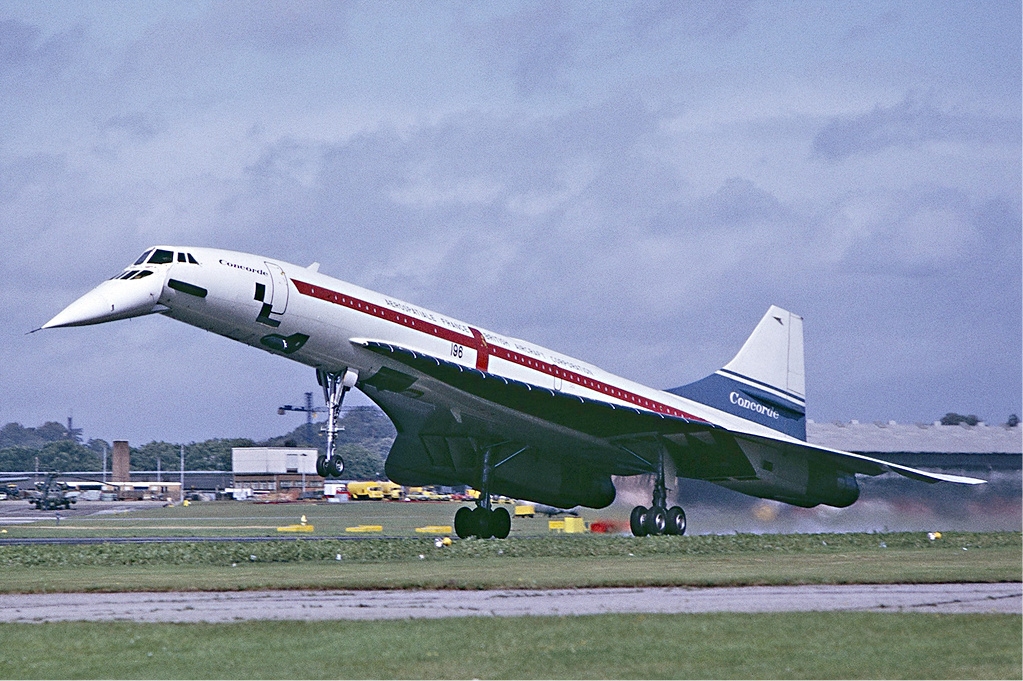
There are two main considerations here which causes the supersonic designs you mention to differ from more conventional, subsonic aircraft:
- the supersonic aircraft employ delta wings to generate their lift. Delta wings are particularly thin wings with little shape to them, but rely on generating strong vorticies to produce lift. The thin profile makes them excellent at producing little drag, however strong vorticies are difficult to produce at slow speeds as viscous forces dominate.
- in order to reduce the drag contribution of shockwaves produced by the wings at high speeds, the designers have made the span narrow with a long chord, resulting in a very low aspect ratio. Low aspect ratios produce an awful lot of induced drag.
So, given these considerations, the angle of attack must be large to produce enough lift at speeds slow enough to land at, and the design of the wings means that stall is less of a design consideration so these AoAs are viable; the drag penalty for flying at such high AoA makes up a smaller proportion of the total drag, so there is a smaller penalty for accepting the additional drag if it reduces landing speed and allows your aircraft to operate out of more airports around the globe.
Also of note: these aircraft fly at significantly higher speeds and somewhere between cruising and pulling up to a terminal gate you have to lose all that speed - using your wings as a giant air brake is a pretty good way of doing that without requiring any heavy braking system, indeed flaring is the primary mechanism of braking for most supersonic aircraft.
Edit: I didn't see your follow up question; almost certainly not, the droop nose is phenomanally heavy and complex to make it a desireable design feature, it was included out of necessity. These days I would almost guarantee a electronic HUD system which allows the pilots to "see" through the floor using cameras and a battery of other sensors to aid them. Such a system would require multiple failsafes in the event of a power outage, however even considering this it would be substantially simpler, cheaper and lighter - quite possibly safer also since the droop mechanism could fail, just as a camera could, and there is a limit to how many failsafes you could feasibly include on such a mechanism. By contrast, having an array of multiple cameras on independant circuits, each with an isolated backup power supply makes for a simple, easily expandable and very effective failsafe.