12

I have a postcard from the family of my 3-times-great grandmother written in old German that was sent to some of their family that came to America.
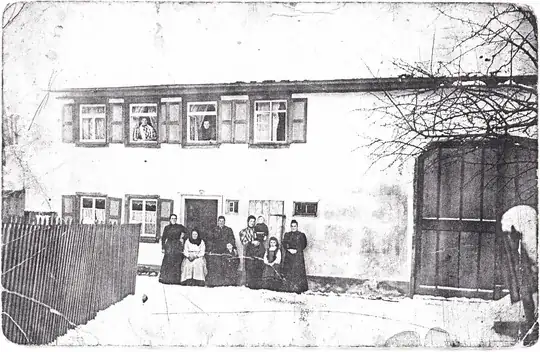
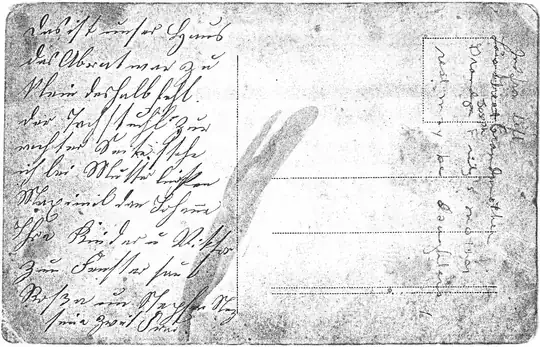
postcard front: photograph of the family postcard back: handwritten text in question

The picture was taken in Hechingen, Germany. My 3-times-great grandmother is the seated woman wearing white. Her name is Elizabeth (or Elisabeth) Fritz. Four of her children came to America:

  1. Gustavus (son),
  2. Cresintia (or Crescentia) (daughter),
  3. Joseph (son), and
  4. Henry (son).

A retired professor of German from the University of Illinois once tried to translate the text. Here is what he was able to determine:
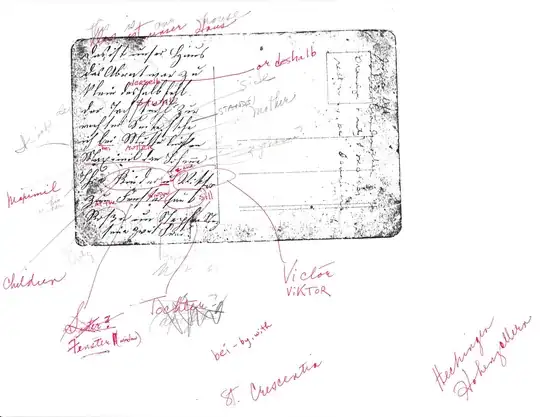
translation attempt of some of the words on the backside of the postcard

As one might guess, the text seems to be describing the picture on the reverse side. In particular, the text says that this is their house and then seems to name each person in the image.

Question: What is a complete translation of the text?

UPDATE

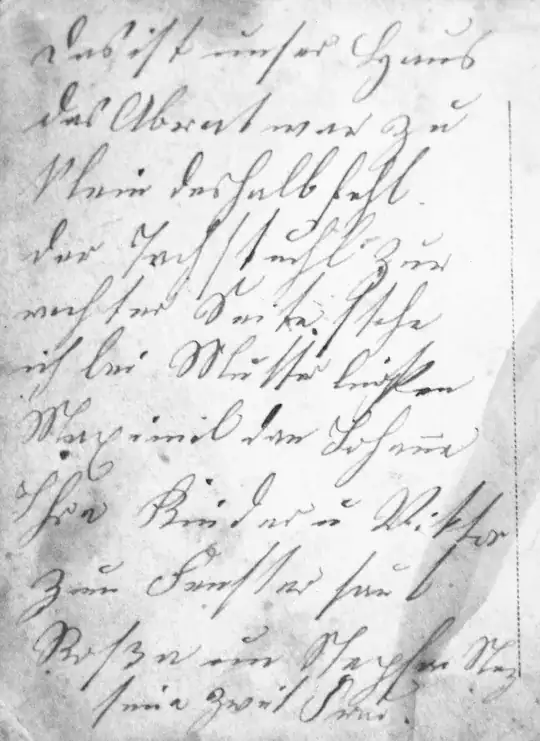
I just obtained a better scan of the text. Maybe this could help the transliteration.
enter image description here

Takkat
  • 70,407
  • 29
  • 165
  • 411
Tyson Williams
  • 221
  • 1
  • 6

1 Answers1

17

My trial for the transliteration: In []-brackets I give characters I cannot determine with certainty or that are not present in the original text but are required for the sake of grammar and punctuation. My best guesses are written without the ?-sign, forms and words where I am very unsure are denoted with a ?-sign.

Das ist unser Haus[.] das [?Ober...t/Aber...t] war zu klein[,] deshalb fehl.[=fehlt] der Tachstuhl. Zur rechte[n/r] Seite stehe ich bei Mutter[,] link[en] Maximil[?ian] [?der] Johanna Ihre Kinder u.[=und] Viktor. Zum Fenster[?saum] l. [=?links] [?Ros...] [?nur/um] Steph[a/e]n [?(N/St)(a/e)(z/y)] sein[e] zweit[e] Frau.

The translation:

That is our house. The [?] was too small; that is why the truss is missing. On the right side I am standing with Mother, on the left Maximil[?ian], Johanna [their, her] children and Viktor. At the window [?edge] l. [=?on the left] [?Ros...] [?only] Steph[a/e]n [?] his second wife.

Some remarks:

  • The script is the Deutsche Kurrentschrift.
  • "Tachstuhl" is an Upper German (Oberdeutsch) variant of "Dachstuhl" meaning "roof truss/framework".
  • Being from the Upper German dialect area, the text probably uses the genitive-less possessive variant with "dem sein": "der Johanna Ihre Kinder", "dem Stephan seine Frau".
Chris
  • 326
  • 2
  • 4
  • I would love to see a legend for the various usages of [] you have in this. It's a little difficult to read through, even as german native. Either way, nice deciphering ;) – Vogel612 Jul 14 '14 at 18:54
  • 7
    "des/der Aberat" may be a misspelling of der Apparat, meaning the camera the photo was taken with. Further down it is zum Fenster hin**. – Takkat Jul 14 '14 at 21:42
  • 1
    Indeed, it is quite imaginable that Aberat is a misspelled Apparat. But I don't think that the word after Fenster is hin, because there is a "u"-hook above and no "i"-dot. – Chris Jul 14 '14 at 21:52
  • The problem is also that the handwriting is a mixture between normal Kurrentschrift and Gothic Kurrentschrift. Made it hard to figure out. – Patrick Sebastien Jul 15 '14 at 09:19
  • 1
    RE: "der Apparat war zu klein" (i.e. "the apparatus was too small"): These seem to be the words of a 18th century woman who ostensibly lives in a farmhouse (see the large barn door to the right) who wants to say that the roof of the house is not in the image because the camera could not fit it all in. – ssc Jul 17 '14 at 15:46
  • @Takkat What is a translation of "Zum Fenster hin"? The translation from the retired german professor for both the word after "Fenster" and the "l." is "sill", in which case, the sentence beings "At the window sill". – Tyson Williams Jul 18 '14 at 03:23
  • The current consensus for second half of the last sentence is essentially "[male name] [connective word] [female name] his second wife." Of the two people in the windows, I think the male is on the left and the female is on the right. Chris has guessed that "l." might stand for "links", which means "on the left". However, this is inconsistent with how the writer described left and right above. She would have said the male is on the right just like she described herself as being on the right. – Tyson Williams Jul 18 '14 at 03:24
  • If I were writing this, I probably would have used "and" or "with" for the connective word between the last two names. Does this way of thinking help transliterate and translate the connective word? – Tyson Williams Jul 18 '14 at 03:25
  • @TysonWilliams: From the persons enumerated I believe she describes the location from her view, i.e. she is the one on the left of the picture (but from her view she is on the right side). Then "Roße" (uncommon spelling of the name Rose) is the one pointing to the left window (= zum Fenster hin), which then is the right window on the picture from our view. People looking out of the window appear not to be mentioned. – Takkat Jul 18 '14 at 06:23
  • 1
    Let me suggest the following translation: This is our house. The aperture was too small, that's why the truss is missing. On the right it is me standing next to mother. To the left Maximil, Johanna with her children and Viktor. To the left window is Roße, Stephan's second wife. - you may get the names better if you had access to other documents from your family. – Takkat Jul 18 '14 at 06:32
  • @Takkat Can you provide an answer with your transliteration and transcription? – Tyson Williams Jul 18 '14 at 06:34
  • Most of the work has nicely been done by Chris. We should hear what they say, maybe then [edit] the answer so that you are able to accept it. Too little I could add here (forgot about the camera, I'll edit that in above). – Takkat Jul 18 '14 at 06:55
  • @Takkat Thanks. Who do you think is Viktor? Yes, the plan is to find other documents of my family. This is the only one I have right now about these people (but I have much more about the siblings that came to America). – Tyson Williams Jul 18 '14 at 11:18
  • Viktor is hard to say... the description is a bit ambiguous. I believe he is the boy standing next to Maximil, and not the boy in the arms of Johanna (because she's supposed to have more than one child here). – Takkat Jul 18 '14 at 11:35
  • Maybe worth considering: since there appear to be several irregular abbreviations ("fehl." for "fehlt" and "un" for "und") and since Latin name endings often get ommitted in dialect, Maximil and Viktor could both be women (Maximiliane and Viktoria). Roße/Roßa and Stephan's second wife could be the two people in the windows. (I'm not convinced that one of these is male.) – Mac Jul 21 '14 at 10:25
  • Also, "zum Fenster *hin" is not very likely: the first letter looks much more like "s" (narrow, spiky) than "h" (pronounced loops); and there's the "u"-hook instead of an "i"-dot... – Mac Jul 21 '14 at 10:27