4

Sie hat immer sehr elegante Blusen und Hosen.

From answers to this question I understand that for the above sentence the adjective takes the ending -e and not -en because of strong inflection.

What does the ending of the adjective become when it is applied to two nouns that are different genders?
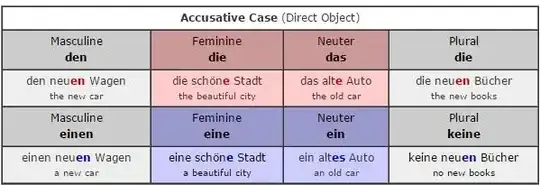
enter image description here

My chart does not help me in the following example:

She always has a very elegant blouse and belt.

Since blouse is feminine (die Bluse) and belt is masculine (der Gürtel), what does elegant become?

sci-guy
  • 391
  • 2
  • 3
  • 9
  • Du hast die starke Deklination vergessen. http://de.m.wiktionary.org/wiki/Flexion:neu – Carsten S Mar 09 '15 at 06:52
  • This has also, as http://german.stackexchange.com/questions/22237/adjectives-pertaining-to-nouns, been discussed in http://german.stackexchange.com/questions/22117/why-ein-blaues-hemd-and-not-ein-blau-hemd and http://german.stackexchange.com/questions/13765/deutscher-schäferhund-or-deutsche-schäferhund. Please start a survey of existing posts using tags and search function before producing duplicates, it makes topics much easier to handle. – Martin Schwehla Mar 09 '15 at 08:53
  • Removed the first of the questions as this would be a dupe indeed. The second question (which is also in the title) was not answered in the duplicate questions we linked to. This would be confusing to other users who come here. Therefore we needed to edit and reopen the question. – Takkat Mar 09 '15 at 19:51

1 Answers1

4
  1. You are forgetting about case. You need accusative here, and what's more, for the indefinite article. Acc. pl. would be die eleganten Blusen, but since you are not using a definite article elegante Blusen is correct.

  2. It depends. If you insist on the singular, you would have to repeat the adjective:

Sie trägt immer eine sehr elegante Bluse und einen sehr eleganten Gürtel.

A better solution, in my opinion, would be to use the plural here, where you can avoid that:

Sie trägt immer sehr elegante Blusen und Gürtel.

Ingmar
  • 19,257
  • 1
  • 48
  • 82
  • You have confused me now. See the chart I added to my post. I know I am in accusative, but it still says to use -en: Die neuen Buecher, order Die eleganten Hosen in accusative. – sci-guy Mar 09 '15 at 05:41
  • 2
    There are separate forms for definite and indefinite articles; cf. "der elegante Gürtel" vs. "ein eleganter Gürtel". Sie trägt die eleganten Blusen would be (grammatically) correct, but without the definite article it's just "elegante Blusen". – Ingmar Mar 09 '15 at 06:39
  • I find you chart somewhat lacking in that regard, it should perhaps read "neue Bücher" somewhere (i.e., pl. without article). – Ingmar Mar 09 '15 at 06:49
  • So 'ohne Artikel' the plural changes endings from en to e :) ok that is easy enough to remember. THANKS! – sci-guy Mar 09 '15 at 07:45
  • @renegade05 Not for any grammatical case. – c.p. Mar 09 '15 at 21:18