19

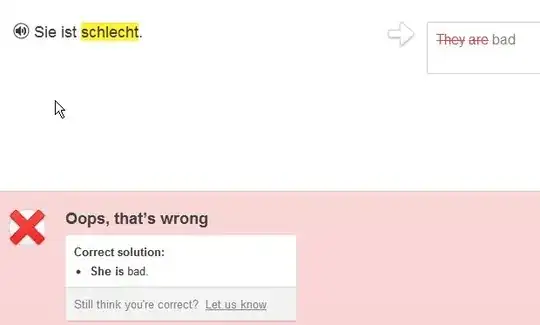
I am starting to learn German and I'm trying out Duolingo, I've faced this problem several times.

If I understand correctly "sie" means both she and they. So if there is no context, can I distinguish between the both?

See this example:

enter image description here

Could I have known which one does it refer to?

How do you do it normally, by context and only context? I know that they are always pronounced the same.

Trufa
  • 309
  • 1
  • 2
  • 6
  • 8
    Related: How do I know if “the sheep are bad” refers to one sheep or several sheep? – Carsten S Oct 17 '15 at 15:24
  • you missed the third sie! you (plural) ! there is no way to distinguish that.. well context ofcourse – Blue Clouds Nov 03 '17 at 08:46
  • 2
    How to differentiate between you (one person) and you (many persons)? For example in "You are bad". How do you know how many people are bad? One? Many? So if there is no context, can I distinguish between the both? No, I can't! This is exactly the same problem. All languages are ambiguous sometimes. – Hubert Schölnast Nov 11 '17 at 06:50

5 Answers5

41

In each case you conjugate the verb differently. Here the verb is sein meaning to be.

Sie ist schlecht.

She is bad.

Sie sind schlecht.

They are bad.

Although to add to the confusion here, there is yet another pronoun Sie meaning you in the plural or polite form. In the middle of a sentence you can see that it is capitalized but in spoken German or in the above examples there is ambiguity. "Sie sind schlecht." could also mean "You are bad." This can only be distinguished by context.

z7sg Ѫ
  • 1,243
  • 13
  • 13
  • 9
    There are also cases, namely accusative objects, where one can't distinguish between all three: "Ich liebe sie" – phipsgabler Jun 21 '12 at 18:48
  • 1
    You conjugate the verb differently... because "she" is a singular and "they" is a plural. At least in the example. Easy, isn't it? ;-) – Jürgen A. Erhard Jun 22 '12 at 00:14
  • 2
    And to add insult to injury: "Ihr ist schlecht" would mean "She's feeling sick/nauseous" :D – Jules Jun 22 '12 at 09:02
  • 2
    @phg: At least in written form, it can only be "she" or "they" — if it were "you" it would have needed an uppercase "S": "Ich liebe Sie". Of course in spoken German, you don't see the uppercase letter. – celtschk Jun 22 '12 at 13:58
  • … and you are bad can also mean ihr seid schlecht, because some English pronouns are also ambiguous. Formal Sie in spoken language is not only almost always obvious by context, but often also carries the primary stress of the sentence. The example with lieben is particularly contrived, because nobody would say that nowadays to someone they are not calling du, i.e. it would always be ich liebe dich if directed at the single listener. – Crissov Oct 17 '15 at 19:38
  • Sie hat ein Schwein... they correct answer is "She has a pig." I feel confused, how does "They have a pig" differ? Would it then be "Sie haben eine Schwein"? –  Mar 26 '16 at 01:20
  • 1
    Yep: "Sie haben ein Schwein" - "hat" vs. "has" and "haben" vs. "have" - Not much difference to English. – tofro Mar 26 '16 at 10:57
  • When you use she, he, they, you in any language, no matter what language you are using, you are always referring to a subject which is mentioned before. When the subject metadata can be extracted from context then why waste words?. In Persian even gender is understood from context and there is no gender in Persian for anything. In Persian you say "حالش بد است". means "He/She is bad". Whether she is a she or he is a he is understood from context. That's why i say Persian is a highly advance language.:) – pouya Nov 04 '18 at 04:59
10

To keep the explanation simple:

If "sie" comes with a verb in singular, it means she.

If "sie" comes with a verb in plural, it means they.

The_Fritz
  • 1,151
  • 10
  • 6
4

There's one more option apart from those explained in the fellow answers, namely a change in gender in translation:

Considering your example

Sie ist schlecht.

the correct answer might as well have been

It is bad / rotten.

if the object in question is some kind of fruit, for example. In English, you speak of orange and lemon as neuter, whereas in German you use feminine gender for both Apfelsine and Zitrone.

Urs Reupke
  • 704
  • 6
  • 10
2

You can already figure out exactly the same distinction in English if it is presented to you as a puzzle. Even though it's not something you usually have to do, because it requires a context in which you don't know what it is that a name refers to. You are just confused when you have to do it in German because you haven't internalised German verb conjugation yet.

Here is the puzzle:

A British pop fan made a confession about his bad taste. Put his sentences back into the correct order. Start with the two that are about a woman.

  1. But I still like them.
  2. Quinn Quinn is really bad.
  3. Clover Leaf make bad music.
  4. But I like her anyway.
1

Sie ist schlecht = "she is bad" because "ist" means "is", which refers to a singular, "she".

Sie sind schlecht = "they are bad" because "sind" means "are", referring to a plural "they".

this does get more confusing though in the first example because "sie" with a capital "S" can also mean "you" in a more formal way (e.g. talking to a boss, coworker, or someone you just met) (in German this is called "sietzen", whereas when you're referring to a person in a more casual way, e.g. a friend or family member, you use "du". To refer to someone using "du" is called "dutzen" in German). If "sie/Sie" used at the beginning of a sentence like the first example, you just have to use context to figure out whether the author is referring to "sie" as in "she" or "Sie" as in "you". In the middle of a sentence you can tell by whether or not "sie/Sie" is capitalized.
user unknown
  • 23,274
  • 4
  • 47
  • 97
Evan
  • 11
  • 1