I was alerted to the fact that your search included the terms ein+solche. The exact terms give 62 results. I had assumed that the search would somehow average over multiple varieties but it doesn’t. Indeed, if you modify your search term to read eine+solche you get 21709 results and even the (possible but more constrained) search terms eine+solch which requires a following adjective returns 403 exact hits.
A few Google Ngrams serve to illustrate the prevalence of different forms, all showing that the combination of ein solche is practically not found aside from mistypings in German:
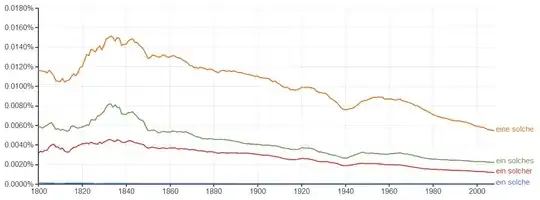
ein solcher, eine solche and ein solches compared to ein solche.
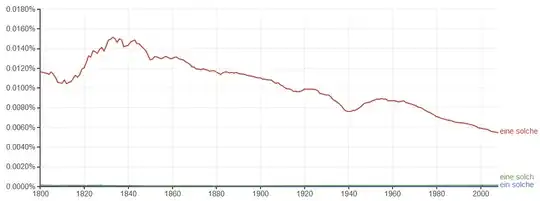
eine solche compared to eine solch and ein solche.
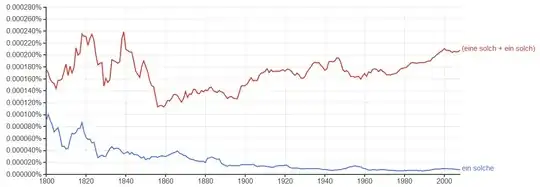
Comparison of eine solch and ein solch (used before adjectives) to ein solche.
The adjective-preceding ein(e) solch are about ten times as frequent as ein solche but they are all minor compared to eine solche (the correct form for feminine nouns) – and even the masculine and neuter versions ein solcher/ein solches – which is 400 times as common as ein solche in the Google Books corpus.
Had the search on your site automatically allowed for variations (e.g. by noting that such a may be corresponding to both ein solche and eine solche in German texts), you would have received a number of correct examples intermingled with the odd incorrect ones. But by searching strictly for an incorrect combination, you would only get incorrect sentences returned.
I will leave the part of the original answer that deals with how the examples are wrong below the horizontal line but note that my criticism of your source no longer applies; instead, the original list may be considered an example of shit in – shit out.
The source claims to take its examples from ‘millions of previously translated texts: movie dialogs, official documents, websites, newspapers’. However, I don’t believe them. Let me go through the first couple of examples:
*Das impliziert gleichzeitig, daß so ein neues Abkommen auch ein solche Menschenrechtsklausel enthalten muß.
Klausel is feminine and so is Menschenrechtsklausel so the article must be eine giving eine solche. Using that would give a correct sentence.
*Es ist einfach ein solche starkes Medium.
Here, Medium is neuter (so ein is correct) but nobody would use solche hier: it should be ein solch starkes Medium.
*Mit der neuen Regel n+2 verfügen wir jetzt über ein solche, und sie beginnt bereits positive Auswirkungen zu zeitigen.
I have difficulty trying to understand the context the sentence is supposedly creating. If the solche is supposed to refer to Regel, (feminine) then it would need to be eine solche which is reinforced by sie in the second half of the sentence. However, the sentence as a whole still wouldn’t make sense which could be due to lacking context.
*Verfahren nach Anspruch 5 oder 6, wobei die verwendete, das Vernetzungsmittel enthaltende Lösung (C') ein solche ist, bei der das Gewichtsverhältnis von Vernetzungsmittel (C) zu Verdünnungsmittel (Vernetzungsmittel (C)/Verdünnungsmittel) 1/3 bis 1/30 ist.
If this sentence was actually published, it was never proofread. It makes sense, but it is as complicated as humanly possible and could easily be rephrased to something much simples. And since solche is referring to eine Lösung which again is feminine it must be eine solche.
*Ein solche Geschenk geht nicht verloren und wird nicht vergessen!
It is das Geschenk (neuter) and therefore the only correct form is ein solches Geschenk.
I skipped over the other examples; I only additionally selected the one about the present to show that not all sentences are wrong in the same way and to display an additional type of error. However, reading them individually, not a single supposed example would be considered correct German.


