5

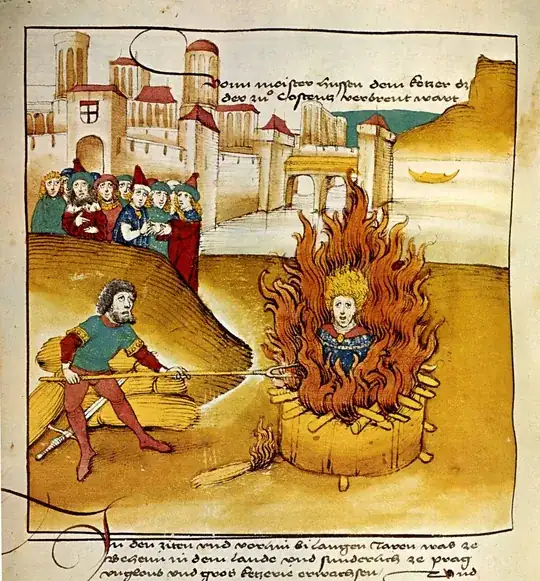
The following is a drawing of the Spiezer chronicle from the 15th Century showing John Hoss being burnt alive, I want to include it in my research about Protestantism.

enter image description here

While preparing a representation about protestantism, and Hus, I stumbled upon that manuscript (full version here) and it would be interesting to know (if possible) some information about it, like, is it a message from the church? Is it a message from the protestants to let people avenge the death of Huss?

I could not find any text transcripts or translations of the captions on this drawing. Therefore it is almost impossible for me to do further research about it.

Can anybody help me to decipher this text, or are there any further ressources where I could find details on this very image?

Takkat
  • 70,407
  • 29
  • 165
  • 411
Lynob
  • 183
  • 4
  • 1
    I can't even read that text, and even if I could, it most probably would be some older form of german most users could not transpose (me included). Why do you even need the text? – Vogel612 Nov 06 '13 at 07:48
  • 2
    as entry for futher researches: Spiezer Chronik. I'm not sure if "Translate my bitmap" questions are on topic. – bummi Nov 06 '13 at 08:08
  • 2
    http://meta.german.stackexchange.com/questions/579/are-questions-on-reading-of-old-handwritings-on-topic – Takkat Nov 06 '13 at 08:33
  • @Takkat judging for the tags, I think the OP is asking for a translation into English. That's why I voted to close it. – c.p. Nov 06 '13 at 09:19
  • 1
    Translations to English are not off topic per se. They would be on topic when an expertise of German is needed to understand the original. – Takkat Nov 06 '13 at 09:22
  • 6
    Take care that the image doesn't render the complete text below the illustration. The original manuscript has six more lines. – tohuwawohu Nov 06 '13 at 09:28
  • @Vogel612 Why do you even need the text? while preparing a representation about protestantism, and Hus, i stumbled upon that manuscript and it'd be interesting to know (if possible) some information about it, like, is it a message from the church? is it a message from the protestants to let people avenge the death of Huss? i speak arabic, french and english fluently and a bit of italian, I don't speak any german and thus, it is almost impossible for me to do research about it, if it is impossible to translate the text or time consuming, then leave it, it's not urgent, just a question – Lynob Nov 06 '13 at 10:06
  • 1
    Ich habe nichts gegen diese Frage, aber ich verstehe eigentlich folgendes nicht: wäre der Text unformatiert, so wäre diese Frage schon längst geschlossen worden. Aber die Frage bezieht sich nicht nur auf eine Übersetzung ohne Mühe zu zeigen, sondern auf Entschlüsselung + Übersetzung ins Englische ohne Mühe zu zeigen und ist nur deswegen erlaubt? – c.p. Nov 06 '13 at 15:29
  • 1
    @c.p.: Ohne die entsprechenden Meta-Disukussionen zu kennen, würde ich vermuten, dass die Forderung nach gezeigter Mühe kein reiner Selbstzwecke ist, sondern dazu dient triviale Fragen, die also keines Experten bedürfen zu vermeiden. Da dieser Text sechshundert Jahre alt ist, ist die Annahme berechtigt, dass seine Übersetzung nicht trivial ist und um dies zu zeigen braucht es daher keine Demonstration vorheriger Mühen. – Wrzlprmft Nov 07 '13 at 00:24
  • @Wrzlprmft: good point. In addition, as from my research this text is not available other than in the scanned form, and there is no translation anywhere. Also note that after the edit the "translation request" was changed to "decipher". Therefore the close reason shown below is unfortunate. IMO this question should be edited to meet requirements for being on topic rather than closed. – Takkat Nov 07 '13 at 07:18
  • Tried with an edit. Any further suggestions? – Takkat Nov 07 '13 at 07:45

1 Answers1

15

This is a temporary answer to give the community an opportunity to decipher the handwriting. Please feel free to edit this post whenever you feel you found out a missing word.

Of course this should be followed by another answer giving the translation, and a guess on the temporal origin if possible.

Vom Meiſter Huſſen dem Ketzer dz(?)
der zu ͦ Coſtentz verbrent wardt

In den Ziten und vorhin bi langen Jaren, was ze
Bohemin in dem lande vnd ſunderlich ze prag
vnglaub vnd gros ketzerie erwachſen, Und
deſſelben unglauben orthaber was, ein gelert man
in engelant, hieß wieglef, Darnach bracht das
harfur(?) ze prage, einer hies meiſter huß, vnd hat
ein gelerten buben hies meiſter Jeronimo Nu ͦ(?)
was dieſelb Ketzerie zu ͦ prag ſo vaſt gewachſenn
das die ketzer die ſterckan (?) wurden, vnd vertreiben,
auch das ſtudium generale, das ze prag wz, vnd
zerbrachen kirchen und cloſter, vnd ertoten vnd er-
ſtachen ſelig prieſter, von ir prediens wegen, Der-
ſelb Huß macht einen niuwen glauben, vnd ein niuw
pater noſter, Si (?) verbranten auch das crucifix vnd
annder (?) Heiligen, Die ding kamen fur das Conci-
lium gen coſtentz, vnd kam der Huß auch dar, *nd wz
lang geuangen, *em letſten von gemeinem
concilio nach red vnd widerrede, wart der ſelb Huß
mit rechter götlicher vrteil verdampnet, in das fure
Und wart ze coſtentz verbrant, Darnach nit (?)
lang, wart Jeronimo ſui dioner zu ͦ coſtentz auch
verbrant

(dz und wz sind wohl Abbreviaturen für daz und waz)


In heutigen Worten:

Vom Meister Hus, dem Ketzer (dz?)
der zu Konstanz verbrannt ward

In diesen Zeiten und schon lange Tage vorher (?) war zu
Böhmen in dem Lande und (ab)gesondert von Prag
Unglaube und große Ketzerei erwachsen. Und
desselben Unglauben Urheber war ein gelehrter Mann
in England namens Wycliffe, darnach bracht das
hervor zu Prag einer der hieß Meister Hus, und hat
einen gelehrten Buben namens Meister Hieronymous
was dieselbe Ketzerei zu Prag so stark gewachsen dass die Ketzer die Stärkeren wurden, und vertrieben auch das Studium Generale, das zu Prag war, und zerbrachen Kirchen und Kloster, und töten und erstachen selige Priester, ihres Predigens wegen, der selbe Hus machte einen neuen Glauben, und ein neues Pater Noster (Vater-Unser-Gebet). Sie verbrannten auch das Kruzifix und andere heilige (Dinge). Die Sache kam vor das Konzil zu Konstanz, und kam der Hus auch dahin, und war lang gefangen. Beim letzten gemeinen Konzil nach Rede und Widerrede ward der selbe Hus mit rechtem, göttlichem Urteil verdammt in das Feuer und ward zu Konstanz verbrannt. Danach nicht lang ward Hironymous sein Diener zu Konstanz auch verbrannt.


In English:

About master Hus, the heretic, who was burnt in Constance

In these times and long years before, in Bohemia and especially in Prague, great unbelief and heresy has arisen. The initiator of this unbelief was a scholar in England named Wycliffe. Afterwards it was brought to Prague by one who was called master Hus and he had a scholarly student named Jerome. This heresy in Prague had become so strong now, that the heretics had become the stronger ones and banished the studium generale, that was in Prague, and they destroyed churches and monasteries and they killed and stabbed priests because of their sermons. This Hus also made a new faith and a new paternoster. They also burnt the crucifix and other holies. The issues were brought before the Council of Constance, and Hus went there as well and he was held imprisoned for a long time. At last, after accusation and defense, this Hus was convicted with a rightful, divine sentence into the fire. And in Constance he was burnt. Not long afterwards, his servant Jerome was also burnt in Constance.
Marc Schütz
  • 101
  • 3
Takkat
  • 70,407
  • 29
  • 165
  • 411
  • @Takkat: Ich sehe mich außerstande der reinen Entzifferung zu helfen. Unklar war/ist mir, wie gut verständlich die Übersetzung der Worte ist. Das ist auch alles nur geraten auf der Basis 2er Deutschstunden kurz nach WWII über Walther von der Vogelweiden. Aber gerade das altdeutſche ſ können wohl Muttersprachler noch häufiger entziffern als internationales Publikum. Wahrscheinlich weiß auch nicht jeder vnglaub zu Unglaub zu übersetzen, wobei ich mir jetzt auch nicht sicher bin. Jedenfalls hängt dieser Transfer vollkommen von der Entzifferung ab, u.d.i es unpraktisch 2 Texte pflegen zu müssen. – user unknown Nov 06 '13 at 14:12
  • Ich habe im modernen Text sowohl Concilium als auch Concilio mit Konzil übersetzt. Wobei ich hier vermute, dass Concilium das gesamte Konzil meint (das über 4 Jahre andauerte) und Concilio ein tatsächliches Treffen der Priester (eine Sitzung). – S22h Nov 07 '13 at 09:46
  • 2
    @cross: Es kann auch gut sein, dass concilio einfach lateinisch dekliniert wurde. Sprich: Nominativ und Akkusativ lauten concilium, der Dativ lautet concilio. – Wrzlprmft Nov 07 '13 at 12:48
  • http://de.wikipedia.org/wiki/Konzil_von_Konstanz – Takkat Nov 07 '13 at 12:50
  • Wissen wir, wer oder zu wem Hus' Schrift nach Prag gebracht? Das könnte haufuo sein, ich meine das ist hier ein Namen. – Takkat Nov 07 '13 at 14:36
  • 1
    Das "harfur" ist wohl als "hervor" zu verstehen, d.h. "danach brachte es hervor zu Prag einer mit Namen Meister Hus". – Marc Schütz Apr 10 '19 at 09:53
  • @MarcSchütz: in guter Einwand... die Antwort ist ein "Community Wiki", du kannst und darfst dies gerne mit einem [edit] einfügen. – Takkat Apr 10 '19 at 19:09