Here is the right answer with prove.
Since you did the partial differentiation on the parametric equation, but it is not the only relationship between $x$ and $r$ in $r^2=x^2 + y^2$. The following section show you the right procedure:
$x^2 +y^2 =r^2$
$x^2 = r^2 - y^2$
$\frac{\partial (x^2)}{\partial {r}} = \frac{\partial( r^2 - y^2)}{\partial{r}}$
$\frac{\partial x}{\partial r} = \frac{r}{x} - \frac{y}{x}sin\theta$
$=\frac{1}{cos \theta} - \frac{sin^2 \theta}{cos \theta}$
$= cos \theta$
$\frac{\partial r^2}{\partial x} = 2x + \frac{\partial y^2}{\partial x}$
$\frac{\partial r}{\partial x} = \frac{x}{r} - \frac{y}{r} \frac{\partial y}{\partial x}$
$= \cos(\theta)-\frac{y}{r} \frac{\partial y}{\partial x}$
$=\cos(\theta)-\frac{y}{r}(\frac{r}{y} \frac{\partial r}{\partial x} - \frac{x}{y})$
$=\cos(\theta)-\frac{\partial r}{\partial x} +\frac{x}{r}$
$2\frac{\partial r}{\partial x} = 2\cos(\theta)$
The question here is why does $\frac{\partial x}{\partial r} = \frac{\partial r}{\partial x}$
For ease of understanding, I will show the surface $r^2 = x^2 + y^2$ and plot $| \sqrt{x^2+y^2}|$


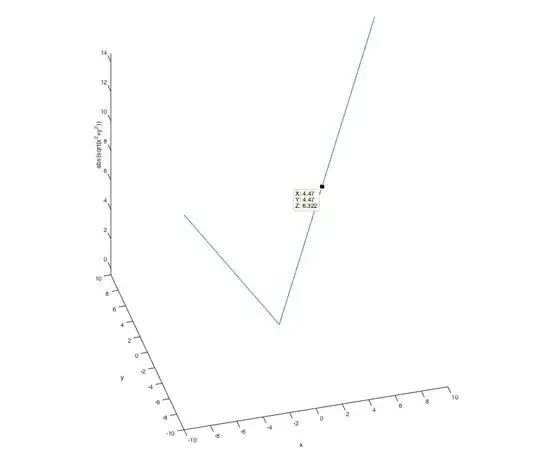
Our problem is $r^2=x^2+y^2$, with parametric equation $x=r\cos(\theta), y=r\sin(\theta), r>=0$.
Since we would like to know $\frac{\partial x}{\partial r}$, so turn the surface and look at the surface in direction which is parallel to y axis (figure 2), as a result, we only view the relationship between $x$ and $r$. Furthermore, the figure 3 shows the relationship between x, y and r.
From equation $r^2=x^2+y^2$, you can imagine that the from top view of the surface. The surface is composed by many circle with ascending radius, larger radius will at a higher level, result a clone. The relationship between r and x is x increase, radius increase. And the ratio is 1:1.
Therefore,
$\frac{\partial x}{\partial r} = \frac{\partial r}{\partial x} = \cos(\theta) = x/r = 1$


